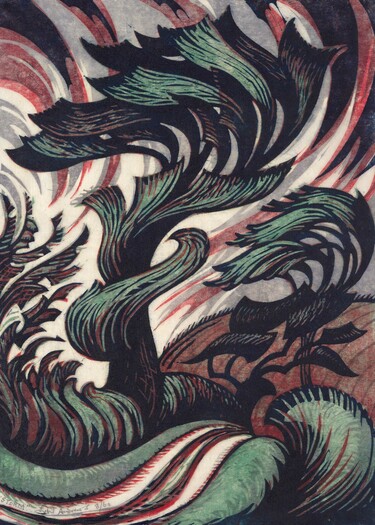
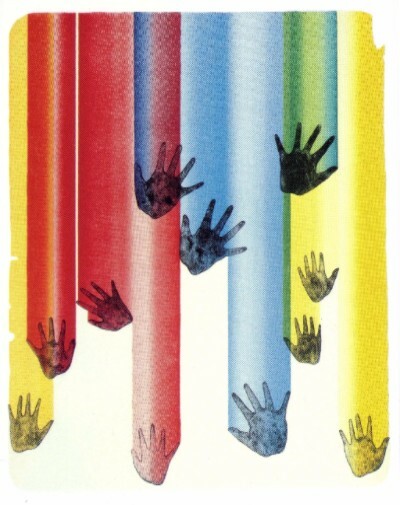
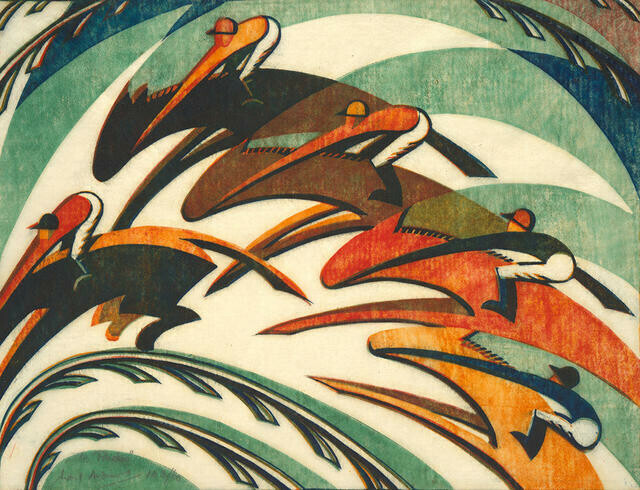
Sybil Andrews Storm 1935. Linocut. Collection of Christchurch Art Gallery Te Puna o Waiwhetū, presented by Rex Nan Kivell, 1953. © Glenbow Museum, Calgary, Alberta, Canada, 2012. Reproduced with permission
Sybil Andrews: Storm
My mum Joan was always coming up with cool ways to keep us busy in the school holidays, and printmaking was a favourite activity for me. You didn’t have to be great at drawing, and all the stages were fun.
Making a design, tracing it onto butcher’s paper, using a sharp knife to cut the shapes out, taping the ensuing stencil flat onto the screen the right way up and drizzling the right amount of paint onto the mesh – there was quite the build-up. Lifting the screen after firmly dragging the squeegee across it was exciting and very satisfying. Then trying to line up another screen to add a different colour was a make-or-break move – as was transporting the wet and floppy print safely to the clothes rack to dry. Knife edge stuff. I’ve made the odd poster or t-shirt over the years since, and my girls enjoyed printmaking in their school holidays as I did. These days however, just looking at the work of clever printmakers is the greatest delight. Prints always catch my eye and glancing around the living room now, five of the ten artworks on the walls are lino, woodblock or screen prints. We’ve got local artists Sam Harrison, Ronnie van Hout, Michael Morley and Tony de Lautour and, most recently, Australian printmaker Alex Gillies.
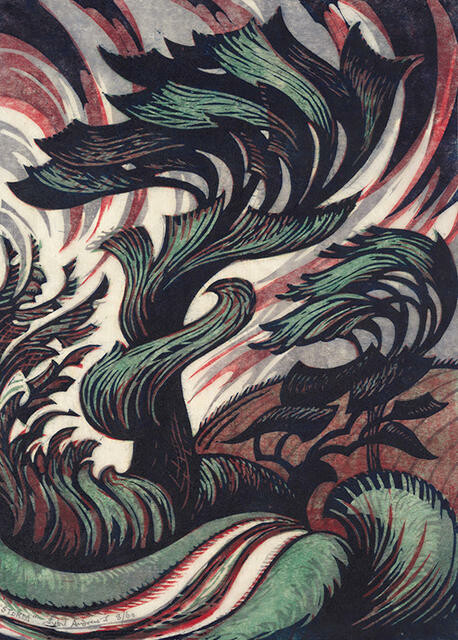
I saw an exhibition at the Gallery a year or so ago that featured British / Canadian artist, Sybil Andrews (1898–1992). I reckon she is the queen of printmaking, and Storm is a brilliant example of her work. One of her specialities is expressing movement, which can’t be easy in a medium that is two-dimensional. You can really feel the wild violence of the storm as the trees flick dangerously in the wind (which I of course imagine to be a howling nor’wester). Even the road and the hedgerows seem to be heaving and flexing as the whole image twists anticlockwise, making the scene look out of control and ominous. At the same time, Storm is very pretty and unsurprisingly, given its date of 1935, the shapes have a stylised art deco look. The colours are unusual I think and add to its beauty. My early hands-on experiences with printmaking probably add a layer to my appreciation of Storm, but Sybil Andrews is a fascinating artist who produced so much to love.
Related reading: Prints
Commentary
For the Price of a Pint of Beer
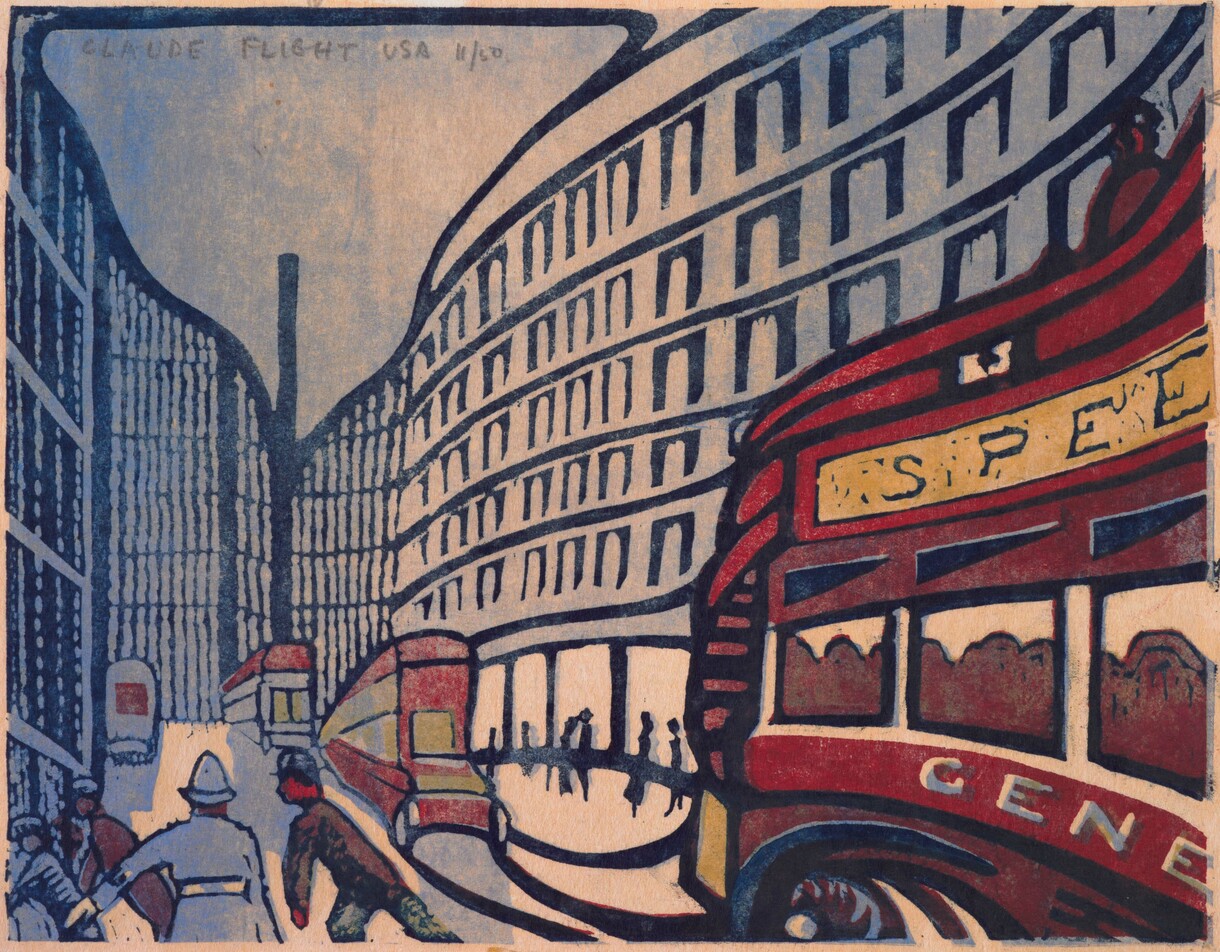
One of the joys of working at a public art gallery is the opportunity to really get to know an institution’s collection. I still remember, as a newly appointed curator of works on paper at the Robert McDougall Art Gallery, coming across a cache of the brightest, most colourful and energetic prints I had ever seen among the Rex Nan Kivell collection of modern British prints. Given to the Gallery in 1953, the sheer breadth and depth of Nan Kivell’s incredibly comprehensive gift, especially when combined with the works he gave to Museum of New Zealand Te Papa Tongarewa, Auckland Art Gallery Toi o Tāmaki and Dunedin Public Art Gallery, makes this a collection of British linocuts to rival those in major collections throughout the world.
Commentary
Cut It Out
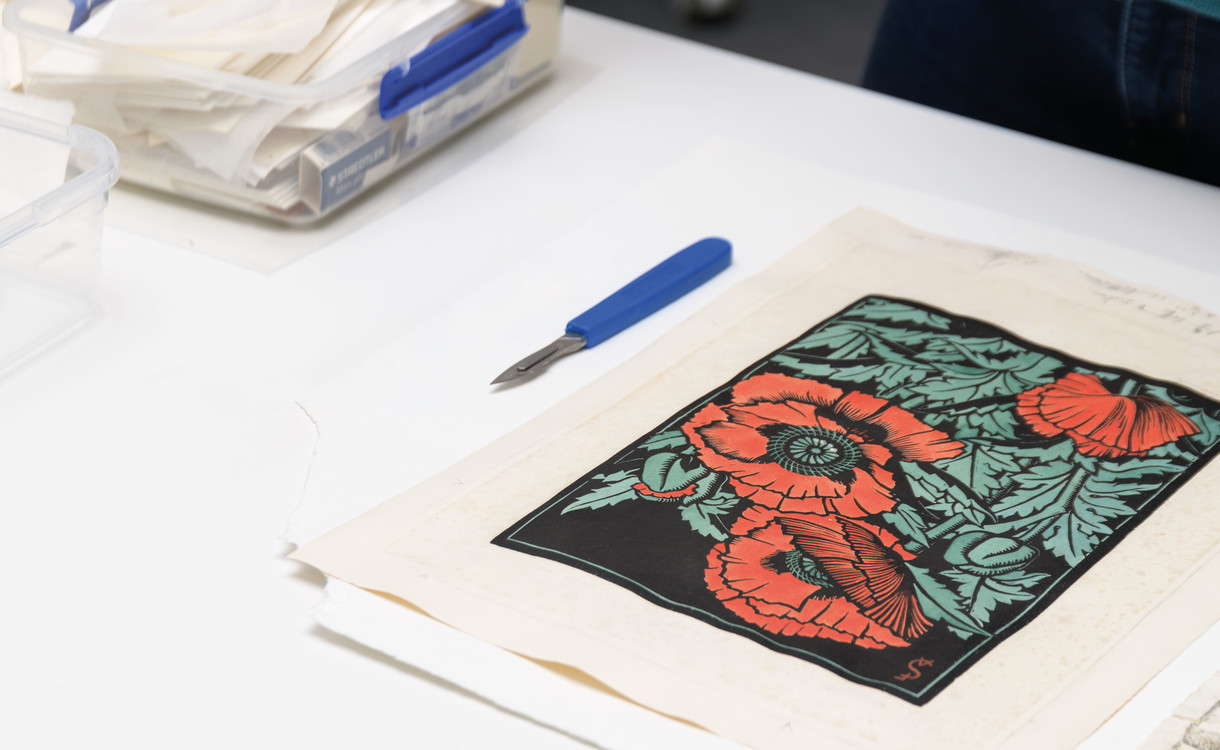
Make no bones about it, Ink on Paper: Aotearoa New Zealand Printmakers of the Modern Era is an exhibition I have long wanted to curate. I acquired my first print direct from Ralph Hotere when I was an art history student here in Christchurch many years ago. Hotere was the artist that piqued my interest in printmaking, but it is the Aotearoa New Zealand printmakers of the 1910s through to the 1950s that I love the most. Ink on Paper focuses on a generation of artists that were at the forefront of the medium when, following the printmaking revival in Britain, printmaking in Aotearoa was increasingly becoming accepted as an art form rather than simply a method of reproduction.
Exhibition
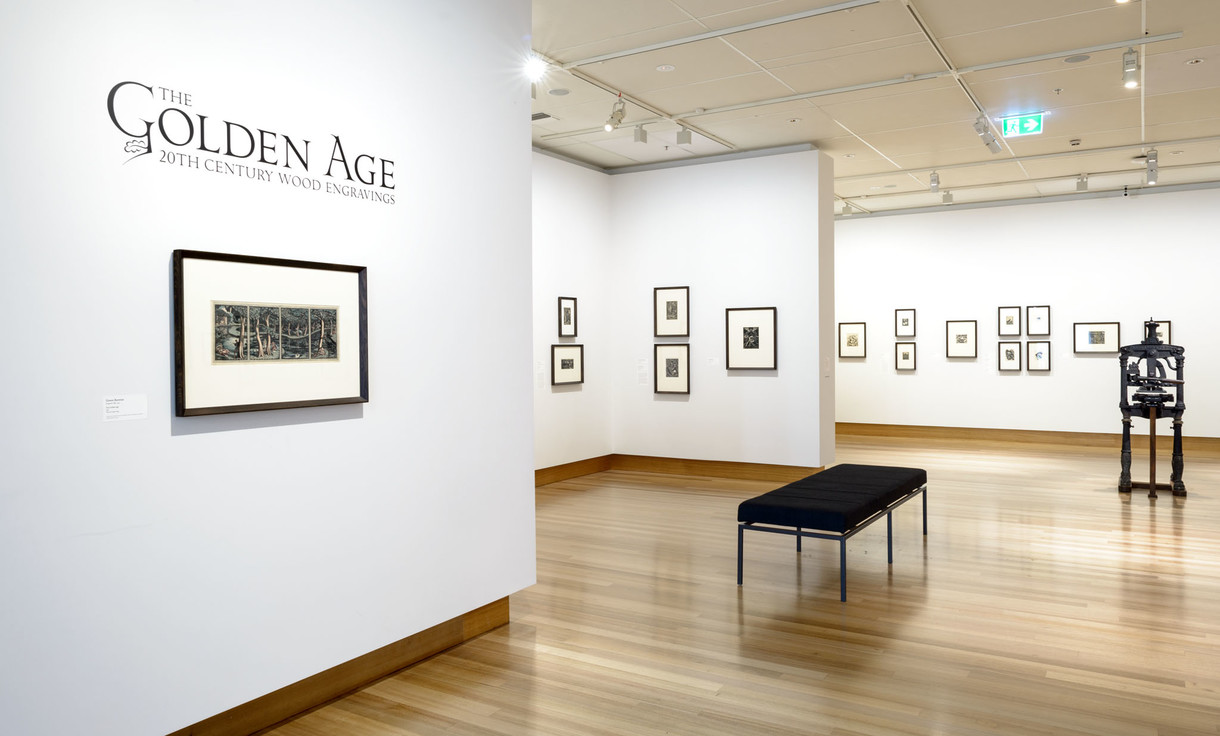
The Golden Age
An exhibition of twentieth century British and New Zealand wood engravings.