Beneath the Canopy
An Interview with Denise Copland
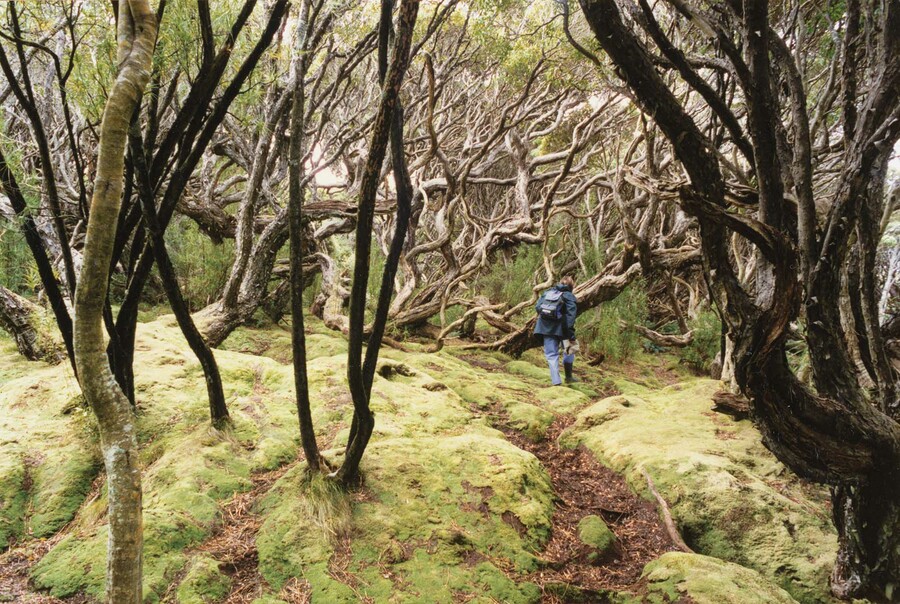
Denise Copland exploring the rātā kahere on Enderby Island, Subantarctic Auckland Islands, 1995. Photo: Malcolm Mackenzie
Denise Copland is one of Aotearoa New Zealand’s most influential printmakers. For over five decades, she has challenged how we think about our relationship with the natural world, combining expressive mark-making with technical expertise. One of Copland’s works, Indigenous III, is currently on display in the Kai raro i te kāuru section of He Kapuka Oneone – A Handful of Soil. Felicity Milburn invited her to share a little more about her practice and approach.
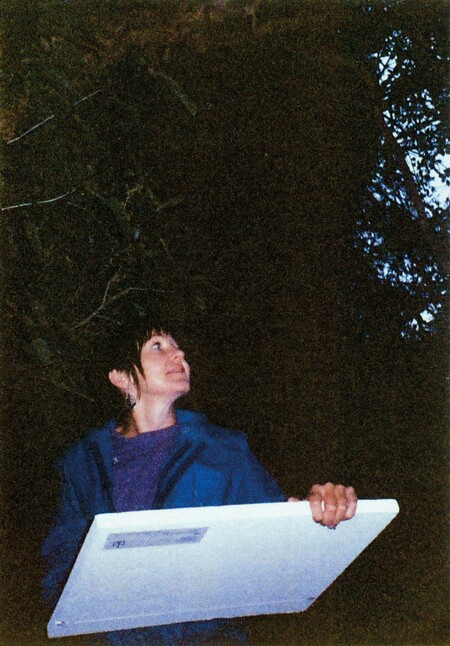
Denise Copland in the Podocarp Loop at Trotters George, Otago, undertaking the initial sketches and written notations for the Indigenous Suite of etchings, 1989. Photo: Barry Cleavin
Felicity Milburn: Dee, you were born in Timaru and studied at the Christchurch Polytechnic (now Ara Institute of Canterbury) and then the University of Canterbury. What was your first introduction to printmaking? Were you hooked from the start?
Denise Copland: I was first introduced to printmaking at the age of ten. My mother taught me how to print with half a potato – carving a design into its cut flat surface, placing the carved side down into a thin layer of artist’s oil paint, then pressing it onto a piece of paper. When removed, the design was revealed. It was a magical moment for me – my curiosity for printmaking was piqued. At secondary school, Gypsy Poulson, an inspirational art teacher, nurtured my interest in the arts, and specifically drawing and the graphic arts.
From there I attended the one-year Diploma in Graphic Design at Christchurch Polytechnic. I was fortunate to be taught several blocks of printmaking – and the history thereof – by Barry Cleavin. The following year I attended the University of Canterbury School of Fine Arts, where I spent three of the four years studying printmaking under the tutelage of Jack Knight. I graduated with Honours in Engraving, as it was known then. Knight championed self-directed learning via investigation, experimentation, trial and error, which I very much appreciated.
At this stage I was totally captivated by printmaking so I decided to commit myself to a career of artistic expression combined with teaching.
FM: In 1985, you undertook a residency at the University of Otago. What was your focus and how did it shape your later work?
DC: My focus was threefold:
Firstly, I wanted to gather inspiration from the bush-clad hillside surrounding Logan Park and the large weeping umbrella-shaped tree in front of the Dunedin Public Art Gallery, where I was staying. The dawn chorus that reverberated from the bush was intoxicating. Together these were a source of inspiration.
Secondly, I wanted to expand my thinking, creative process, approach to, and manipulation of, everything the various intaglio printmaking techniques have to offer.
And finally, I wanted to finish the test plates and text for a hand-printed, limited-edition educational book, titled The Intaglio Print: Chemically Assisted Process, which I was working on.
This residency did shape my later artwork – particularly my desire to create larger print-based work combined with other media in order to expand the parameters of my art practice. I also began to search out largely untouched remnants of indigenous kahere and research historical and contemporary stories of survival.
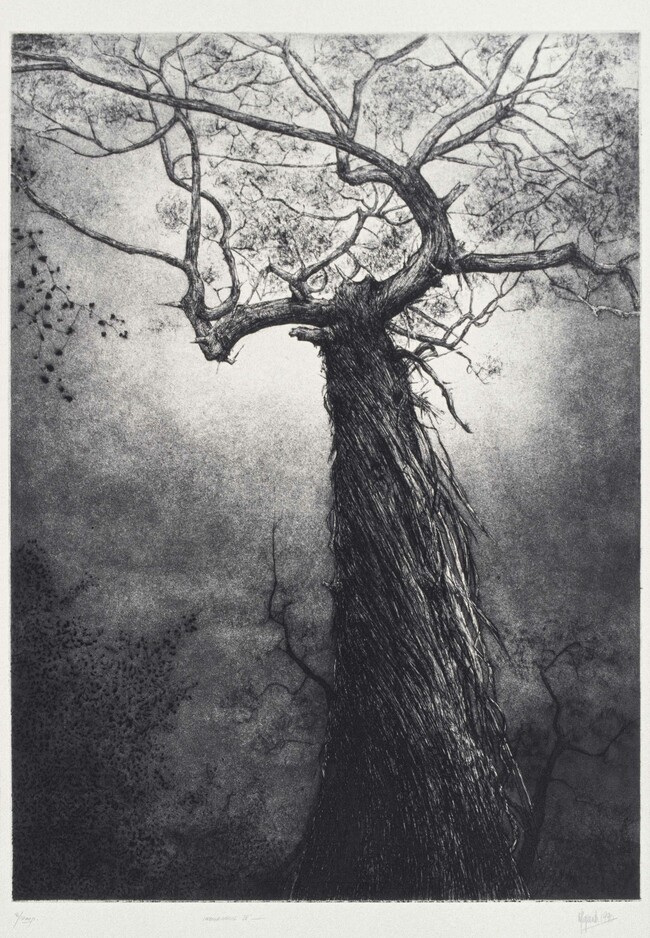
Denise Copland Indigenous IV 1991. Etching, aquatint. Collection of Christchurch Art Gallery Te Puna o Waiwhetū, purchased 1993
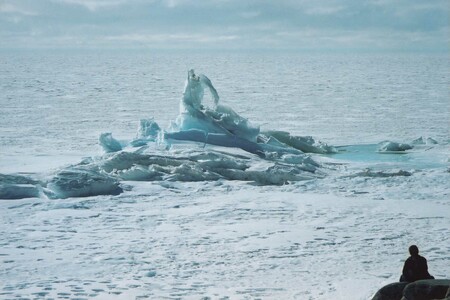
Denise Copland making field notes and sketches of a pressure ridge at Cape Geology, Granite Harbour area, Antarctica, December 2001. Photo: Brian Reid
FM: You often choose from, or combine, different printmaking techniques. Is that choice about experimentation and extending boundaries – or responding to the subject’s demands?
DC: It’s both. The overall concept and the subject matter within it directs me towards a combination of various media or a specific matrix that suits what it is that I wish to visually communicate. Once decided, I then undertake a considerable amount of experimentation.
Invariably the results are totally unexpected, which I relish because they open up new possibilities to extend the boundaries of both the media and the overall concept being realised. You can see this in printed works like my Human’Nature series (1996); and also in Shore to Shore (2000) and A Standing Place (2005), which are both installations.
FM: In 2001 you received an artist fellowship to travel to Antarctica, and your experience there subsequently informed a significant body of work. That was also true for your previous visit to the Subantarctic Auckland Islands. Direct experience of place has been central to your practice. Why is physical engagement with a landscape so critical to your work?
DC: I am attracted to and inspired by challenging remote wilderness environments – both onshore and offshore. In these environments I am an explorer and seek to absorb as many visual and sensory impulses as possible. Directly experiencing the abundant characteristics of such environments allows me to gain a deeper physical and psychological reading of them. Being taken out of my comfort zone, into the unknown, is of paramount importance for me, as it challenges my thinking and creative processes.
When creating the work from these trips I rely on my many drawings and notes, memory, imagination, additional research and analysis more than photographic imagery. My aim from this engagement is to imbue the resulting body of work with a greater perception of depth, atmosphere, meaning and emotion.
FM: In the 1991 exhibition Implantations, you juxtaposed indigenous kahere with exotic plantations. How did you determine your approach to this subject, and what role did experimentation play in the process?
DC: At the inception of Implantations I was living on the outskirts of Christchurch surrounded on three sides by a large Pinus radiata forest. There were few birds at all, and certainly no indigenous dawn chorus. This combined with a rather confronting personal experience to make me think about colonisation and its impact on endemic kahere, and the flora, fauna and avifauna within them. The focus specifically related to Aotearoa New Zealand.
After researching the overall concept for the Implantations series, it became apparent that intaglio etching coupled with woodcut relief printing was the ideal means by which to do this. I could work on a larger scale and explore the full potential of the etching process. Experimentation was a factor – for example, I wanted to utilise the actual forest floor residue that surrounded the chosen indigenous trees within the etching process. I used these to create some of the essential textural elements as I attempted to capture the innate qualities and characteristics of the kahere in the Indigenous Suites, the Human Impact Suite and the Avifauna Suite.
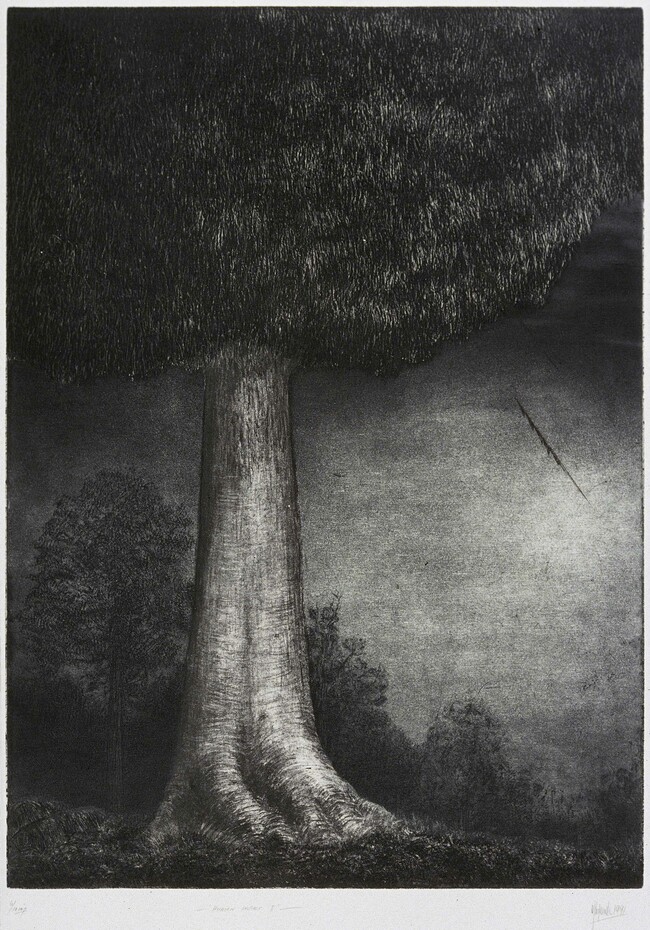
Denise Copland Human Impact II 1991. Etching, aquatint. Collection of Christchurch Art Gallery Te Puna o Waiwhetū, purchased 1993
“As our climate becomes ever less stable the works have become more important to me. They represent a turning point in my creative process, my relationship with kahere and humankind’s impact on the climate.”
FM: The Indigenous prints in that exhibition were inspired by remnant forests in Te Waipounamu South Island and Rakiura Stewart Island. When did you first encounter those kahere and what was their impact on you? What qualities did you want especially to convey?
DC: Being raised on a farm heightened my awareness of the varying pulses of nature through the distinct seasonal changes. Trees were always in view, as they are now in abundance where I currently live on the Otago Peninsula. At primary school, my first encounter with a remnant indigenous kahere was in the Podocarp Loop at Trotters Gorge, south of Moeraki, in Otago. I recall the feeling of wonder and excitement at being surrounded by such tall indigenous trees. The distinct crisp clean air, the smell, the rustling sounds and the shadows that were cast across the damp, mossy, woody undergrowth as the sun filtered through the kahere fascinated me.
While attending art school, I visited the Peel Forest Park Scenic Reserve. I had a similar feeling of wonder as the trees here were monumental in scale. They towered skyward, their outstretched limbs twisting, turning and swaying with the rhythm of the wind as they reached for the light.
I returned to these two kahere several times between 1988 and 1991 to draw from the selected indigenous trees directly onto pre-prepared zinc plates. Returning to my studio, I further developed these drawing, by referencing my sketches, notes and memory. These trees were showing the signs of aging, some beaten by the wind and others split in places, yet still thriving. After the drawn zinc plates were substantially etched out they were printed to reveal Indigenous I, II, III, IV and V, together forming the Indigenous Suite (1991) in the Implantations installation.
I wanted to convey the tensions between reality, imagination, illusion and wonder. I also hoped to capture the atmospheric and intrinsic qualities of the various trees within the darkest and most mysterious interior areas of these indigenous forests. All of which to reflect the life story of the two kahere.
FM: Has time changed how you see these works – and your own relationship with the kahere?
DC: Yes it has. As our climate becomes ever less stable the works have become more important to me. They represent a turning point in my creative process, my relationship with kahere and humankind’s impact on the climate. Some thirty-five years on from Implantations, the climate is noticeably warmer, more unpredictable and rapidly approaching numerous tipping points. My engagement with kahere, particularly indigenous ones, has significantly deepened from a physical and psychological point of view. They continue to offer me solitude, beauty, inspiration and a place to observe the ecosystems that thrive on the skin of the earth. And importantly, they sequester carbon dioxide over a very long period of time.
Within a few minutes’ walk from home, I am fortunate to be able to regularly visit and engage with a small pocket of indigenous kahere, which is providing me with some new ideas for consideration.
Felicity Milburn spoke to Denise Copland in January 2026.
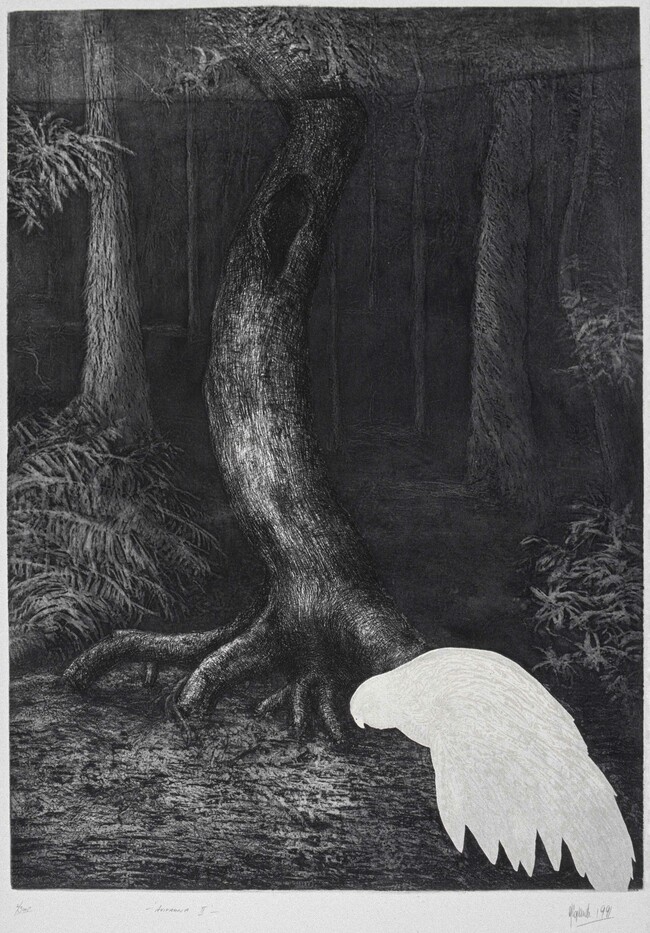
Denise Copland Avifauna II 1991. Etching, aquatint. Collection of Christchurch Art Gallery Te Puna o Waiwhetū, purchased 1993
Related
Exhibition
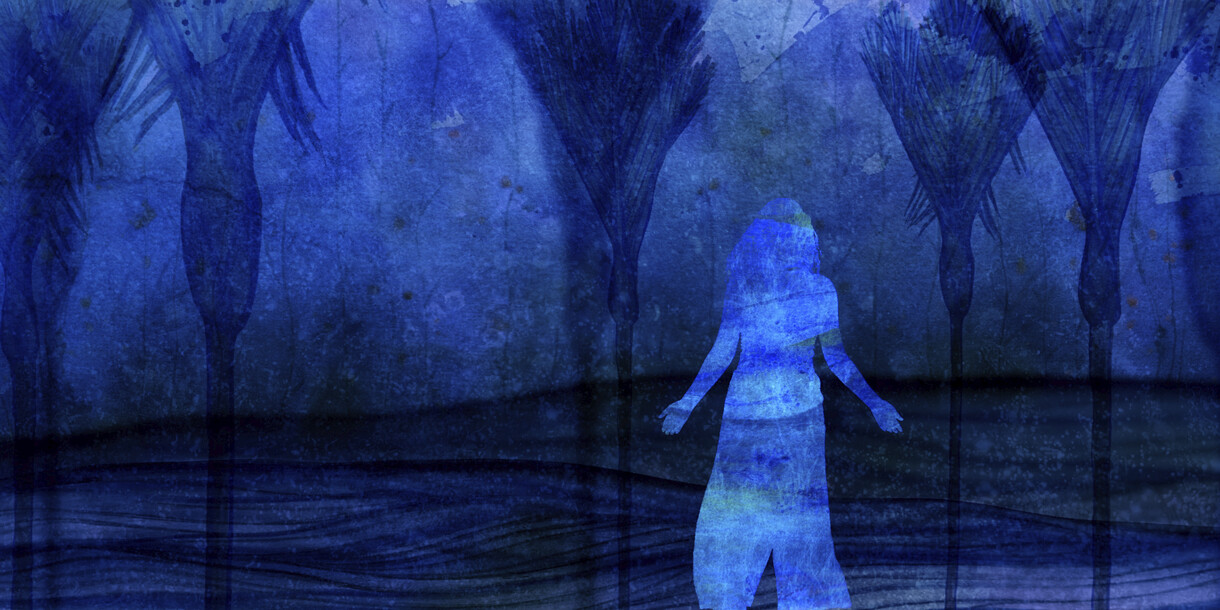
He Kapuka Oneone – A Handful of Soil
From 24 August 2024
Exploring the relationship between tākata and whenua – people and land – through Aotearoa New Zealand’s art history.