Te Pō-whāwhā
Ana Iti in conversation with Melanie Oliver
Installation view of Ana Iti: Ngahere Behind a Pile of Metal at Christchurch Art Gallery Te Puna o Waiwhetū, 2026
Over the past decade, Ana Iti (Te Rarawa, Ngāi Tūpoto, Ngāti Here, Pākehā) has developed a distinct multidisciplinary practice, combining drawing, sculpture, text and moving image to explore decolonial histories and relationships to the land. For her immersive new commission for the Gallery, Ngahere Behind a Pile of Metal, Iti spent time in Te Tai Tokerau, researching the impact of colonisation and legacies of the kauri logging industry for her tīpuna, whānau and the region. Here, she talks with curator Melanie Oliver and shares some context for her new installation.
Melanie Oliver: Ngahere Behind a Pile of Metal, references the nineteenth-century kauri logging industry in Te Tai Tokerau Northland. Can you tell me what initially sparked your interest in kauri?
Ana Iti: Quite a few years ago I bought a book about my dad’s family history, and at the time I didn’t have a lot of whakapapa knowledge from that side. The book was about my great-great-great-grandparents, Christopher and Ngahuia Harris. Christopher had come to Aotearoa New Zealand as a young man to be a sawyer, to be involved in the forestry trade. He sort of married a few different women before he ended up with Ngahuia – for people working in that industry, marriage was one of the ways that they gained access to forestry. I came across that piece of information many moons ago and it floated around in my mind. I didn’t grow up in Te Tai Tokerau – I actually grew up in the South Island with my Mum – and I haven’t had much opportunity to spend time in the far north until recently. In 2024, I spent a couple of months on a residency in Rawene and that’s when I really started to understand what the character of the Hokianga was like. I spent a lot of time doing a mangrove walk, taking this little path that passed through the site of a historic mill, and there was quite a lot of information about that. I was staying in a church that was made from kauri timber and I also read this report that Patu Hohepa had written for the Waitangi Tribunal; he was talking about the history of the Hokianga, what it would have been like pre-human, any human, arrival. He talked a lot about the kauri forestry industry and, because I was there, my interest in kauri became more prevalent. I was looking out at the landscape and I was like, “Oh, it’s obviously completely changed”. And that was the beginning.
MO: Rawene is also not far from Tāne Mahuta, the largest living kauri in Aotearoa.
AI: Yes, of course, I went to see him.
MO: Did you already know about the relationship between Kauri and Tohorā, the whale?
AI: I think the first time a friend told me that pūrākau was when I was at Te Wananga, so I received the story in te reo Māori and I’m not sure how much of the detail I really absorbed, but I do love that pūrākau. My interpretation of it is that our tūpuna saw and believed that there was an intrinsic relationship between the kauri and tohorā, and that there might be ways that we should and could look after them through that relationship. Sometimes that information is not easily knowable, or maybe it’s no longer remembered, but there’s some kind of arrow or connection there for us.
Installation view of Ana Iti: Ngahere Behind a Pile of Metal at Christchurch Art Gallery Te Puna o Waiwhetū, 2026
MO: I think this is maybe the first time you’ve directly addressed environmental issues as complex problems that involve ecologies, people, places and living things. When we think about kauri it’s important to understand that it was part of a capitalist system of extraction, deforestation and timber milling. It was such an important industry for Te Tai Tokerau. Can you share a little more about your research?
AI: One of the things that I get to do as an artist is to pass quite lightly over a lot of these subjects – I can gather information and then I get to filter it through my artistic lens, which is what makes me different from an ecologist or a historian or someone like that. But I did learn a lot about the kauri industry. And one thing that I have been thinking about in my work, especially more recently, is trying to orient myself away from stories of loss or destruction. There’s no doubt that the kauri industry fundamentally changed the ecology and the landscape of Hokianga. So it’s kind of like, it is what it is. There was a lot of waste in that process, lots of things were lost.
When the trees were cut down they were transported in different ways, and some would be destroyed or lost in the water. Some stories talk about them getting buried in the banks. And then I also learnt about the kāpia (kauri gum) industry, which coincided with the logging, and how all of that material was gathered and then exported to New York and other industrial trading centres throughout the world to be used for making varnishes and stuff like that. But I have been trying to give some agency in my mind to the kauri as a being. To do that I was thinking about it as something that has a lot of magnetism – the ability to attract people. And attract desire for its body really, which is a bit of a hard one. However, through that magnetism it also created all these relationships and genealogies, including mine. Some of the relationships and some of the genealogies are troubled, but you know, there’s other things that come out of it as well. Like me.
Installation view of Ana Iti: Ngahere Behind a Pile of Metal at Christchurch Art Gallery Te Puna o Waiwhetū, 2026
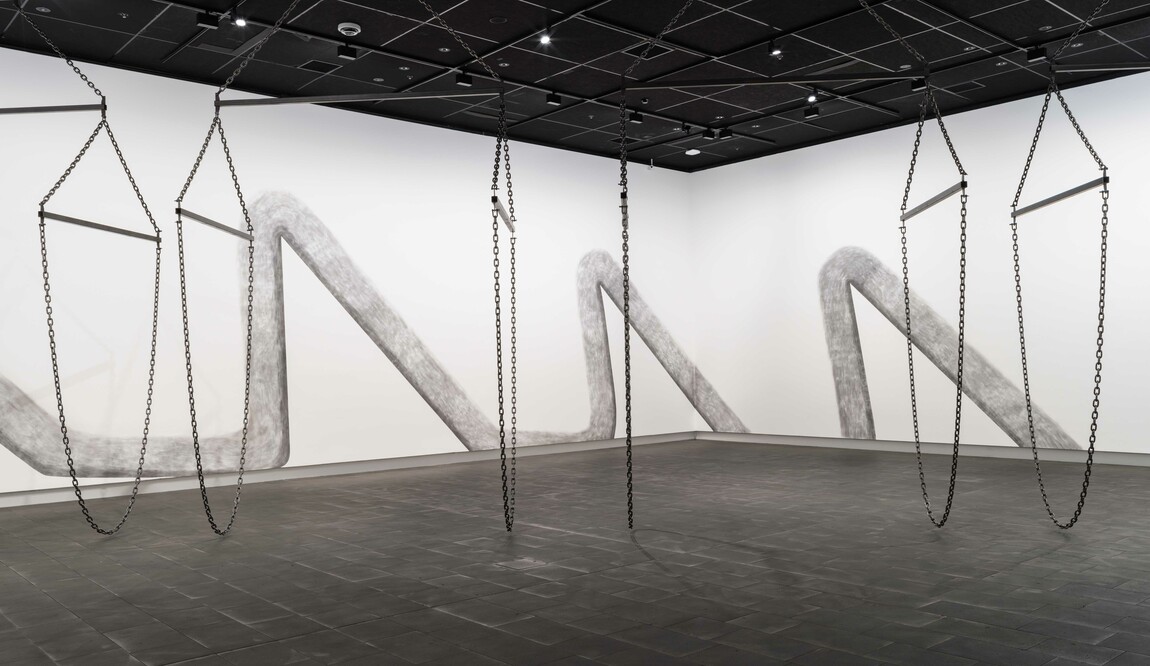
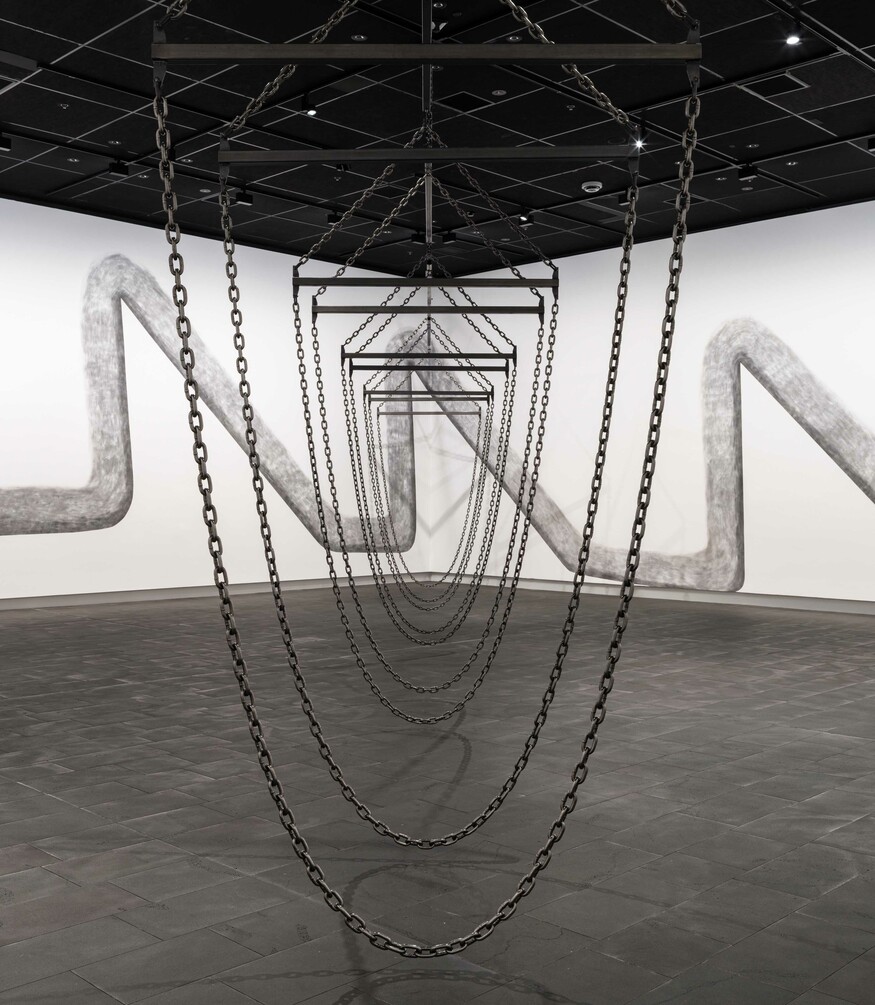
MO: It’s interesting how this situates the local industry within a global supply chain and market. With the wall drawing being made from burnt kauri charcoal and then the sculptural form riffing on the way that kauri logs were transported, is there anything you want to share about how you arrived at those formal components?
AI: One of the starting points happened before you invited me to make a work. I had seen this funny image on a Facebook page, Rawene What’s Up. It was a photo of a boat being lifted out of the water by a crane. There’s a sort of hammock made out of strops and bars that slip underneath the boat and cradle it as it is lifted out of the sea. I was drawn to the image because it looked like something that I might make.
I also liked that the boat is hovering between the sea and the land, in this in-between place, and I’m always really attracted to that sort of liminal zone, the in-betweenness of things. And then I was like, what does it mean? I don’t know. Later I went on this trip to Northland, which happened while I was in the phase of the project where I’m feeling around for the shape of things. Sometimes in my work, I like to make things feel a bit more friendly. I think about the transition of te pō into te ao mārama. It’s a bit like the creative process – one of the stages of the night is te pō-whāwhā which is when the night is so dark you can’t see anything, you’ve got to feel around with your hands and touch stuff. I thought, that’s where I am, I’m in te pō-whāwhā, which is a cool place to be because it could be anything.
MO: Full of potential.
AI: And there’s something near for you to find as well. It was at this time that I went to Matakohe Museum – I didn’t realise how gigantic it is, rooms and rooms of photographs, dioramas, machinery, slices of kauri, kauri gum. It was very intense, and that’s where I encountered the saw blade that the charcoal drawing is based on. It’s also where I saw photos of the kauri being transported by sea. They called it rafting – they drilled holes in the logs and then lashed or connected them together with wire ropes and chains, then they’d float them on the water tucked behind another boat to either transport to where they were going to be stored, or to the ship for export. Then I went to Opononi to visit an archive there, and I found out about the movement of kauri, which was dragged out by bullock teams – there’s even a photo of kauri being transported across a gorge via flying fox. I became really interested in these different forces.
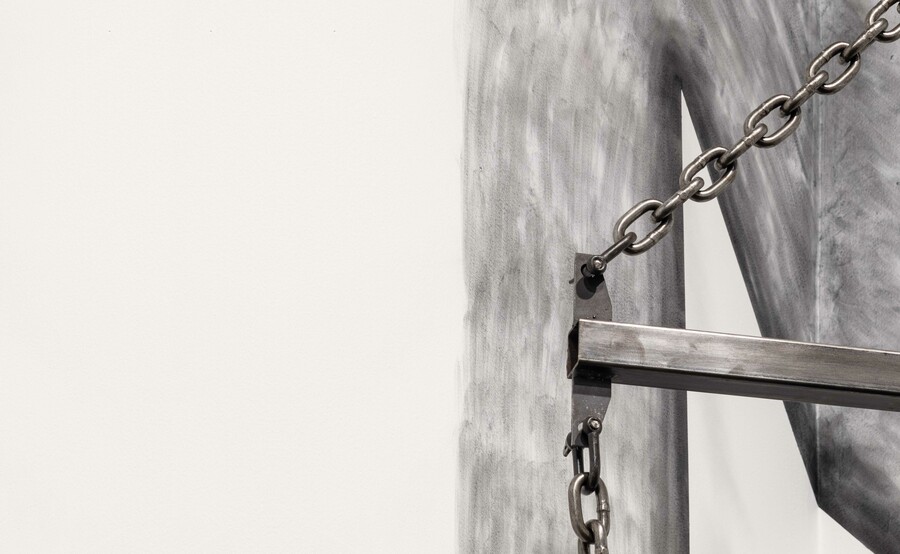
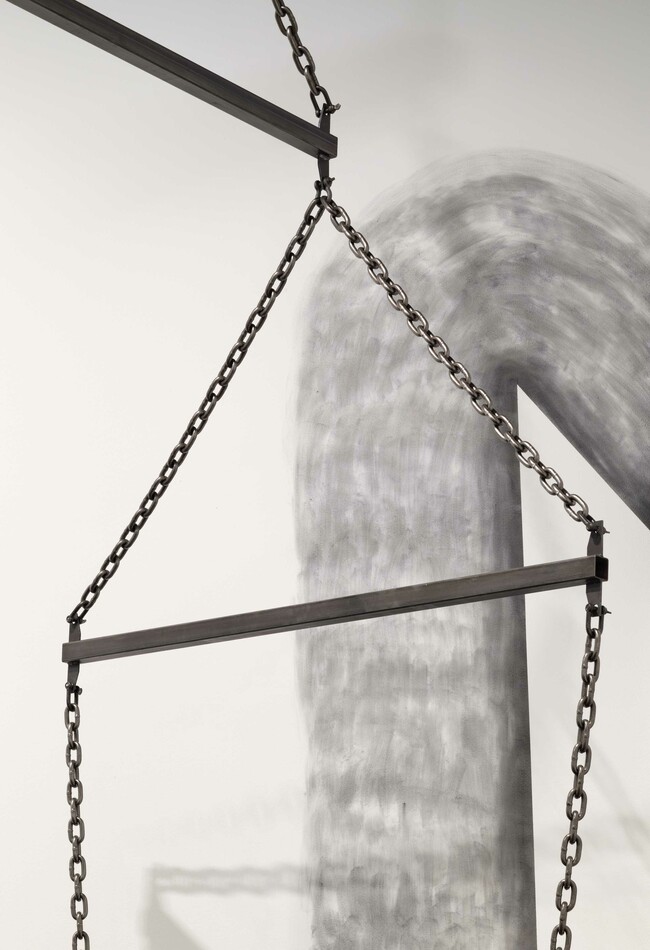
In some areas people were making dams to collect the kauri and then when there was high water or big storms, they would release the dams and the power of the water would transport all the logs down the hillside into another waterway. I was blown away by the forces that were at play, but I kept thinking about those photos of the logs on the water; the kauri is a taonga and the water is the Hokianga, which is my ancestral water, so like you say it’s that relationship between kauri and tohorā. The tree on the water was the hook I guess, and that’s when I started to remember about the crane and I could see the connection. The crane is about lifting, removing heavy things from the water and transport. For the show, I made my crane out of chains, which are similar to the type of material that would have been used to lash the logs together. And in terms of the scale, I made it so that the size of a log that can be held in my crane is about the size of me. If a kauri tree is the diameter of an Ana Iti, the diameter of me, it’s maybe 600 to 800 years old, which is not even that old when it comes to being a kauri tree.
Installation view of Ana Iti: Ngahere Behind a Pile of Metal at Christchurch Art Gallery Te Puna o Waiwhetū, 2026
MO: It’s interesting that through this process, the diameter of the sculpture encapsulates a sense of time as well.
AI: Totally. When I was looking at how people talk about the trees, they talk a lot about the girth. And they’re huge. In the archives, I would be seeing photos of people standing or sitting on the stumps. So that is one of the ways that they were measurable in those archives.
MO: We both read Nadine Hura’s book Slowing the Sun and I think you got a lot out of that book, the way she situates a personal story of loss within the overwhelming state of climate change in such a beautiful way, poetically drawing these things together to think about the interconnectedness of climate and people and Indigenous thinking. Were there any moments in the book that you found really special or important, and what drew you to her writing?
AI: Well, when I look at my copy of the book, I have so many sticky notes in it, so there must have been many different points where it resonated with me. But in terms of Nadine’s writing in general, I’ve been a big fan for ages. She’s written about identity and language, family, grief. I’ve found it at times where I really needed it. It’s really great that she’s written something for my project.1 One of my favourite essays in the book is called ‘Once Were Maunga’ – I don’t know if you remember that one, but in it she’s talking about her dad and how he worked making gravel and roading. I liked that as a kid it made her think about the roads differently and that when she looked at a road she thought about her dad and how he had some hand in making it, and whether or not there could be some kind of connection between the two of them through that. That’s a really interesting thought because one of the things that people say sometimes is, you may not know your maunga, but your maunga knows you. And sometimes, the land has been transformed into something else. I’ve always wondered about that – those materials that have been transformed and are now maybe far away from their point of origin, whether or not they have some kind of resonance or memory. Nadine talks about how, in this extractive work, it is often Indigenous people who are doing the work. And her father, he’s a very skilled person, he’s proud of the work that he does and it’s complicated, isn’t it? It’s not that we can blame the people who do the work for the outcomes of it.
MO: It is certainly complex when we think of the labour involved with extraction. It also subtly enters into the title a little bit, doesn’t it? Ngahere Behind a Pile of Metal came from talking to your uncle and trying to find kauri on your hapū land and him saying, “Oh, it’s behind that pile of metal.” But I hadn’t thought about metal in terms of road metal until now. It all coalesces, doesn’t it? Language is often at the heart of your work, are there any other texts that inspired this project or did you yourself do much writing around it?
AI: I read pretty widely, but I think of myself as a magpie – I’m looking for little shiny bits and pieces. I read a lot but often the texts tend to be quite dry, to do with courts and things like that. I do often write as part of my process, and I did do a lot of writing during this project. I kept a journal while I was in Northland, which was really cool for me when I saw Nadine’s text, because it was a similar format. Writing helps me process all of the different information that I put in, teasing out the different strands. Returning to Northland brings up a lot of personal feelings: some of those I put in the work and some I keep separate.
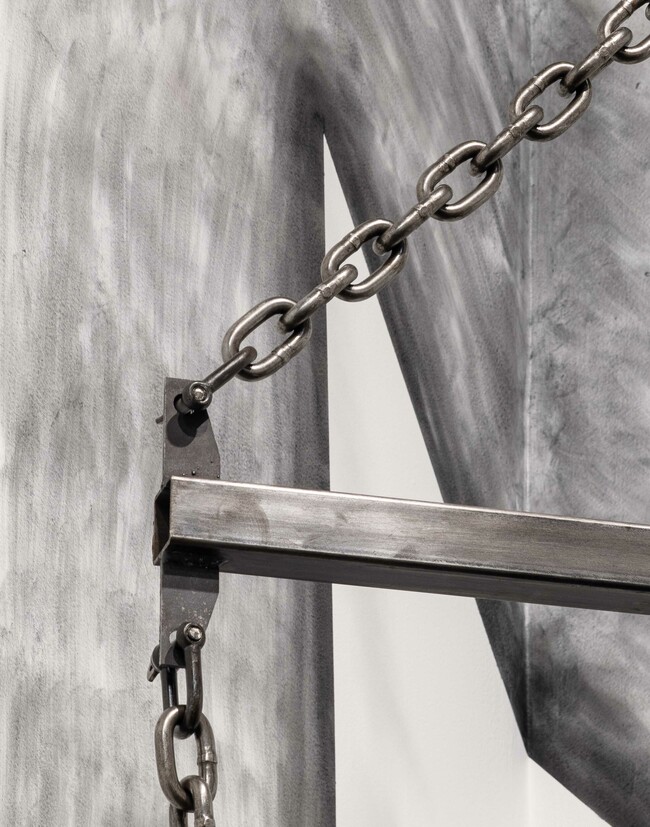
Installation view of Ana Iti: Ngahere Behind a Pile of Metal at Christchurch Art Gallery Te Puna o Waiwhetū, 2026
MO: Spending time in the Hokianga and catching up with your whānau there, what do they think about the project?
AI: When I was there I was in that te pō-whāwhā space, and because I was working, I didn’t get to see all of my family, but I did get to see an auntie and uncle of mine who are both historians and writers. They were the most perfect people to talk to because they’re deeply interested in local history and they have all of this knowledge.
One of the old hapū businesses was the creamery, and behind that building there’s an area of land where a small group of them have been doing regenerative planting over the weekends for the last couple of years. It’s amazing you know, pulling out the pampas grass which is a big problem. I live in the city and I don’t often see the direct outcome of this kind of hard work that people do. It was really changing the character of the place and regenerating, it was awesome.
MO: A long slow process but it’s got to start somewhere and they’re doing it.
AI: Totally and what was cool was that there was this old kahikatea tree from the same era as the creamery. Kahikatea were cut down and made into boxes to put the butter in, so it was sort of this remaining part of the history of that place as well.
Ana Iti spoke to Melanie Oliver in March 2026.
Related
Exhibition
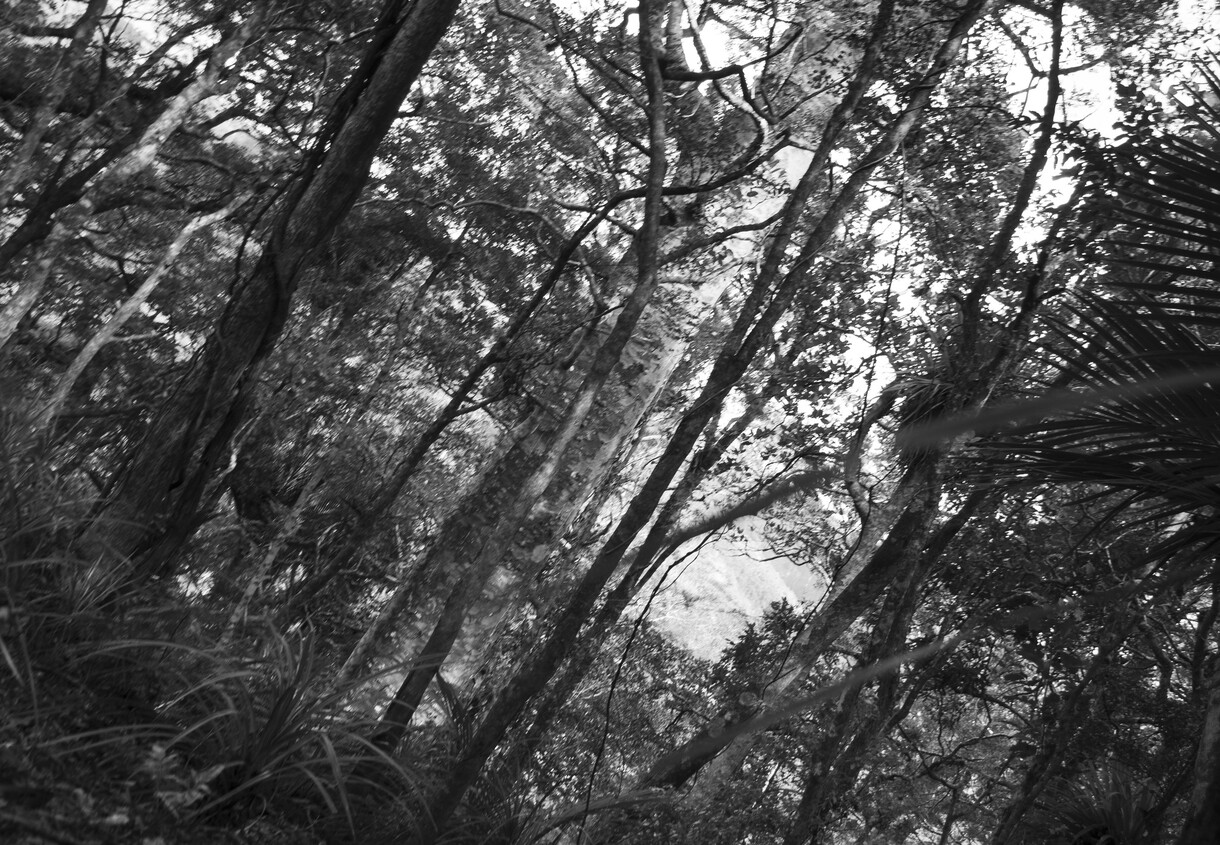
Ana Iti: Ngahere Behind a Pile of Metal
7 March – 26 July 2026
An immersive installation considering the legacies of deforestation and significance of kauri trees.
Commentary
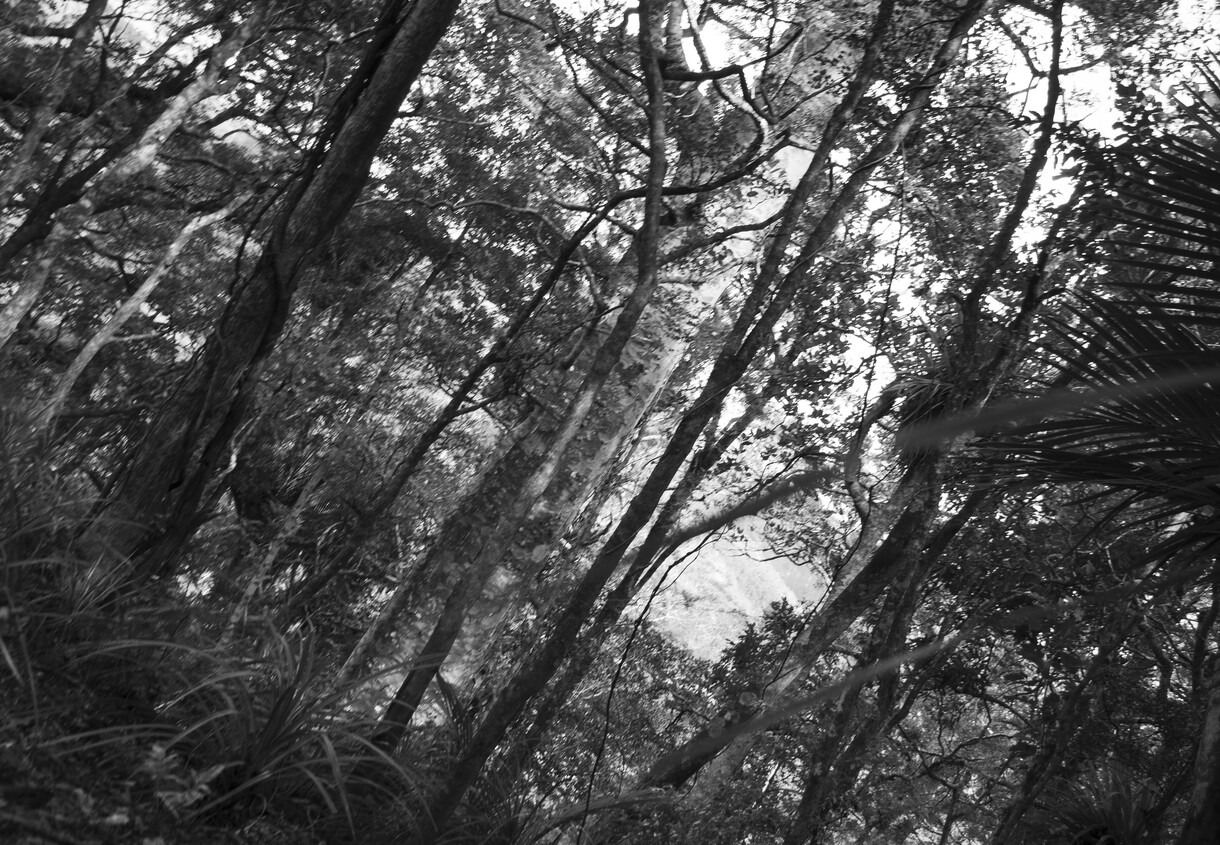
Ōmutu
10 December
5.45am. Two starlings in Stacey’s unblooming pōhutukawa. A tūī guns past the window in the direction of the sea. Wednesday’s freight train rumbles north leaving a tail of sound. Dear Ana. The building inspector came on Monday. We should know by tomorrow or Friday at the latest. If my house goes unconditional I’ll finally be able to breathe again and eat. I’m sorry I haven’t been able to focus on the kauri yet.