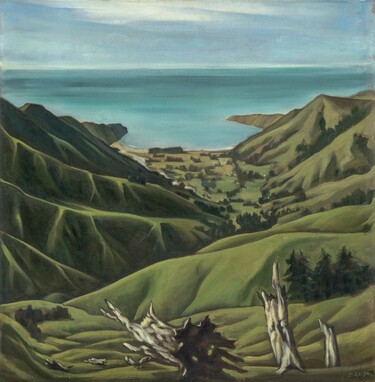
Doris Lusk Okains Bay, Banks Peninsula 1949. Oil on canvas board. Collection of Christchurch Art Gallery Te Puna o Waiwhetū, bequest of John Cleaver, 2013. Reproduced courtesy of the Doris Lusk Foundation
Revisiting Te Pātaka o Rākaihautū Banks Peninsula and Whangaroa Akaroa Harbour
Te Pātaka o Rākaihautū Banks Peninsula and Whangaroa Akaroa Harbour have long been a haven for walkers and hikers, boaties and swimmers alike. The winding roads offer stunning vistas of Whakaraupō Lyttelton Harbour and the other outlying bays from high vantage points, and for decades artists have been inspired by the sheer power of the volcanic landforms.
During the late 1940s, Doris Lusk and her family started visiting the tiny settlement of Takamatua in Akaroa Harbour. Selwyn Hamblett (brother of Anne McCahon) and his wife Margaret were friends who lived there and occasionally Lusk, her husband Dermot Holland and their young family would spend weekends or holidays with them, staying in an old two-storeyed house on their property.
The 1940s were an important decade for Lusk, and the paintings she produced during this time are now seen as amongst her most important. They include the monumental Akaroa Harbour, Banks Peninsula (Te Papa Tongarewa collection), Okains Bay, Banks Peninsula (in the collection of the Gallery) and The Old House, Duvauchelle (private collection). It was a vital period, as Lusk stamped her mark on what’s now commonly referred to as the Canterbury School.
All three of these paintings are dated 1949, and by this stage Lusk was a busy mother with small children in tow. However, this certainly didn’t hinder the quality of her output; if anything it achieved the opposite. In imagining how precious making time for painting must have been for Lusk, I’ve often speculated on the possibility that this in fact heightened her perception. It’s also surprising to learn that her youngest child Rachel was born in November that same year. Her son Patrick, years later related the following anecdote: “A playpen was in use at home while I was a toddler. Doris would set up her easel inside the pen and happily get on with her painting, free from interference while I roamed outside it.”1 The prominent landforms and imposing vistas around Akaroa Harbour drew Lusk back again and again. The striking Onawe Peninsula (a former pā site) projecting into the harbour, became a favourite location, and resulted in a very surreal interpretation in 1963.
Retirement from her lecturing position at the University of Canterbury School of Fine Arts in October 1981 was an important moment for Lusk. Freedom to paint full-time prompted a renewed burst of work. The following year, she presented a major show in the much-loved Akaroa Gallery – a former hydroelectric powerhouse, it was a small venue with a white painted brick-lined interior and raffia floor matting and where her friend Leo Bensemann had held a retrospective a decade earlier. Venturing to openings there became a happy day-long outing. The winding hilltop car journey from Ōtautahi Christchurch, the charm of Akaroa township, and the exhibition all added to a memorable experience for the artists, friends and collectors who attended. In terms of the artist’s longstanding passion for the region, the exhibition venue couldn’t have been more appropriate.
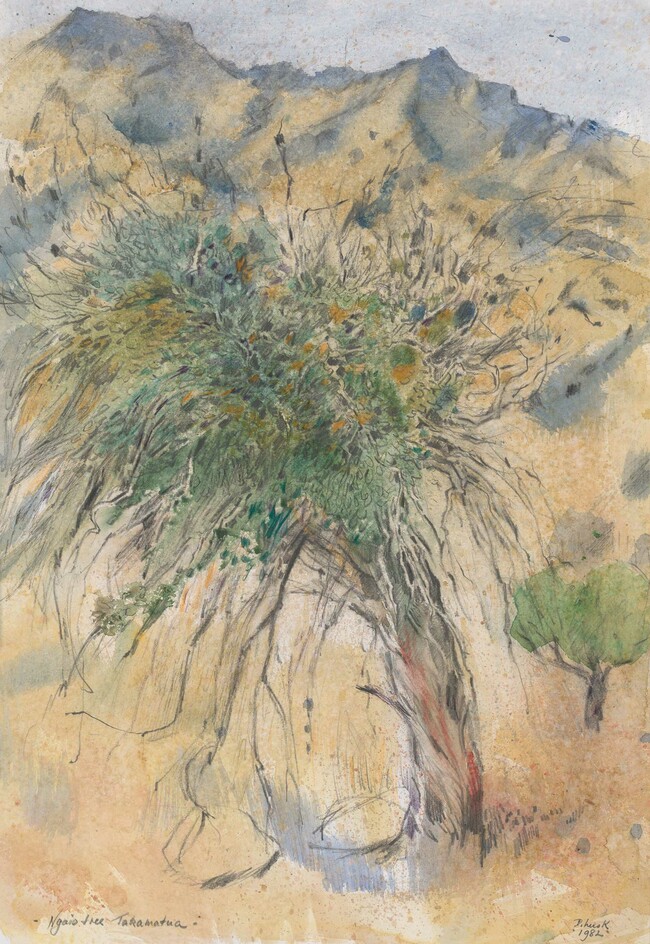
Doris Lusk Ngaio Tree Takamatua 1982. Watercolour and pencil. Collection of Christchurch Art Gallery Te Puna o Waiwhetū, William A. Sutton bequest, 2000. Reproduced courtesy of the Doris Lusk Foundation
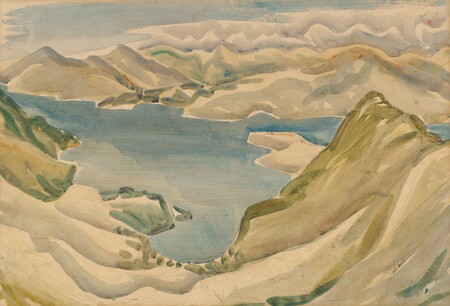
Doris Lusk Lyttelton Harbour c. 1956. Watercolour. Collection of Christchurch Art Gallery Te Puna o Waiwhetū, transferred from Christchurch City Libraries Ngā Kete Wānanga-o-Ōtautahi collection, 2001. Reproduced courtesy of the Doris Lusk Foundation
Lusk organised the content of the exhibition herself: Banks Peninsula: Retrospective & Recent Paintings. The show included four key oils from the 1940s, one watercolour from 1961, and eighteen new works, all produced in 1981–2; a mix of oils, watercolours, gouache and coloured pencil and two collages. The show included the gentle watercolour Ngaio Tree Takamatua (1982) and her close friend and former colleague Bill Sutton purchased the painting (taking his collection of Lusk paintings to four). As an accomplished watercolourist himself, I suspect Sutton greatly admired the combination of wash and exquisite graphite drawing (exemplified in Lusk’s Arcade Awnings series of 1976).2 Employing a wet-on-wet watercolour technique, the paper was first wet all over and then washes of colour were applied to create the blurry softness that was a signature of much of Lusk’s watercolour painting.3 Not one for expensive paper, simple cartridge paper did the job – its flat surface ideal for any additional drawing.
On first viewing, Ngaio Tree Takamatua presents a quiet tenderness, a lightness, the tree an almost abstract mass of intertwined marks. Wandering branches radiate outwards from a gnarly trunk and almost touch the ground. Age and a sense of longevity is recorded.4 Lusk achieves a sense of scale with the inclusion of a small tree on the right. However, any recessional space is diminished until the crisp edge of Akaroa’s crater rim surfaces at the top of the work like a cloak protecting the subject. Inscribing the title on the work points to reading it more as a study than a finished painting. A comment Lusk made relating to an earlier show seems appropriate: “… I resigned myself to a series of garden studies, rather tickled at being engaged in the good old-time exercise in perception.”5 Lusk’s watercolour Lyttelton Harbour (c. 1956, also in the Gallery’s collection), illustrates a freedom with uncluttered broad marks.
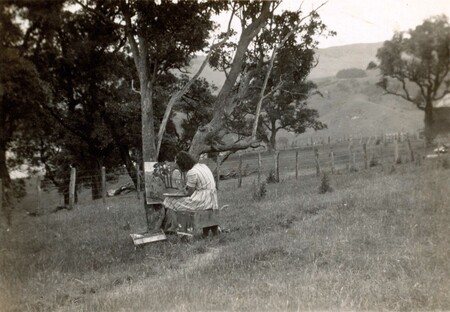
Unknown photographer Doris Lusk painting The Old House, Duvauchelle c. 1949. Reproduced courtesy of the Doris Lusk Foundation
The dramatic vista looking down towards the beach in Okains Bay, Banks Peninsula, one of her largest oils sweeps the eye out to a calm sea and distant horizon, but it’s the tree stumps in the foreground that command attention. The original name for Okains Bay is Kā Awatea and the bay itself, steeped in Māori mythology and legend, was originally a place of mahika kai (food gathering). The bleached trunks speak of past histories, of native matai, kahikatea and tōtara trees now gone. As sentinels, they point outwards, like guardians watching and waiting. Lusk focuses on the jarring remnants of trees, which take on an almost human presence. The skeletal ridges on the left are in shadow and overlapping velvet-like folds in the foreground sweep down the steep valley to a flat area of land and an encircling bay.
A small black-and-white photograph in Lusk’s archives shows her seated on a wooden stool with a painting propped against a tree. She is working on The Old House, Duvauchelle, mixing paints on a conventional palette resting on her lap, in line with her early training in Dunedin (where plein air painting around Dunedin Harbour and Central Otago helped her to assess form, colour and tone). No doubt working in oils outdoors presented hazards, however, one would assume this work and other oil paintings were finished back in the studio.
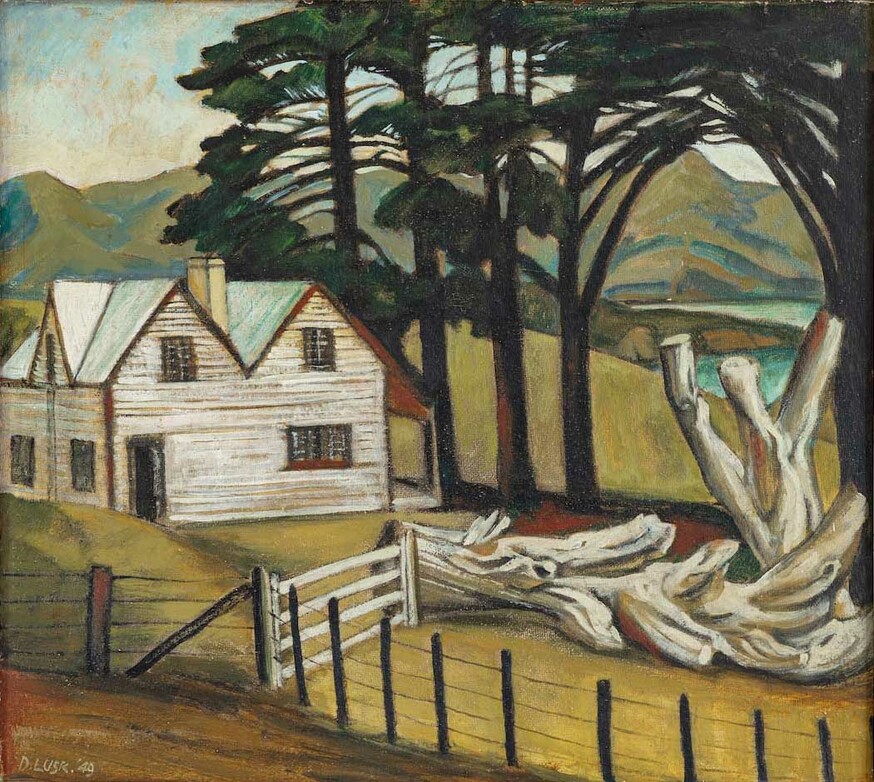
Doris Lusk The Old House, Duvauchelle 1949. Oil on gesso on textured board. Private collection. Reproduced courtesy of the Doris Lusk Foundation
The painting itself presents a complex composition; the house touching the left edge of the frame, the foreground fences and macrocarpa trunks and a view through arch-shaped trees to the distant harbour. One of the trunks takes on the shape of a standing figure with raised arms. The tree appears symbolically to represent a human presence much like Eric Lee-Johnson’s painting Slain Tree (1945) and in the work of noted English artist Paul Nash (1889–1946). Art historian Lisa Beaven observed that, “As a picture of her holiday house, Lusk’s vision is not a reassuring one, the grotesque, twisted trunks [appear] disturbingly large in relation to the farmhouse.”6 One could perhaps see this image illustrating a story about a haunted house. The enormous scale of the tree trunks in relation to the house, the dark shaded fence in the foreground and the closed white gate catching the light all add to the foreboding atmosphere of the scene.
Captivated by the vast landforms, harbours and vegetation of Banks Peninsula, the area sustained Lusk’s interest for over four decades. The power of her imagery – particularly the oil paintings produced during the late-1940s – confirms her status in the canon of landscape painting in Aotearoa and retain a haunting presence even today.
Related
Exhibition
He Kapuka Oneone – A Handful of Soil
From 24 August 2024
Exploring the relationship between tākata and whenua – people and land – through Aotearoa New Zealand’s art history.
Collection
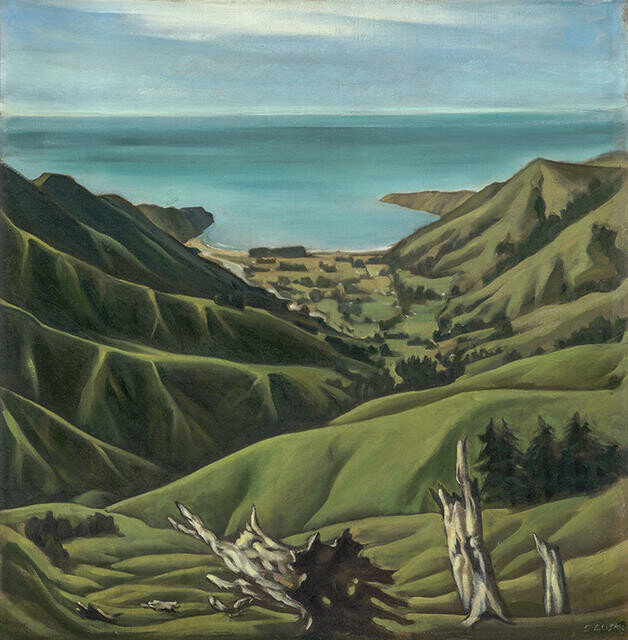
Doris Lusk Okains Bay, Banks Peninsula
“When the Pākehā arrived, much of the peninsula was heavily forested with Podocarp. You can still see old fossilised tōtara stumps lying all around the tops of the hills. As I understand it, Christchurch was built off those forests.” —Tā Tipene O’Regan
In this work, Doris Lusk draws attention to the dead trees commonly seen around Horomaka Banks Peninsula, painting several above the settlement of Kawatea Okains Bay. The surrounding area is shown as ordered and controlled, divided into the individually owned parcels of land that are common for European-style sedentary farming. Both Māori and Pākehā burned forests for settlement – Aotearoa New Zealand’s forest cover had dropped from more than eighty percent to roughly fifty-three percent by 1840, and stands at just thirty-three percent today.
Pākehā ~ New Zealander of European descent
He Kapuka Oneone – A Handful of Soil (from August 2024)
Artist Profile
Doris Lusk: An Inventive Eye
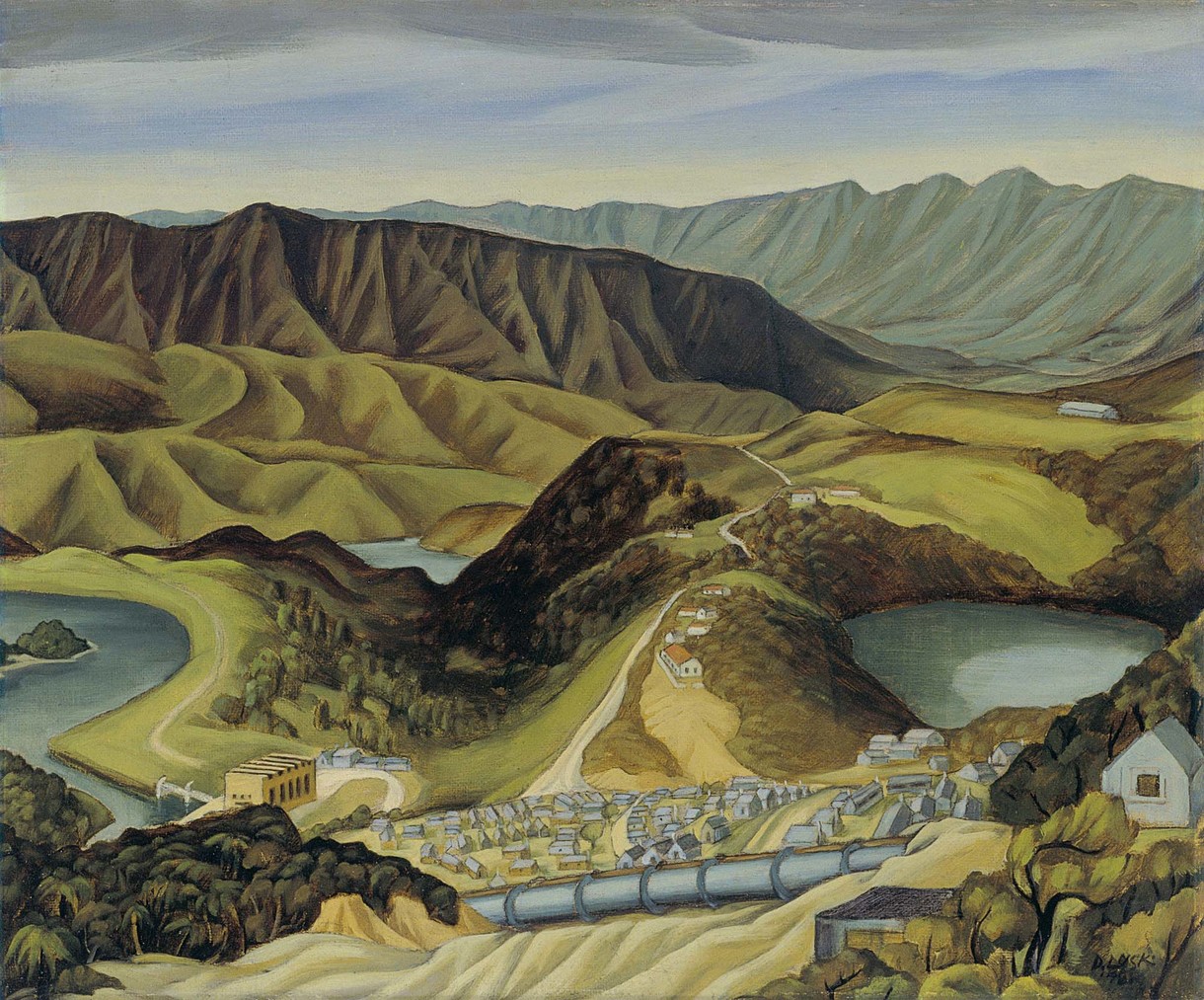
In the strange, stunned afterlife that ticked slowly by in the first few years following Christchurch’s February 2011 earthquake, a curious note of recognition sounded through the shock and loss. As a massive programme of demolitions relentlessly hollowed out the city, many buildings were incompletely removed and lingered on for months as melancholy remains – stumps abandoned in a forlorn urban forest. Hideous, sculptural, beautiful; they bore compelling resemblance to a body of paintings created in the city more than three decades earlier.