Post More Bills
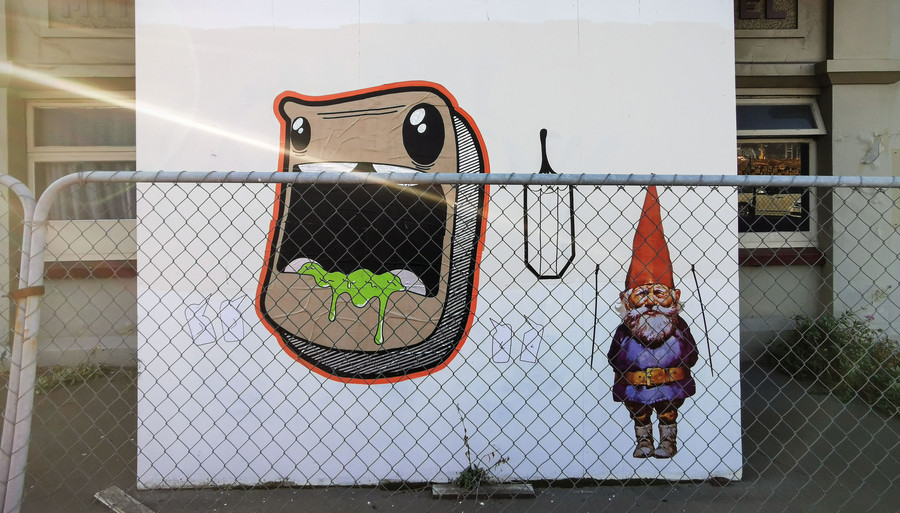
Bongo and Teeth Like Screwdrivers in Lyttelton
Perhaps no other art movement has undergone the expansive shift that urban art has experienced since the turn of the millennium. Today the subversive, disruptive and anti-institutional origins of graffiti and street art sit alongside, perhaps even behind, contemporary muralism, street art festivals, blockbuster museum exhibitions and urban art auctions. When considering this evolution from rebellious outsider forms with strong do-it-yourself ethics to an increasingly nebulous contemporary identity, aspects of Ōtautahi Christchurch’s recent and somewhat unexpected urban art profile provide the chance for reflection.
Sprouting, as it does in most cities, from graffiti culture, Christchurch’s small and relatively youthful urban art scene extends back beyond the earthquake cluster, but the post-disaster terrain and its subsequent reincarnations have provided a fascinating setting for the performances of urban art. Graffiti writers, already entrenched in the city’s peripheral and liminal spaces, were the first to take advantage of the broken landscape, adding existential layers to the city’s empty buildings. Their example was followed by the diverse interventions of guerrilla street artists, who played off the city’s social, physical and political landscape. Finally, the rise of commissioned muralism cast its enveloping shadow over those more reckless roots, gaining plaudits and garnering an international reputation.
While all three strands still coexist within the shifting local environment, muralism and graffiti have maintained the greatest prominence: muralism as a celebrated form of public art, graffiti as an enduring and vilified subculture. Yet post-graffiti street art, while less conspicuous and less grandiose, remains engaging for its diversity and revealing relationships with the urban environment. Bypassing permission to disrupt the daily experience with unexpected, intimate moments of engagement, guerrilla street art affords unshackled creative freedom.
Graffiti adheres to its signature-based roots, and outside of more avant-garde approaches, largely stays true to its traditional tools: spray cans and marker pens.1 Although more wide-ranging thematically, muralism is also largely consistent as an image-making process.2 Not constrained, however, by the same rigidity of approach, street artists have embraced a wider materiality that is often inspired by details of the urban setting. From Invader’s pixelated mosaics to Olek’s camouflaged yarn-bombings and Slinkachu’s tiny sculptures, the spectrum is as broad as the imagination allows. By embracing material, stylistic and thematic possibilities, artists can engage with their surroundings – hiding in plain sight, creating juxtapositions, highlighting absurdities, and raising questions about the relationship between art, artist, setting and audience.
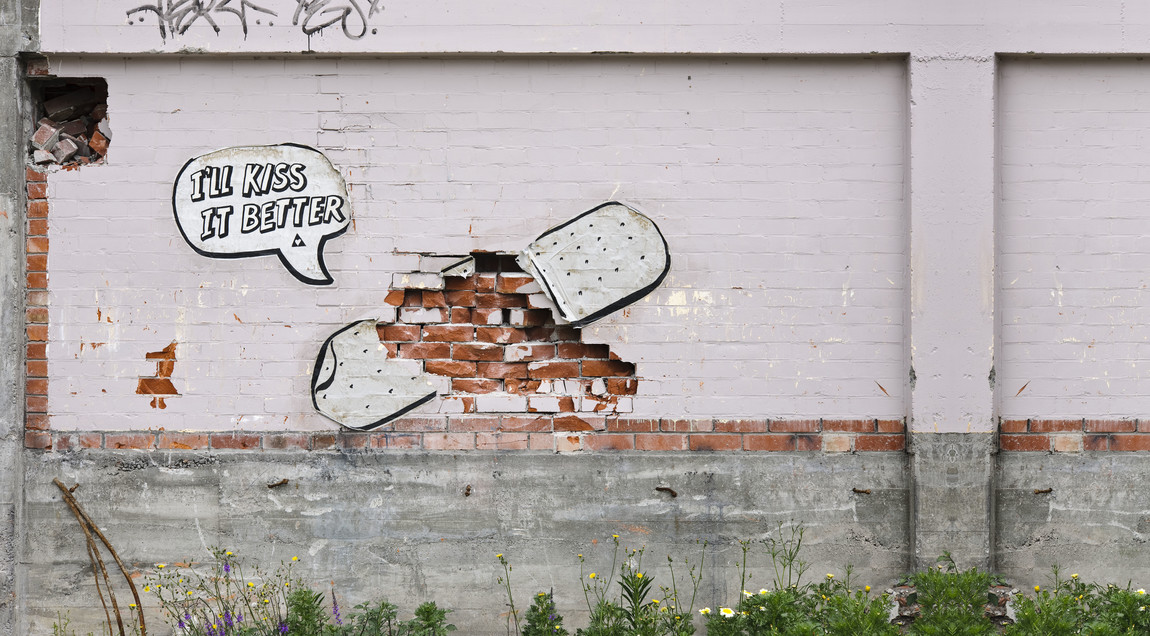
The futility of the paper Band-Aids was revealed when brick work crumbled from underneath this version on Manchester Street. Photo: John Collie
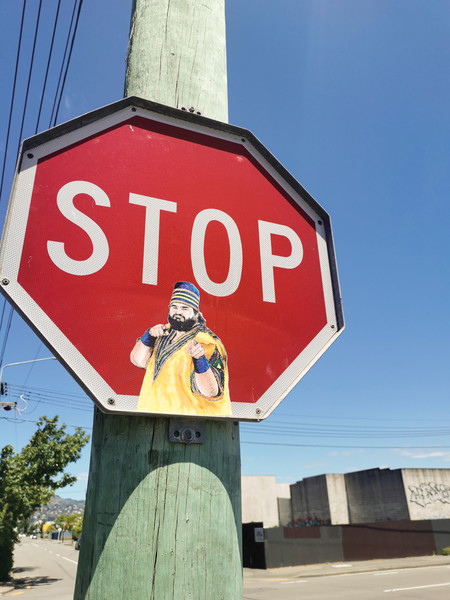
A stop sign is altered with the presence of a pasteup of a 1980s professional wrestler.
In Christchurch, one form of street art in particular has allowed artists to engage with the changing environment. Paste-ups, from giant Band-Aids to strips of bacon, have populated a layered cityscape where change has been constant and forms of visual communication omnipresent. A specific, yet broadly defined element of street art, paste-ups are works on paper applied to urban surfaces using a variety of adhesives – traditionally homemade wheat paste. Paste-ups range widely in size and methods of production, and are accessible and inviting. They echo historical instances of public posters and other urban ephemera, and draw on aesthetic, physical and social cues from the urban sphere for their meaning.3 From political campaign posters and advertising billboards to the protest posters of the Paris student revolt of 1968 and the street visuals of subcultures such as punk and hip-hop, varied influences imbue paste-ups with echoes of familiarity, often subverted by an anarchic sense of humour and DIY aesthetic.
The litany of artists who have pasted their work to public walls throughout the world is lengthy. From Jenny Holzer and The Guerrilla Girls, whose text-based works critiqued social and institutional norms, to Robbie Conal, whose gnarled caricatures of Ronald Reagan emphasised the political lineage, and Blek le Rat, who transferred his stencils to paper to avoid harsher punishments,4 street posters and paste-ups have been adopted by artists for decades. Revs and Cost, whose nineties fly-poster campaigns blurred the distinction between graffiti and street art, inspired Shepard Fairey’s now iconic OBEY paste-ups, a copy-shop exercise in Heideggerian phenomenology. More recently, Swoon’s woodcut portraits have illustrated the beauty in deterioration, Faile’s pop-inspired posters have combined comic book and advertising aesthetics, while JR’s black and white photographs have made overlooked communities visible.5 Such performances are intimately tied to their specific settings, and here in Ōtautahi, paste-ups have drawn not only on these precedents and associations, but also the local environment and experience.
While concert posters, political and protest fly-posters and advertising provide instances of the local lineage of urban postering, Inkest’s larger-than-life burlesque figures, serving as urban caryatids on the pillars of the Colombo Street underpass, provide pre-quake paste-up examples. Slowly deteriorating over time, the figures made use of both the specific physical forms on which they were pasted, and a liminal space that sat outside the city’s normal economy of use. Their presence offered an edgy alternative to the crowds in the city’s more active zones.
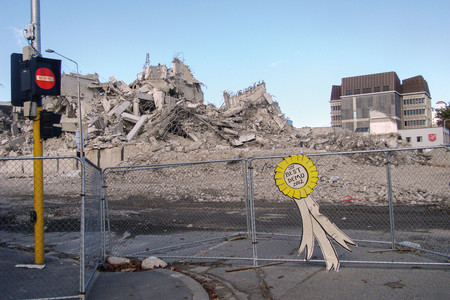
The Best Demo rosette was awarded to the site of the Hotel Grand Chancellor demolition in 2012.
The post-quake landscape further highlighted the potential performances of paste-ups. In mid-2011, following a significant aftershock, Dr Suits and Jenna Ingram’s oversized paper Band-Aids began to appear around the city – touching but ultimately futile gestures of healing applied over cracked and crumbling walls. Writer Justin Paton noted that as a public intervention it was both tender and ironic:
On one hand it feels like an expression of genuine care, with the artist as a kind of urban physician… But you can also see it as an expression of anxiety and frustration, as if the artist is wondering, in the face of all this damage, what anyone can actually do.6
Indeed, the inability of the paper plasters to repair broken buildings hinted at the size of the task confronting the city. In one instance brickwork fell through a Band-Aid, highlighting the futility. Pasting rather than painting the Band-Aids was a telling decision, the literal act of applying a caring veneer would not have been as apparent in paint. Similarly, the deterioration of the paper tracked the passage of time and reinforced the slow process of healing; part of the urban patina, they reflected the wear and tear of the urban setting like dissipating surgical stitches.
While the Band-Aids were an earnest response to the broken city, the ‘Band-Aid Bandits’ also illustrated a playful sense of humour in other paste-ups, such as the ‘Best Demo’ rosette awarded to the crowd-pleasing demolition of the Hotel Grand Chancellor. Like the Band- Aids, the rosette benefitted from its paper form, the DIY quality and large size highlighted the absurdity, while its application to the surrounding hurricane fencing created a visible juxtaposition with the exposed demolition site. Lasting only as long as the fencing stayed erect, the joke never outlived its reference.
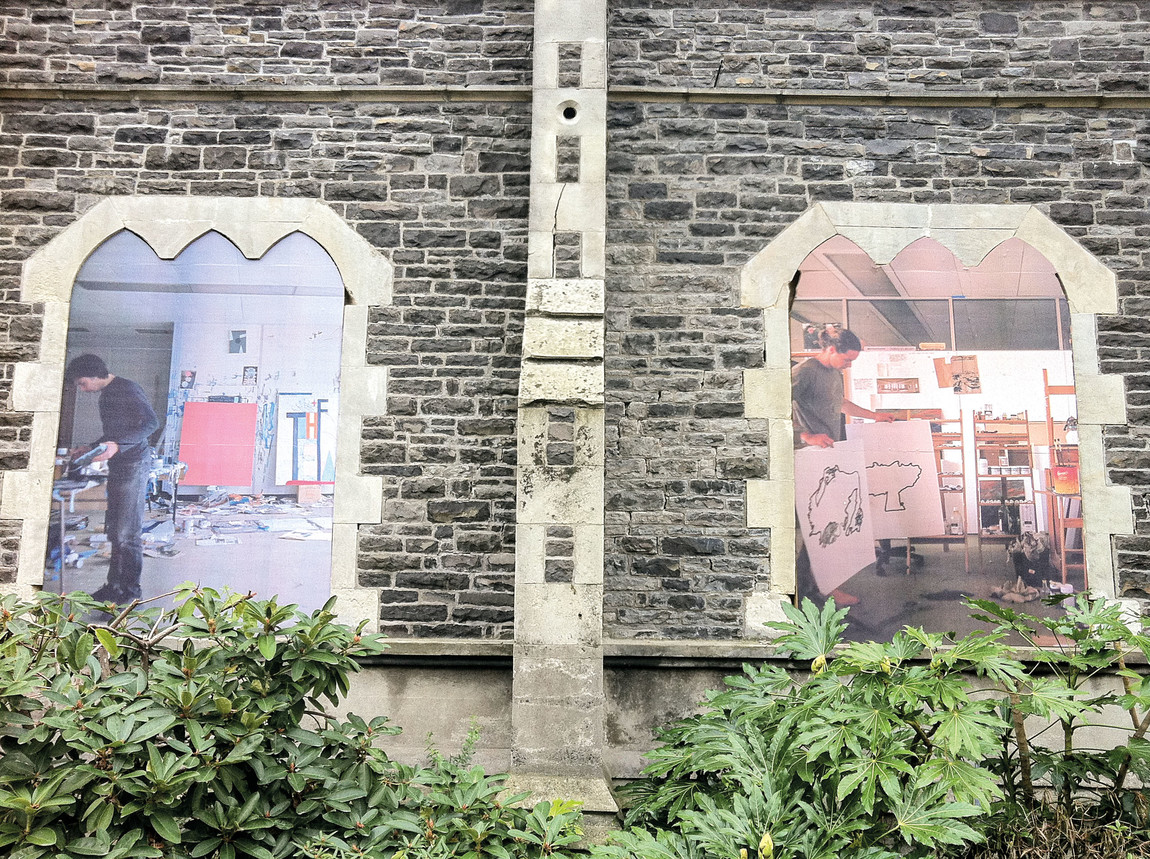
Detail from Mike Hewson’s Homage to Lost Spaces, central Christchurch, 2012.
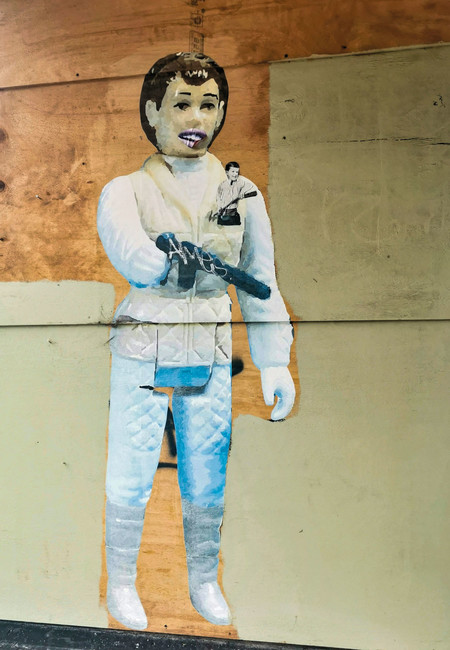
Princess Leia in Lyttelton, another of Mark Catley’s Star Wars paste-ups.
If the Bandits’ illustrative paste-ups borrowed from street art’s iconographic tendencies, working on paper also allows alternative image-making approaches. Applying large-scale photographs to the wooden window insets of the vacated Normal School in Cranmer Square, Mike Hewson evoked our connection to lost spaces. On the doomed heritage building, the photographs of the artist’s time in the studio spaces of the also quake-damaged Government Life building both depicted a lived-experience for Hewson and reactivated a much-loved building. This latter quality was emphasised by comments from the passing audience, who recalled music lessons or other experiences inside the building. Either way, the images, originally installed anonymously, evoked memories of place and recognised the impact of the quakes on such relationships. By using photographs, Hewson was depicting real people with real stories; even if identities were obscured by their guerrilla installation and lack of explanation, the reality was clear, touching and shared.7
Mark Catley’s sentimental paste-ups also took advantage of the wooden hoardings around the city, his stylised images of Star Wars figurines applied to the temporary surfaces. Recognising the transitional quality of the plywood fixtures in combination with the less invasive nature of the paper applications, Catley’s installations sidestepped the anger drawn by more direct interventions. Nostalgia for the heroes and villains of a generations-spanning pop culture phenomenon added to this warm reception. Drawing on the visual noise of the urban city, yet without the manipulation of advertising, Catley’s geek-powered paste-ups subverted expectations of the cityscape, the life-sized scale of what for many were childhood companions adding a playful, whimsical quality to a landscape that at times felt like a galaxy far, far away.
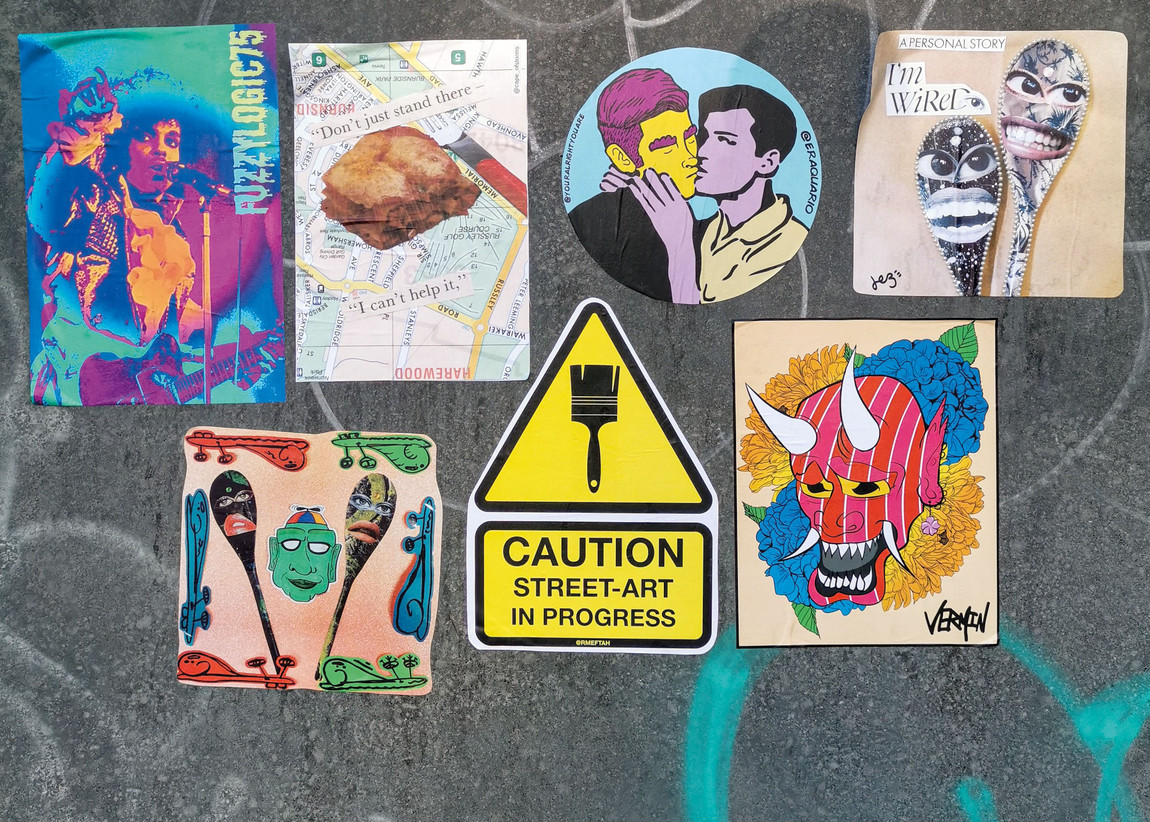
A selection of paste-ups, featuring Fuzzy Logic, Cape of Storms, Vermin, Vez, RMEFTAH, Your Alright You Are, Eraquario, Snail Gang and Usurp the Streets.
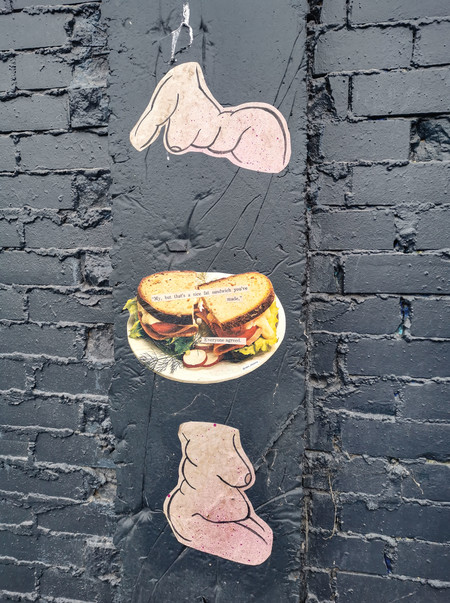
Paste-ups by Bexie Lady and Cape of Storms.
The recent emergence of the Slap City crew, distanced from the overbearing influence of the earthquakes, has provided a different body of work to consider. The Slap City collective is a disparate and amorphous group of artists pasting their work across the city, reinforcing the freedom and diversity in post-graffiti, but also suggesting a communal potential. Established by Lyttelton-based artist Teeth Like Screwdrivers, Slap City began as a monthly sticker workshop but has since become something more adventurous, its members taking to the streets with buckets of paste, filling brick walls and wooden hoardings with conglomerations of work.8
The various members of the collective range from graffiti writers and street artists to découpage, collage and cross-stitch makers. This diversity is mirrored in the evident thematic interests, and paste-ups deal with social issues, personal politics, absurd humour and seemingly meaningless iconography. Teeth Like Screwdrivers’ pencils, sitting between instant identification and recurring mystery, add moments of levity to the urban experience. Vez’s anthropomorphic spoons follow a similar path, each unique character forming part of a larger cutlery collective. Alternatively, by combining images from vintage publications with humorous text, Cape of Storms provides a hint of commentary around human relationships, and Bexie Lady’s female forms both break the expected decorum of official visuals and reinforce body positivity. This scope reflects the fact that paste-up street art, imbued with the associations of urban postering, does not require explicit messaging for meaning. The lineage of political, protest and advertising posters empower pasted interventions with potential readings, even the absurd or seemingly nonsensical.
Notably, paste-ups enable a network of sharing and collaboration. Not only does the application process at times necessitate teamwork, but works on paper and digital files can be easily shared, printed and even added to as a collaboration, allowing an artist’s work to span continents. In Christchurch, paste-ups by international artists such as Your Alright You Are, Vision Ox, Fuzzy Logic and countless more, have been pasted by local artists. Adding a cosmopolitan element to the local setting and highlighting the adaptability of the form, these examples also raise questions about authorship, execution, location and transference.
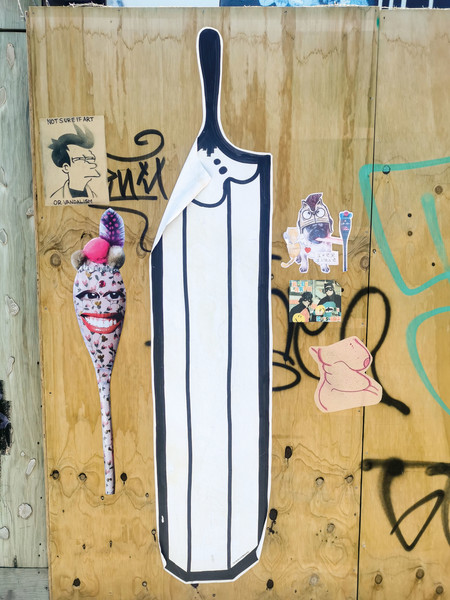
A large Teeth Like Screwdrivers pencil and a Vez spoon are surrounded by other paste-ups in the central city.
Over the last decade, paste-ups have engaged with the local cityscape in numerous ways, from direct references to the impact of the earthquakes, to exercises in phenomenology where apparently meaningless images challenge our expectations. As a strand of post-graffiti street art, paste-ups can draw on a particular lineage of influence, the material and tactical qualities of postering, and the potential relationship with both setting and audience in their performances. Perhaps a final local example highlights these myriad concerns. On an inner-city hoarding surrounding a construction site, Dr Suits’ paste-up explorations were condensed into one poster. Appearing like an advertisement for an as-yet-unpublished book, the peeling paste-up echoed sanctioned commercial imagery, yet it technically only advertised the presence of an urban artist, echoing official channels of promotion with a DIY gusto. The photo, accompanied with text identifying the artist as an ‘urban contemporary artist’, featured Dr Suits pasting a large collage, highlighting the evolution of his style from illustrative to abstract.9 In encapsulating these ideas in a singular work, Dr Suits was able to draw on the multi-faceted potential of post-graffiti paste-ups, a reminder that perhaps, existing in the shadows of urban art’s more prominent forms might just illuminate their performance.
Related reading: Graffiti
Notes
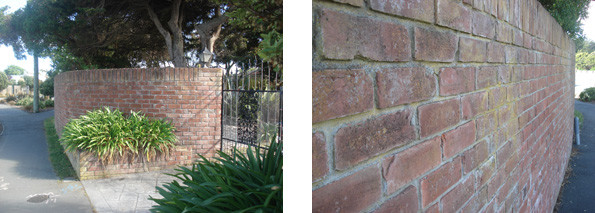
Another Brick In The Wall
Coming across an undamaged, fully standing, curved brick wall in the battered eastern suburbs is something of a rarity.
Notes
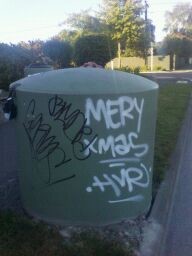
Aw, bless their little aerosol-coated hearts
Let it not be said that Christchurch's vandals, ahem, street artists, lack a sense of community spirit.
My Favourite
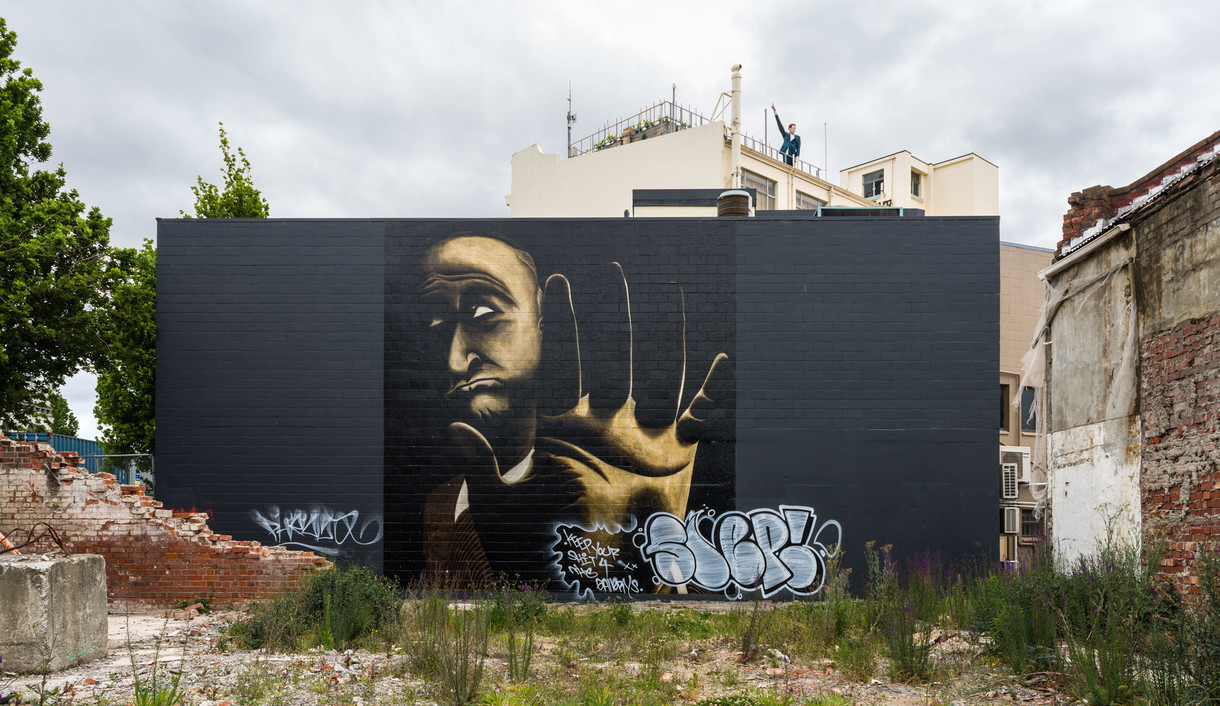
My Favourite
I’ve been continually fascinated by the plethora of creative interventions inserted into the wasted post-quake city. A number of works have offered sharp reminders that what we have been witnessing in the past five years is not normal.
Article
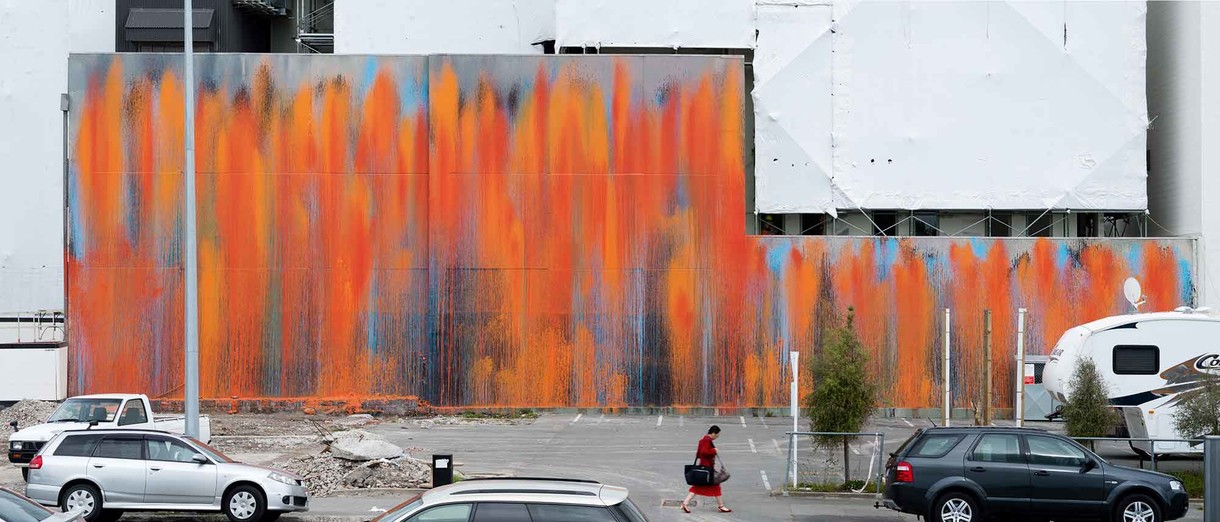
Sparks that fly upwards
Curator Felicity Milburn remembers five years and 101 installations in a gallery without walls.