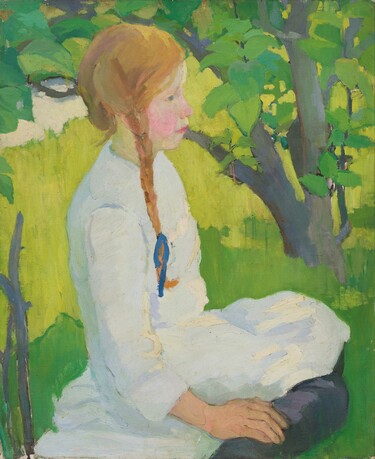
Edith Collier Girl in the Sunshine 1915. Oil on canvas. Collection of the Edith Collier Trust, in the permanent care of Te Whare o Rehua Sarjeant Gallery
Ahead of Her Time
An Introduction to Edith Collier
Whanganui born artist Edith Marion Collier (1885–1964) was one of the earliest pioneers of modernism in Aotearoa New Zealand. During nearly nine years of art studies in Europe from 1913 to 1921 she produced some of the most avant-garde works by any New Zealander at that time.
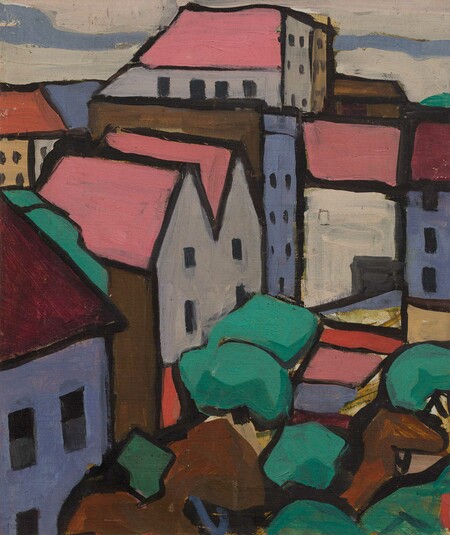
Edith Collier Buildings, Leinster Square c. 1918. Oil on canvas. Collection of the Edith Collier Trust, in the permanent care of Te Whare o Rehua Sarjeant Gallery
Edith Collier was the eldest of ten children born to Eliza and Henry Collier, a successful Whanganui businessman and prominent landowner. In 1903, aged 18, she enrolled in the Wanganui Technical School of Art and Design where her tutor Dennis Seaward suggested she continue her studies in England. Ten years later, with the support of her parents she enrolled in St John’s Wood School of Art in London. Collier made the most of every opportunity London presented, exhibiting her work, visiting exhibitions and meeting with like-minded individuals. However, as her training progressed she began to feel restricted by the conservative teaching at St John’s Wood and sought other avenues of training, including lessons from Australian modernist Margaret Preston (née McPherson) and fellow New Zealander Frances Hodgkins.
Collier joined Preston’s summer art schools in the village of Bonmahon in County Waterford, Ireland, in 1914 and 1915.1 She enjoyed the stark beauty of the coastal landscape and pronounced it to be “...a grand place for painting”.2 Girl in the Sunshine (1915) shows Collier’s growing confidence and her adoption of post-impressionist features like the flattening of the picture plane and simplification of forms. Bonmahon was experiencing extreme hardship following the recent closure of local mines and Collier requested her mother send clothing she could distribute to children in need. She made such a lasting impression on the local community that a century later, in 2014–15, they organised a series of commemorative events to honour her visits.
Collier’s second trip to Bonmahon was cut short by wartime restrictions and she returned to London, where she rented an attic flat in Leinster Square. This flat served as a base for her enlisted brothers and cousins – at one stage there were five men sleeping in their greatcoats on her floor. During this time Collier produced one of her most historically significant works: Ministry of Labour – Recruiting Office for Women (1917–18) is a bustling street scene showing women vigorously contributing to the war effort, and offers a rare glimpse beyond the usual wartime images of the front lines. Conditions in London were challenging and opportunities to paint outdoors were limited so Collier resorted to painting the view from her attic studio. With its bold and brightly coloured geometric shapes heavily outlined in black, Buildings, Leinster Square (1917–18) is an outstanding example of her advanced development.
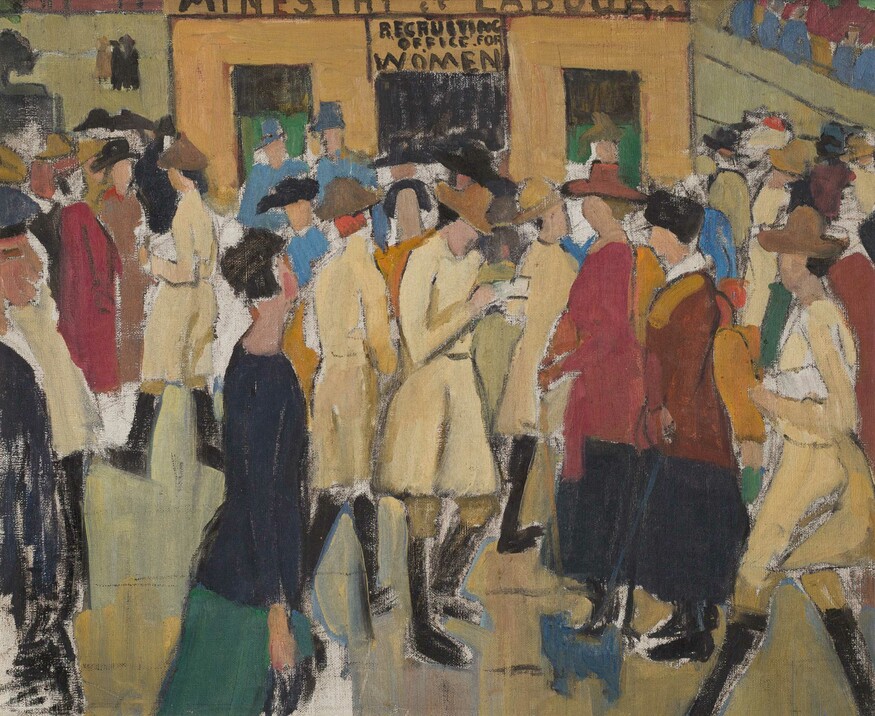
Edith Collier Ministry of Labour – Recruiting Office for Women 1917–18. Oil on canvas. Collection of the Edith Collier Trust, in the permanent care of Te Whare o Rehua Sarjeant Gallery. Conserved with the generous support of Jim Norris, 2004
Late in 1917 Collier began to hire models to pose for her, telling her parents “… I won’t be able to get figures in Wanganui”.3 The resulting series of innovative nude paintings includes Girl Sitting on a Bed (1917–18), in which the model is shown seated on Collier’s bed directly facing the viewer. There is no artifice in how she is portrayed, the simplicity of the spartan interior of Collier’s room and the limited colours focus the eye on the luminous flesh tones. With its highly original treatment of the nude figure The Lady of Kent (1917–18) is the most remarkable work from this series – shockingly the slightly amused model is presented seated outdoors on the grass. Confrontationally placed at the very front of the composition, Collier applied a decorative treatment to the English oasthouse (hop kiln) scene in the background. She clearly valued this picture and regularly selected it for exhibition, including at the Society of Women Artists show in London in March 1918, where it was favourably commented on by a critic from The Times newspaper.4
In 1920 Collier was invited to take part in Frances Hodgkins’s summer school at St Ives, Cornwall. Inspired by the artist’s advice, “Don’t – reproduce – Get the character & essential spirit of the place in the simplest manner”,5 and working mainly in watercolour, Collier produced some of her most mature and avant-garde works. Art historian Jill Trevelyan comments, “There is no comparison … in the art produced in New Zealand at the time: the modernist experiments of Colin McCahon and Toss Woollaston, in the mid 1930s, were still years away”.6
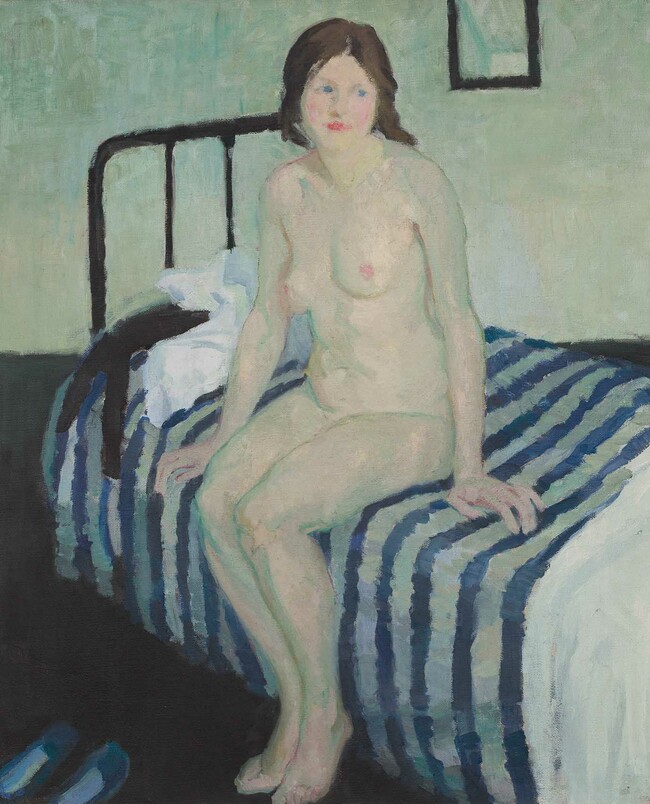
Edith Collier Girl Sitting On a Bed 1917–18. Oil on canvas. Collection of the Edith Collier Trust, in the permanent care of Te Whare o Rehua Sarjeant Gallery
Her teachers were impressed: Preston wrote to Collier’s mother saying “Miss Collier is working very hard. She will do good things ... I think you will be astonished at the quality of her work ... I assure you, she has quite an excellent talent for portraiture & ought to do very well in New Zealand.”7 Hodgkins wrote of her progress in October 1920, “I have one very bright N. Zealander, from Wanganui, Collier by name – who is coming on wonderfully – I’ll make something of her I feel sure...”8
Collier’s parents’ support meant that she was free to experiment without having to secure a living from her art, but she never established her independence and was constantly advocating with them to remain in England for a bit longer. Unfortunately, by 1921 her family’s financial situation had become strained, and when Hodgkins invited Collier to join her in the South of France her parents finally called her home. In December 1921 she packed up her paintings and books and set sail back to New Zealand.
Arriving home in January 1922, Collier became engrossed in the rapidly expanding Collier family life. She tried exhibiting in Whanganui, at the Academy of Fine Arts in Wellington as well as with The Group in Christchurch (in 1929 and 1931) but, at such a distance from Europe, her modernist works were generally met with incomprehension. Collier’s first show in her home town, the 1926 Wanganui Arts and Crafts Society exhibition, resulted in scathing reviews from an anonymous newspaper critic: “Miss Edith Collier is yet another whose work suffers from a slavish imitation of a prevailing fad ... it is a pity she goes out of her way to distort nature under a mistaken idea that that is the way to display originality.”9 A few weeks later in another review the critic stated that modern art “marks a lack of culture, as positively as a vulgar accent or want of manners”.10 The same year, having harboured high expectations of her celebrated return, Collier’s disappointed father destroyed a number of her works in a fit of frustration while she was out shopping.
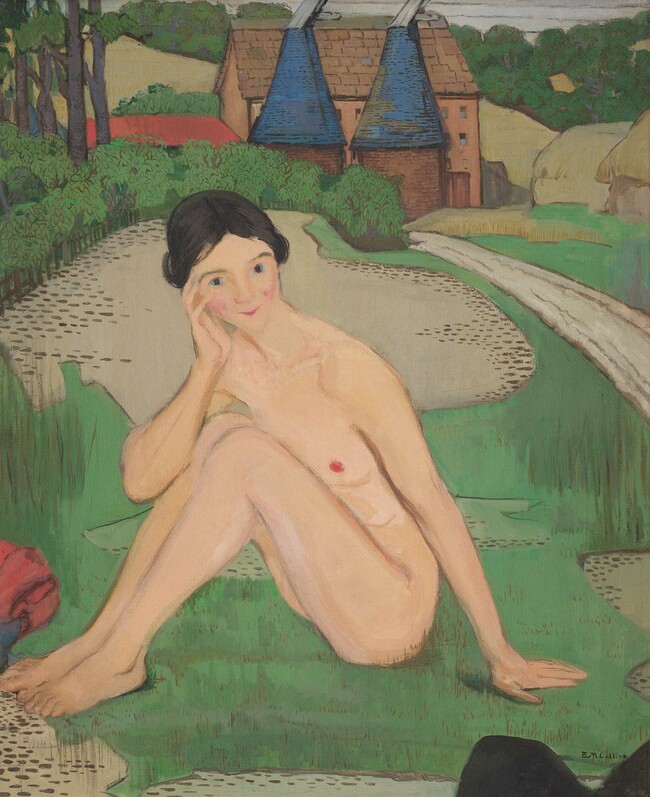
Edith Collier The Lady of Kent 1917–18. Oil on canvas. Collection of the Edith Collier Trust, in the permanent care of Te Whare o Rehua Sarjeant Gallery
Collier was a curious mixture of opposing temperaments, being both independent and tenacious (surviving the dire conditions of World War I London) while painfully averse to self-promotion of her work. She was reluctant to sell any of her works, preferring to either hold onto them or give them to family members, and appeared to feel at odds with what society expected of her. In a letter to her mother she said, “A peculiarity I am & always will be.”11 Over time she took on more of the family responsibilities, nursing her elderly parents and taking care of her many nieces and nephews. Apart from a six-month period at Kāwhia in the Waikato during 1928, when she painted portraits of kuia and local landscapes, her artistic development slowed.
Edith Collier died in Whanganui in 1964, and her artworks and archives were transferred to her sisters Dorothy and Helen Bethea Collier. Gordon H. Brown initiated contact with the Collier family during his tenure as Sarjeant Gallery director (1974–7) with a view to organising an exhibition of her work. Subsequent director Bill Milbank saw this project to fruition and Edith Collier in Retrospect opened at the Sarjeant Gallery in 1980 and went on to tour New Zealand.12 After the death of Dorothy Collier in 1983 the collection passed to Edith’s niece Barbara Stewart, who placed it in the care of Te Whare o Rehua Sarjeant Gallery the following year. The Edith Collier Trust, comprised of family members, was established 1993–4 and continues to work closely with the Sarjeant Gallery to care for the Edith Collier Trust Collection and promote Collier’s work.
Aside from the Sarjeant Gallery holdings and five works acquired by Te Papa Tongarewa in 1941 and 1957, very few works are held in public collections. Despite regular exhibitions at the Sarjeant Gallery, Collier remained largely overlooked until New Zealand historian Joanne Drayton published Edith Collier: Her Life and Work in 1999 with an exhibition toured by the Sarjeant Gallery.13
At a time of growing international interest in the work of women modernists, Collier is now receiving increased attention. In 2024 Edith Collier: Early New Zealand Modernist formed part of the reopening programme at the Sarjeant Gallery with an accompanying publication.14 In 2025–6, Collier’s work was prominently featured beyond New Zealand shores for the first time in the exhibition and accompanying publication Dangerously Modern: Women Artists in Europe 1890–1940 at the Art Gallery of South Australia and Art Gallery of New South Wales. Collier is finally receiving the international acclaim she deserves and would most likely have received during her lifetime if she had not returned to conservative 1920s New Zealand.
Related
Exhibition
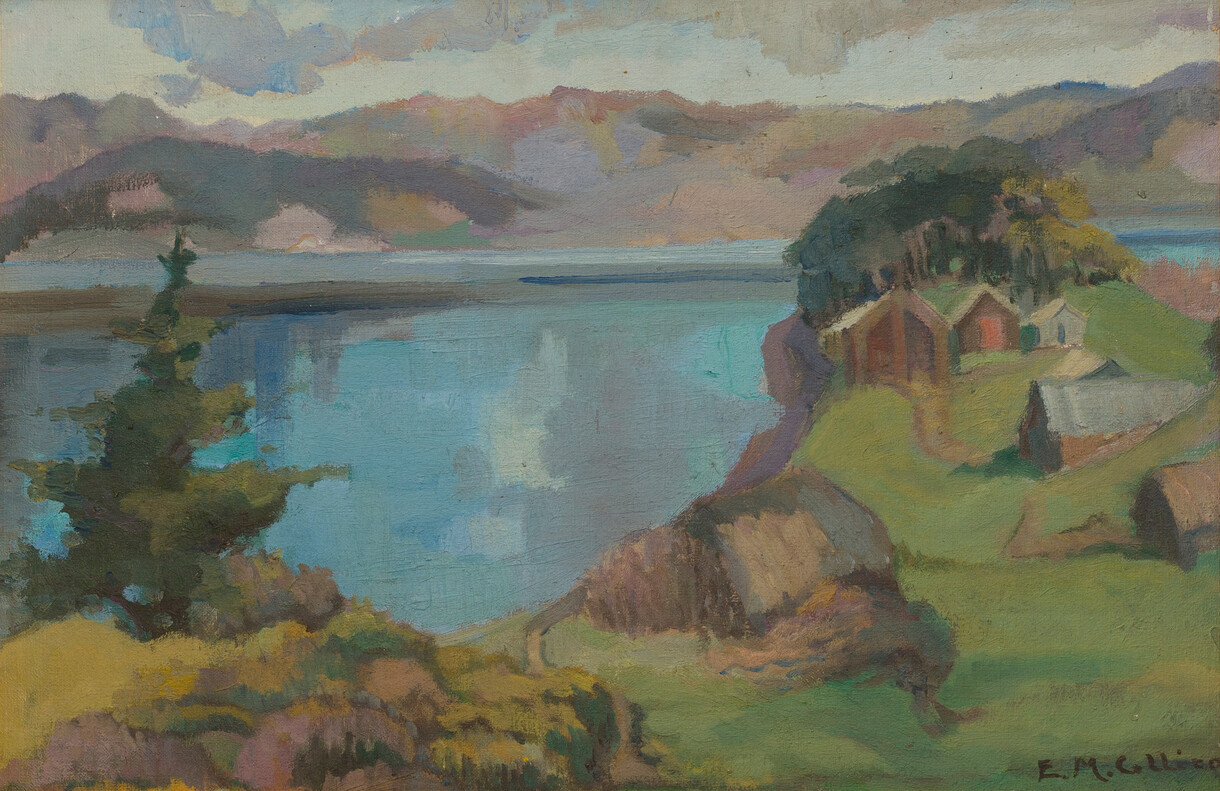
Edith Collier: Early New Zealand Modernist
9 May – 30 August 2026
A rare opportunity to view the work of one of Aotearoa New Zealand’s most adventurous and experimental modernist artists.