The Funeral on Marken
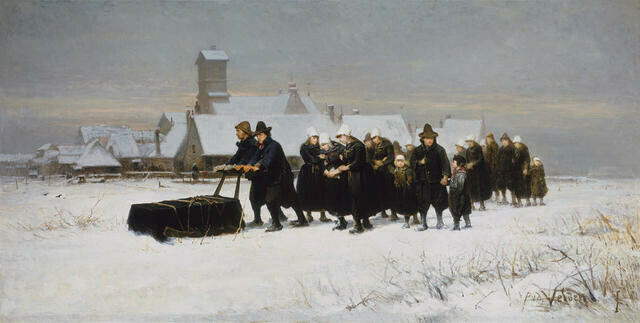
![Petrus van der Velden Burial in the Winter on the Island of Marken [The Dutch Funeral] 1875. Oil on canvas. Collection of Christchurch Art Gallery Te Puna o Waiwhetū, gift of Henry Charles Drury van Asch, 1932](/media/cache/21/55/21556f58f9e99f46e7b9afd84a7c711e.jpg)
Petrus van der Velden Burial in the Winter on the Island of Marken [The Dutch Funeral] 1875. Oil on canvas. Collection of Christchurch Art Gallery Te Puna o Waiwhetū, gift of Henry Charles Drury van Asch, 1932
Despite its sombre character, Petrus van der Velden’s Burial in the Winter on the Island of Marken is a work that has long captivated Ōtautahi Christchurch audiences. Colloquially known as The Dutch Funeral, it shows mourners crossing a snowbound landscape, reflecting the hardships of life, both unforeseen and seasonal, in a nineteenth-century fishing community in the Netherlands. It remains an expressive testament to sorrow and loss. Recent discoveries aided by historian Jan Schild, a Marken resident and meticulous researcher, deepen that emotional register.
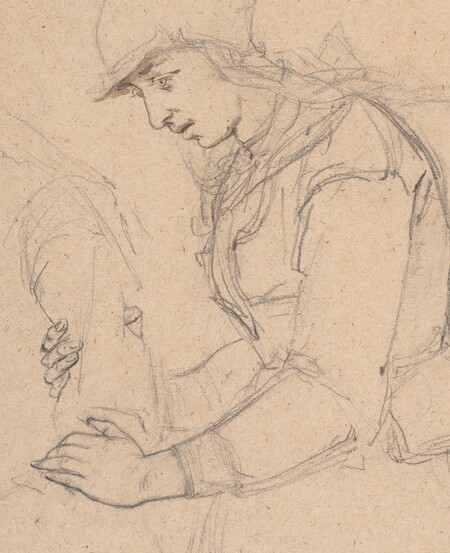
Petrus van der Velden Figure Study for Dutch Funeral (detail) c. 1872. Pencil, ink and wash on paper. Collection of Christchurch Art Gallery Te Puna o Waiwhetū, presented by the family of A. F. Nicoll, 1960
The island of Marken, where artist Petrus van der Velden settled for about two years from 1871, lies some twenty kilometres from Amsterdam and is now joined to the mainland by a causeway. In March 2020, just two weeks before the global COVID-19 lockdown, Jan Schild visited the Gallery. Schild’s visit – and his ongoing generosity in sharing his research and insights – initiated a correspondence that encouraged new investigation into this and other works by van der Velden.
Among the discoveries prompted by this exchange were early reviews of the painting’s 1875 unveiling. One account of the summer exhibition at The Hague described van der Velden’s “truly brilliant debut with the large painting A Burial on the Island of Marken, to which the committee, in our opinion, with every right, assigned a place of honour. The scene is deeply sombre. It is winter on the island of Marken. Nature has donned her shroud.”1 It further described:
Two men, [who,] followed by a group of villagers, push a sledge upon which, beneath the pall, rests the mortal remains of a lamented dead person. Such is the subject, the idea of which is expressed with such unity and simplicity that one is almost involuntarily carried along with that procession of grieving relatives, and a feeling of isolation and loneliness irresistibly takes hold of you.
The writer found the figures “full of action, thanks to the care bestowed on each of them and the tasteful and pleasing grouping, which gives the whole a very good effect.”
A further review appeared in an Amsterdam newspaper nine days later, noting that van der Velden, “who formerly painted water scenes,” was making “his debut as a figure painter.” Describing the stark contrast between “the black figures of the funeral procession and the expansive snowfield,” the critic concluded: “The artist must have witnessed such an event there in reality in order to render it, so movingly felt, with such tragedy.”2
When the painting was exhibited again in Brussels later that year under the title Un enterrement à l’île de Marken (Hollande), it emerged within the tonal world of the newly-named Hague School, referred to by some as the “Grey School” for its attraction to what one painter described as “the poetry of grey”.3 Five years later, the canvas arrived in Aotearoa New Zealand.
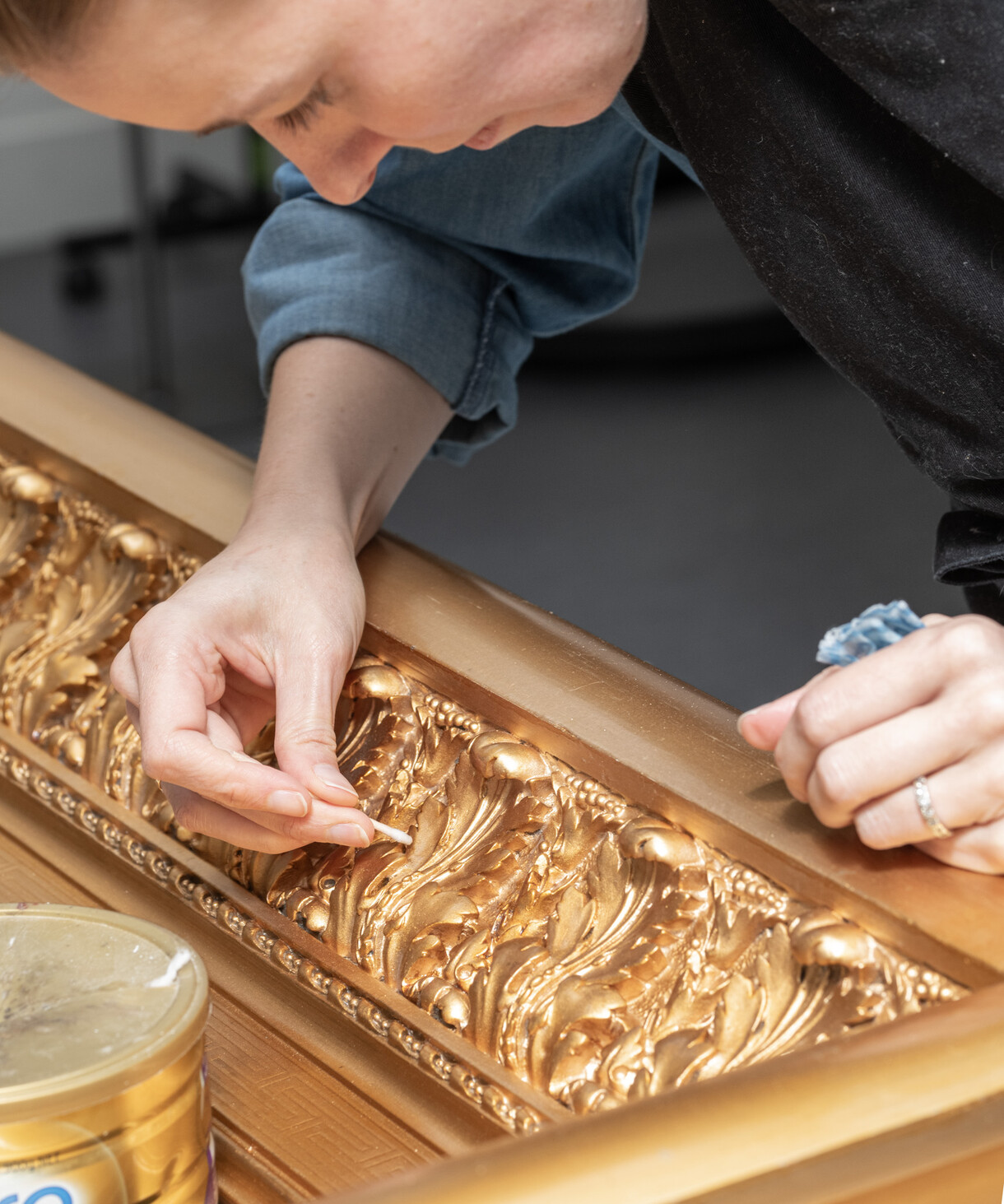
I found myself speaking in front of the work in October 2025, celebrating the regilding of its monumental frame by conservator Anne-Sophie Ninino, supported by the Christchurch Art Gallery Foundation.4 With many months of work newly completed, it was placed on display during a brief gap between exhibitions. Along with many appreciative others, I began seeing the work afresh, freed from my previous reflexive response to the frame’s unsatisfactory glossy gold surface. Its quieter glow also gently restored the work’s strengths and subtleties.
For a start, the formal composition appeared even more markedly radical: a stark division of grey, black and white in broad tonal bands. At its centre is a bold axial arrangement, almost a double subtraction: a black-cloaked coffin on a sled, followed by a trailing procession of mourners – grieving family and community united in endurance as they head across the frozen ground. The more subdued gilding now also drew the eye to hints of colour in the sky, suggesting a momentary lifting of cloud. Shadows beneath the black-garbed procession echo this illumination, briefly lighting the expanse of hard, snow-covered earth.
The figures themselves invited individual rereading and scrutiny. Explicating a work whose popularity I had never fully understood, I found myself now pointing out – and being impressed by – van der Velden’s careful orchestration of detail and narrative. Small observations accumulate into something larger: snow-dusted shoes, noses reddened with cold, children holding adults’ hands, an older woman being supported, her grief central to the scene and rendered with sympathy and restraint. The artist’s attentiveness to human experience – and evident connection to the community he depicted – gives the painting much of its enduring power.
A newspaper report from shortly after van der Velden’s arrival in Christchurch in 1890 recorded his reacquaintance with this work – brought here a decade earlier by his friend Gerrit van Asch, also originally from Rotterdam and founder of the Sumner Institution for the Deaf and Dumb (now named Van Asch College and Kelston School for the Deaf). The artist and his family were then living in tents on the van Asch property, and the large painting was said to depict a fisherman’s funeral.
Many visitors to the Sumner Institute have seen a large and very striking painting there, the subject of which is a fisherman’s funeral in the island of Marken – a curious old-world spot – in the Zuyder Zee. It is winter time, and there is deep snow on the ground. The coffin is being pushed along on a sledge, and the mournful procession of fisher-folk from the hamlet are walking in the rear. A quaint-looking old Dutch church is seen in the background, and the winter atmosphere and the look in the sky which tells of more snow to come, are very finely caught.5
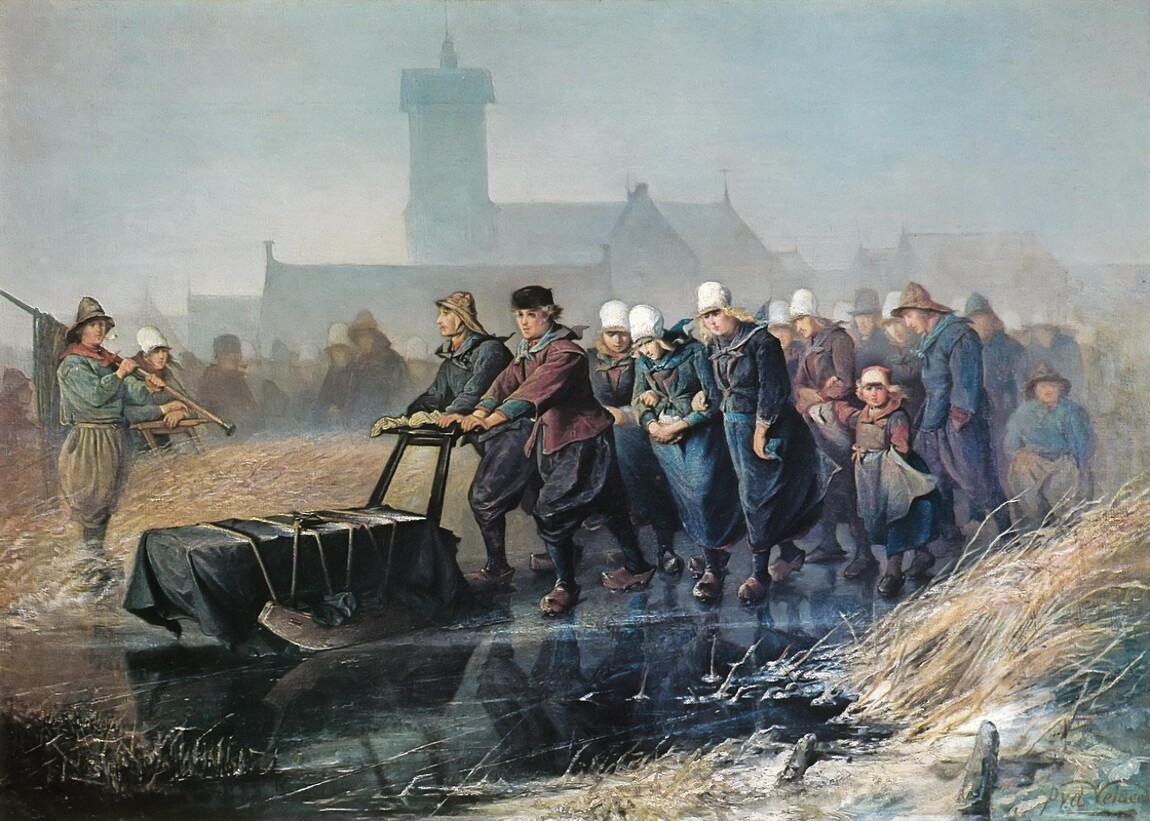
Petrus van der Velden Marken Funeral Procession c. 1872. Oil on canvas. Collection unknown
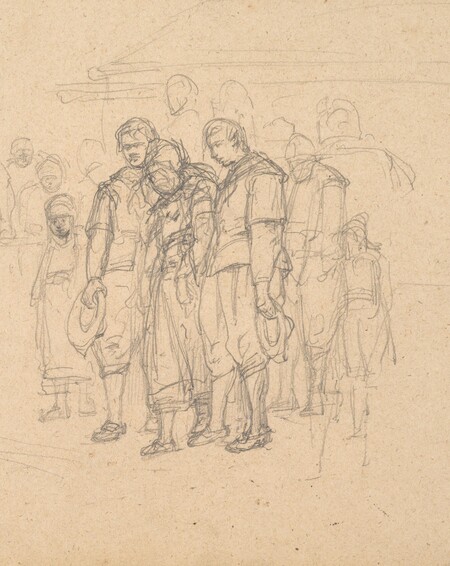
So the question I later sent Jan Schild was a deceptively simple one. Whose funeral was it? Van der Velden evidently arrived on Marken in the summer of 1871 and spent about two years there.6 There was, however, a considerable delay before Burial in the Winter on the Island of Marken made its debut at The Hague in 1875.7 A closely related, much smaller version, apparently completed by 1872, indicates an earlier origin for the scene.8 Looser in handling and clearly preparatory in character, it includes additional figures later altered or omitted, while its light snowfall and exposed grasses suggest an early phase of winter.9 If this is accepted as based on an actual event, the death likely occurred only months after the artist’s arrival on Marken.
Schild’s reply to the question of whose funeral it may have depicted came sooner than anticipated and opened the possibility of a different kind of reading of the work. Consulting Marken’s burial records, he reported: “In 1871, twenty-nine people died. In the months when there could be snow – January and February – only a child of three months died, and one child was born dead.” These were both before van der Velden’s arrival on Marken. However, “In December 1871, three people died: a man of forty-one years, whose wife would have followed the coffin; a child of six months (I think in those days there was no ceremonial burial); and a woman, but there is no man (widower) behind the coffin.”10
The records supplied the following entries:
Cornelis Kaars – died 06-12-1871 – 41 years
Cornelis Bootsman – died 09-12-1871 – 6 months
Lobbetje de Wit – died 23-12-1871 – 58 years
On this basis, Schild believes the deceased to be Cornelis Kaars, who is listed on his death certificate as “van beroep visscher” (by profession fisherman).11 This conclusion is consistent with both the 1890 Christchurch newspaper description and the 1872 dating of the preparatory painting. Issued on 8 December 1871 and signed by fellow fisherman Klaas Kaars, aged 45, the document gives no cause of death but confirms that Cornelis Kaars died two days earlier at 9.30pm at house number 76 in the Kerkbuurt, the church neighbourhood of Marken. It also records that he was the son of Cornelis Kaars, fisherman, and Sijtje Nooitgedagt, both deceased.
![Petrus van der Velden Burial in the Winter on the Island of Marken [The Dutch Funeral] (detail) 1875. Oil on canvas. Collection of Christchurch Art Gallery Te Puna o Waiwhetū, gift of Henry Charles Drury van Asch, 1932](/media/cache/1f/c1/1fc1a13907ccac61e7f29899eafa176a.jpg)
Petrus van der Velden Burial in the Winter on the Island of Marken [The Dutch Funeral] (detail) 1875. Oil on canvas. Collection of Christchurch Art Gallery Te Puna o Waiwhetū, gift of Henry Charles Drury van Asch, 1932
Schild’s research further revealed that tragedy had already marked Kaars’s life: his first wife, Wolmet Zeeman, died in 1866, and over the preceding years two of their three children had died in infancy. His second wife, Jannetje Kaars, had experienced widowhood before their marriage in 1867; her first husband, Jan Teerhuis, had drowned in a storm on the Zuiderzee four years earlier, leaving her with five children, one of whom died in 1870. Cornelis and Jannetje were also raising three more of their own; many children were caught up in this ongoing chain of loss. With the tragedy of 1871, as Jan Schild aptly notes, “It is hard to imagine how much grief Jannetje Kaars had to go through.” And more was to come.
The widow, walking directly behind the coffin and supported on either side, was heavily pregnant at the time of her husband’s funeral. Eight days later she gave birth to their son, Jan, who survived for less than a month. After Cornelis’s death, she was responsible for seven surviving children between the ages of two and seventeen. Knowledge of this surely fell within van der Velden’s close acquaintance with the community, giving impetus to a work essentially about grief, loss and burden-sharing. The artist entered this society as an empathetic observer and guest.
Van der Velden was an extraordinarily attentive artist, and the many preparatory sketches and figure studies connected with the painting, including a surviving large drawing of one of the younger women supporting the widow, reveal it as the result of prolonged observation and development of his theme. Burial in the Winter on the Island of Marken was clearly shaped by close involvement with a vulnerable community in which hardship, grief and mutual care were inseparable from everyday life. That may partly explain why it has continued to resonate with Ōtautahi Christchurch and, more recently, Marken audiences.
Related reading: Petrus van der Velden
Exhibition
Timeless: Treasures from the Historical Collection
19 September 2026 – 30 May 2027
Across centuries and continents, artists have long looked outward in a spirit of discovery.
Exhibition
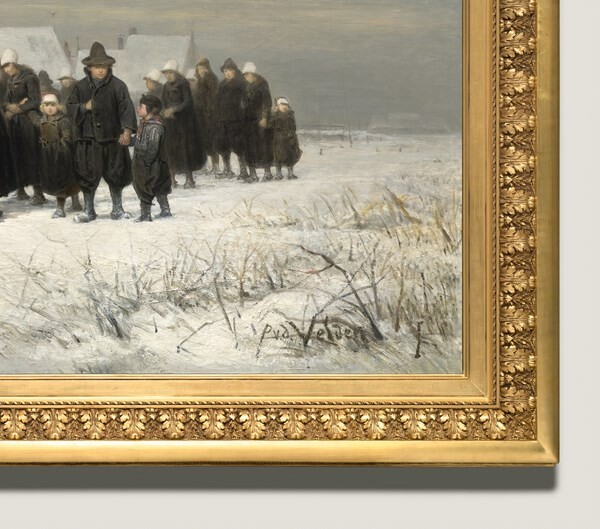
Gilded: Van der Velden's The Dutch Funeral
11 October – 16 October 2025
For a short time only, see one of Ōtautahi Christchurch’s most cherished paintings, Petrus van der Velden’s Burial in the Winter on the Island of Marken.
Exhibition
Persistent Encounters
10 March 2020 – 19 September 2021
From the real to the ideal, from the everyday to the impossible.
Collection
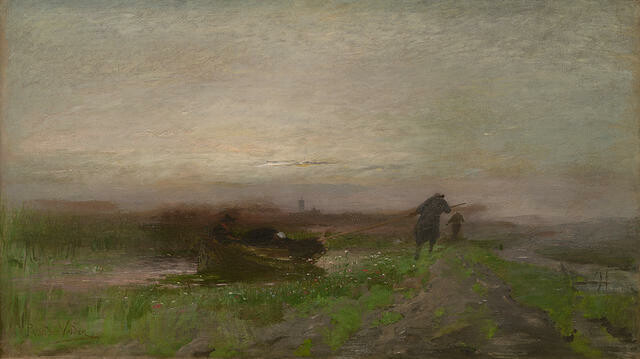
Petrus van der Velden Marken Funeral Barge
This is one of the major paintings from van der Velden’s Marken funeral series, which also includes Burial in the winter on the island of Marken [The Dutch Funeral]. Marken Funeral Barge focuses on the final journey of a drowned fisherman, travelling by barge and accompanied by his widow, to the town of Marken, which can be made out in the distance. By the 1870s, van der Velden had established himself as a successful painter and had become a member of the Hague School, a group of leading Dutch artists interested in realism and portraying the daily lives of rural peasants. As was popular with the Hague School painters, van der Velden used subdued tones to show the atmospheric effects of light on the landscape and accentuate the sombre nature of subjects like this funeral.
(New Dawn Fades. November 2018)
Collection
![Burial in the Winter on the Island of Marken [The Dutch Funeral]](/media/cache/ba/58/ba582fbead83cae6d3dc89f6402ffa81.jpg)
Petrus van der Velden Burial in the Winter on the Island of Marken [The Dutch Funeral]
Research for the exhibition Closer (16 December 2017 – 19 August 2018) resulted in the restoration of this work's original title. In Dutch 'Begrafenis in den winter op het eiland Marken' and in English 'Burial in the winter on the island of Marken'.
Petrus van der Velden’s funeral procession moves slowly across the snow-covered landscape of Marken. The black-clad mourners and casket form a dark, concentrated mass against an expansive field of grey and white, while the village behind merges with the winter sky. The scene is solemn, yet van der Velden’s care in observation gives the mourners an extraordinary immediacy, making their progress across the frozen ground almost tangible. When the painting was exhibited in The Hague in 1875, one reviewer praised van der Velden’s “truly brilliant debut” and described the scene as “deeply sombre. It is winter on the island of Marken. Nature has donned her shroud.” Another noted the contrast between “the black figures of the funeral procession and the expansive snowfield”, concluding that the artist must have witnessed such an event “in order to render it, so movingly felt, with such tragedy.”
Whose funeral?
For many years, the story behind Petrus van der Velden’s Burial in the Winter on the Island of Marken was unknown. Recent research by Marken historian Jan Schild has identified the man being laid to rest as Cornelis Kaars, a fisherman who died on 6 December 1871. Van der Velden appears to have begun developing the subject soon afterwards, returning to it over several years before completing the large painting.
Kaars’s widow, Jannetje, can be seen behind the sled and casket. She was heavily pregnant when her husband died and gave birth to a son eight days after the funeral; the child survived for less than a month.
Knowing the circumstances behind the funeral changes the procession of anonymous figures into a particular community bearing a shared loss. Van der Velden’s extensive studies of Marken and its people reveal an artist deeply engaged with the lives of those around him, transforming a tragic local event into one of his most ambitious and memorable works.
(Timeless: Treasures from the Historical Collection 19 September 2026 – 30 May 2027)
Interview
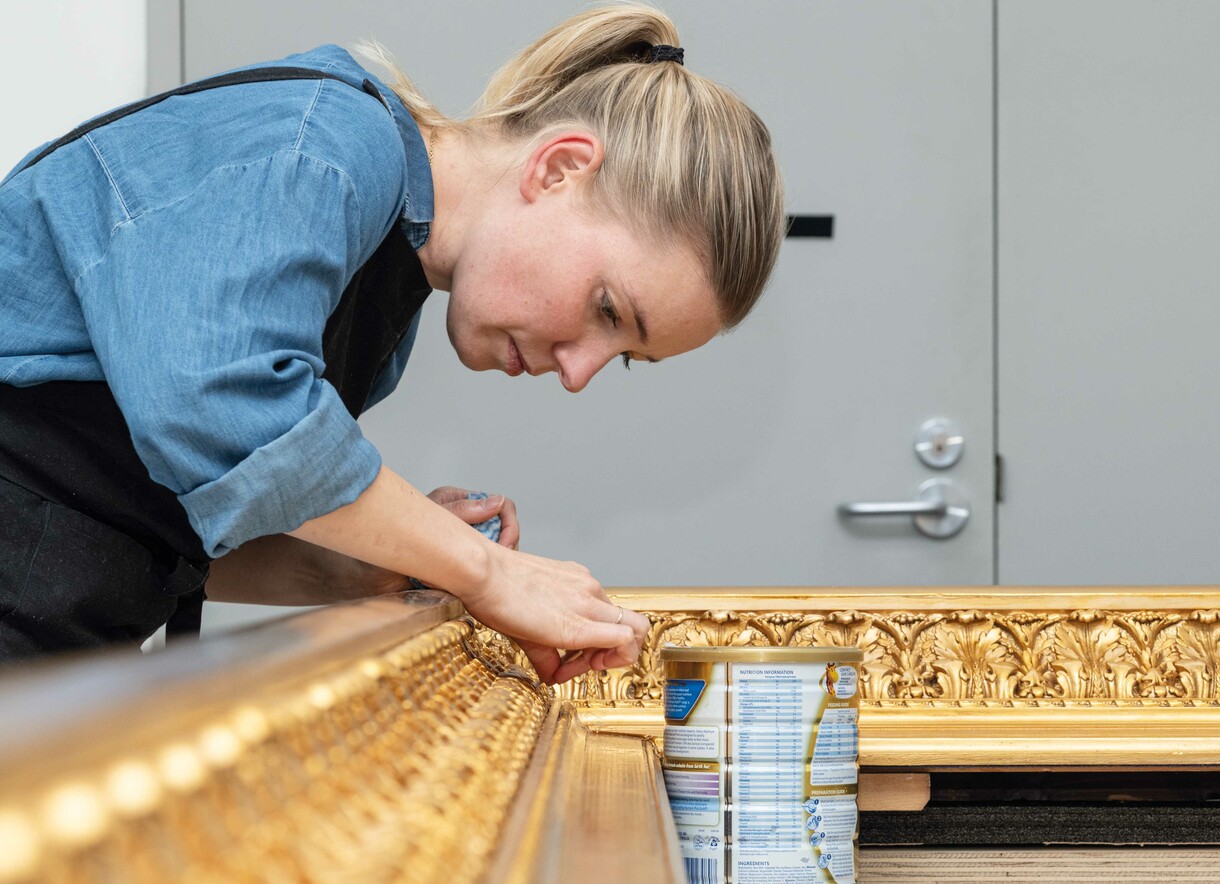
Gold, Chalk and Rabbit-Skin Glue
Bulletin talks to Anne-Sophie Ninino, a French-trained conservator based in Ōtautahi Christchurch with international experience in museum conservation and a specialisation in gilding, frame and heritage restoration.
Commentary

The Dutch Funeral, Retitled
When you think about it, The Dutch Funeral is a peculiar title for a work painted in the Netherlands, by a Dutch artist. You could imagine such a work being titled The Funeral, or A Funeral; or even more likely, A Funeral at a Specified Place or possibly At a Specified Time. Even Of a Certain Person. But The Dutch Funeral? Most unlikely. It was while we were researching works for the Closer exhibition that its strangeness suddenly became evident to me. I was surprised that I’d never questioned the title before. But then, like many people who grew up in Christchurch, I was used to The Dutch Funeral as a fixture of local culture, a work so large it could never be taken off the wall at the McDougall; a magnificently gloomy painting which van der Velden scholar Rodney Wilson once described as “a sort of Christchurch version of the Night Watch with an immense public following”.
Interview
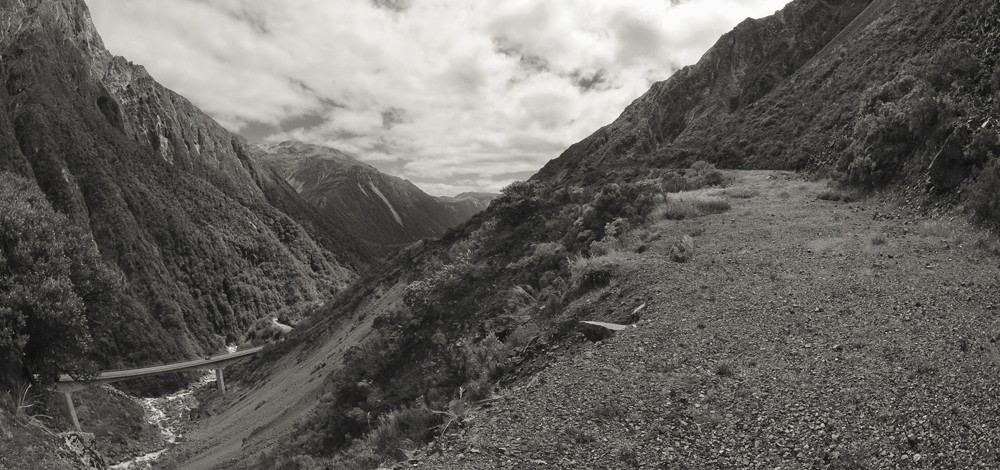
Otira: it's a state of mind
A short road trip to the Otira Gorge was the scene for a conversation between Gallery curator Peter Vangioni and two of the artists included in Van der Velden: Otira, Jason Greig and the Torlesse Supergroup's Roy Montgomery.
Article
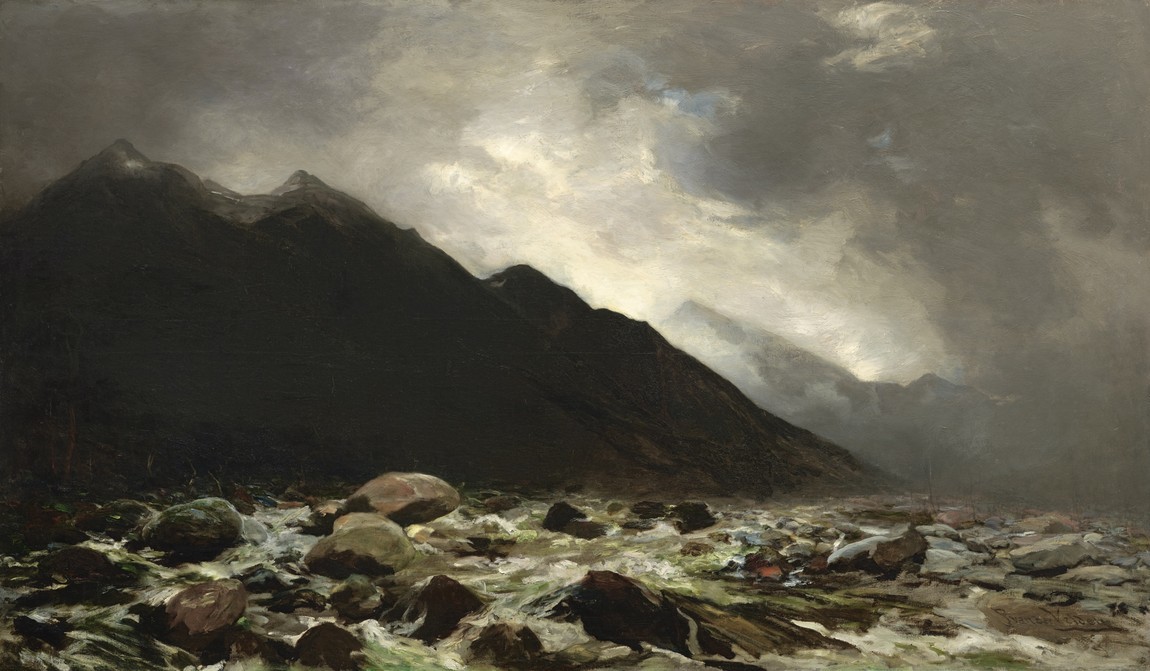
Van der Velden: Otira
A first encounter with a painting by Petrus van der Velden more than twenty years ago was the start of many years of research for Gallery curator Peter Vangioni. Peter is the lead author of the Gallery's new book on van der Velden, and talks here of his fascination with the artist's Otira works.
Exhibition
Van der Velden: Otira
This exhibition brings together a comprehensive selection of Van der Velden's paintings portraying the wild, untouched natural beauty of the Otira region's mountainous landscape.