Taharaki Skyside in Venice
Horizons and Transcendence
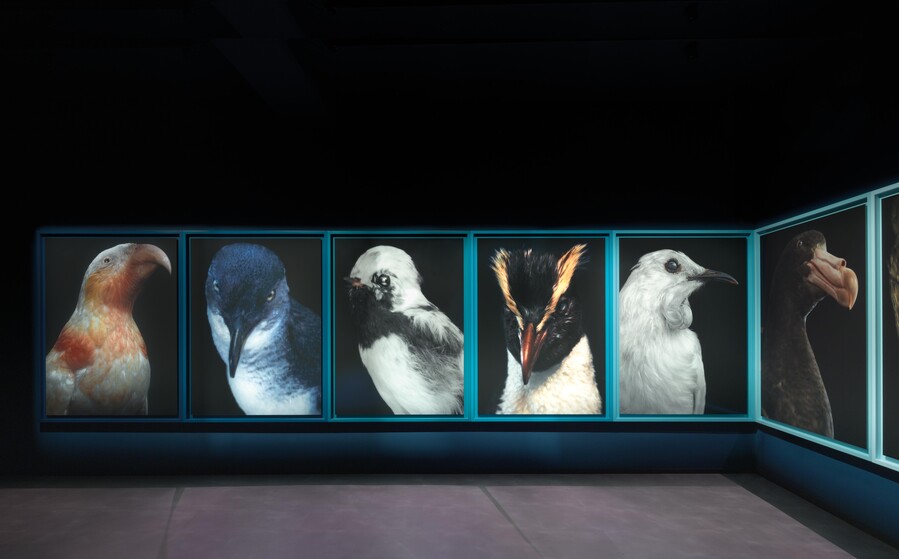
Fiona Pardington, Taharaki Skyside installation (detail). Photo: Neil Pardington
Christchurch Art Gallery Te Puna o Waiwhetū is immensely proud of the role it has played as delivery partner for Aotearoa New Zealand’s participation in the 61st International Art Exhibition La Biennale di Venezia. Since Creative New Zealand confirmed us as their delivery partner and endorsed our choice of Fiona Pardington as the artist in late 2024, Taharaki Skyside has drawn on the expertise, commitment and collaboration of staff across the Gallery. Seeing that collective effort realised in Venice when the exhibition opened in early May this year was a significant moment for everyone involved in the project. The Gallery team has worked closely with Fiona Pardington and her team (including Neil Pardington, creative director) and Creative New Zealand, with the support of many others, to deliver an exhibition of the highest possible standard on one of the world’s most prominent cultural stages.
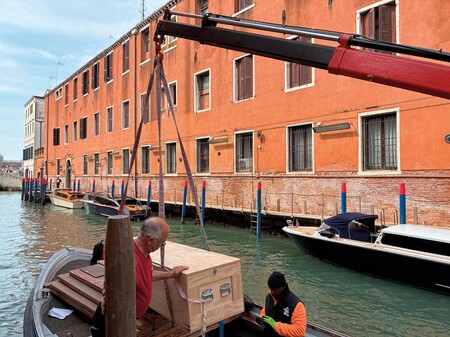
Fiona Pardington’s exhibition arrives at the venue by boat
La Biennale di Venezia was founded in 1895 and is one of the world’s oldest and most influential international exhibitions of contemporary art. Held every two years, it combines a large, themed multi-artist exhibition with independently organised national pavilions. This year, there were 111 participants in the curated show (which included individual artists and artist-led collectives), 100 national pavilions and many other associated projects.
This all unfolds across two sprawling venues – the original, tree-lined Giardini and the Arsenale, a former shipyard – and in sites around the whole of Venice. The Biennale typically attracts between 600,000 and 800,000 visitors and it continues to play an important role as a global meeting point for artistic exchange and critical reflection.
This Biennale provided a particularly resonant context for Taharaki Skyside. Its theme, ‘In Minor Keys’, was conceived by the Cameroonian-Swiss curator and cultural leader, Koyo Kouoh, known for foregrounding artists and perspectives from Africa and the global diaspora, and for making space for overlooked histories, collaborative practices and artmaking that is socially engaged.
It was a shocking and profoundly sad moment when news of Kouoh’s death from cancer broke in May last year. Her curatorial vision was realised posthumously by her team. Full of colour and texture, her curated exhibition also emphasises subtlety and depth, encouraging visitors to engage with more reflective forms of artistic expression rather than spectacle. Many of the artists in national pavilions also chose to work in quieter registers, encouraging reflection and considering ideas about ecological precarity, Indigenous knowledge, cultural memory and survival. This allowed for rich overlaps with Taharaki Skyside, with its focus on manu, mauri and whakapapa. Pardington’s work, and the Biennale as a whole, demonstrated the continuing relevance of art as a way of thinking through complex contemporary realities.
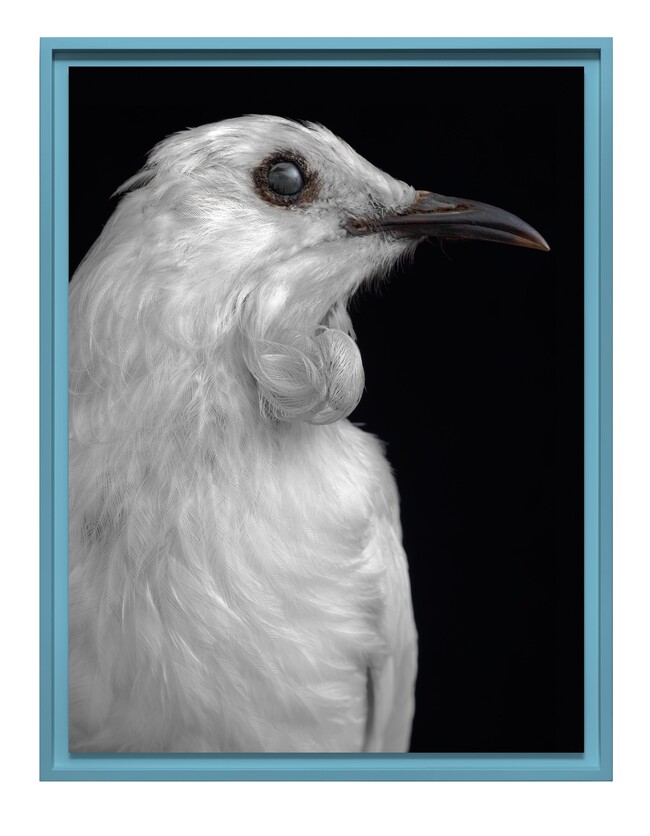
Fiona Pardington Tūī, Prosthemadera novaeseelandiae, aberrant white specimen; collection of the Museum of New Zealand Te Papa Tongarewa (OR. 026541), Te Whanganui-a-Tara Wellington, Aotearoa New Zealand 2025. Pigment inks on Ilford Galerie Smooth Cotton Rag. Courtesy of the artist and Stark White
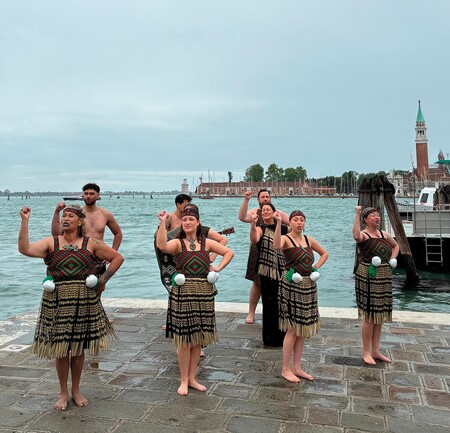
The Kāi Tahu rōpū on the Venice waterfront
One of the first and most important aspects of the project was the selection of venue. After looking, both on the ground and online, with the artist at many different possibilities we found one that would satisfy her vision of a continuous frieze of large-scale images, enfolding the viewer within an intimate and immersive space. Part of the same complex that hosted et al.’s Biennale exhibition in 2005 and Bill Culbert’s in 2013, La Pietà holds a special place in Venetian hearts and history.
A famous fourteenth-century orphanage, convent and elite all-female music school, the Ospedale della Pietà was best known for its association with composer Antonio Vivaldi and for the gracious Chiesa della Pietà (also known as Santa Maria della Visitazione). It was established by the Venetian Senate in 1346 as a result of efforts by Franciscan friar Petruccio D’Assisi to shelter abandoned and orphaned children, and especially to prevent newborn infants from being left to starve or drown in Venetian canals. Foundlings and orphans (many of them the illegitimate children of the nobility) were housed and raised, funded by the state, charitable donations and private bequests. D’Assisi walked the streets of Venice crying out “pietà, pietà” (mercy, mercy) to raise money and gain support for the Ospedale. La Pietà had a scaffetta, a revolving door where infants could be left if they could not be cared for. A stone plaque from 1548 still warns parents against abandoning children improperly. The building became known as a musical conservatory, where talented female residents (known as figlie di coro) received world-class training in vocal and instrumental performance. Antonio Vivaldi served as master of violin and resident composer from 1703 to 1740, and some of his best-known works were originally written for the young women to perform. People travelled from across Europe to hear the famous unseen female orchestra perform behind ornate grilles during Sunday services. A recent film, Primavera (2025), tells a story based on this history.
The exhibition space for Pardington’s exhibition is at the rear of the La Pietà complex, in a modern building that could be adapted to hold her works. One advantage was its proximity to the water – instead of wheeling nine heavy crates across the cobblestones of Venice, our team had them delivered almost to the door by boat.
Visitors to Taharaki Skyside enter via an iron gate, walk past signage designed by Neil Pardington, and around to the attendant’s desk where everyone gets a warm welcome from the visitor attendants (some from the Gallery team) who are hosting the exhibition so beautifully.
Just inside the door to the exhibition space is Kiri-waerea, a pounamu from the Arahura river on the West Coast of Te Waipounamu. Generously lent by the Parata whānau, it is there as a touchstone for visitors, connecting Venice with the waters and lands of Aotearoa, and an embodiment of the kaitiakitanga and mauri of the artist’s Kāi Tahu iwi.
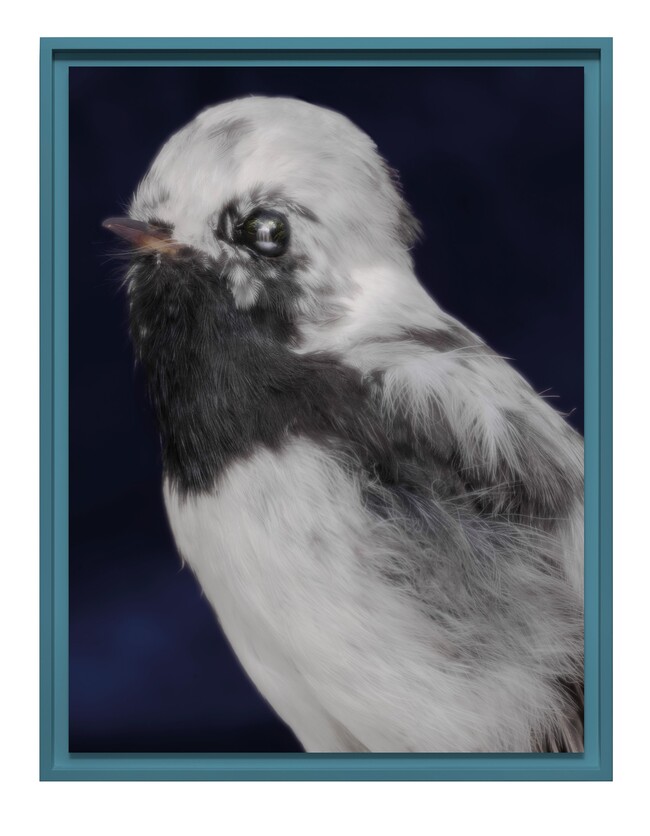
Fiona Pardington Kōmiromiro, Tomtit, Petroica macrocephala, leucistic, adult male, Whakatū Nelson; collection of Canterbury Museum (AV 2651), Ōtautahi Christchurch, Aotearoa New Zealand 2025. Pigment inks on Ilford Galerie Smooth Cotton Rag. Courtesy of the artist and Stark White
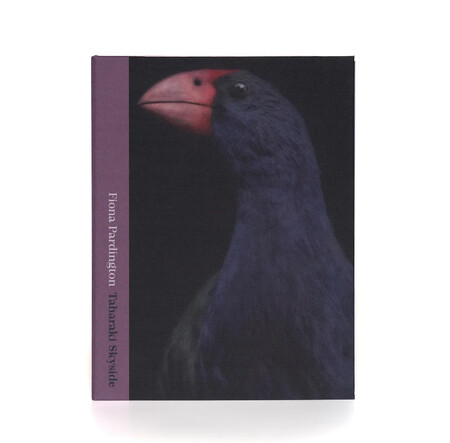
Fiona Pardington: Taharaki Skyside
Beyond it, visitors encounter Pardington’s continuous frieze of seventeen manu, which range from tiny kōmiromiro to massive toroa, all shown on the same grand scale in images more than two-metres high. They are decisively portraiture rather than documentation. Pardington’s careful attention to scale, angle, lighting and composition repositions these taxidermied specimens from museum collections in Aotearoa and Australia as powerful living presences, honouring and uplifting their mauri. This makes for a highly charged, extraordinarily resonant encounter that encourages us to consider the weight of our own responsibilities. Many of the species included, like the whēkau and the huia, are now extinct or critically endangered due to colonial collecting, habitat loss and introduced predators. Those that remain face a new threat with the arrival of the avian flu in Aotearoa. Several manu exhibit rare colour variations, such as the albino tūī and kōkako, and the spectacularly salmon and pearl-coloured kākā kura, a rare colour morph held in the collection of the Museum of New Zealand Te Papa Tongarewa. Most visitors to Taharaki Skyside spend their first minutes in the space absorbing the shapes, colours and sheer presence of the birds. About halfway round, they may catch something unexpected in the birds’ eyes. The artist has filled their taxidermied eyes, often now opaque with age, with small glimpses of landscapes taken from nineteenth-century photographic postcards. The view she has chosen for each bird corresponds to what would have been its natural habitat, an indelible memory of the places they were taken from. It is a kind of repair that reconnects them with the wild, but also reminds us of their longer claim to places we now regard as our own. In the space, we meet the consequences of our actions eye to eye.
For many years, Pardington was associated with black and white imagery, but colour plays a key role in Taharaki Skyside. With Neil, she developed an exhibition and frame palette that connects these manu from Aotearoa, Southern and Northern Hemisphere landscapes and Dante Alighieri’s Divine Comedy (a gesture of acknowledgement to her Italian hosts). When Pardington first visited Venice in 2024, she found that the sunrises over the water echoed those she knew from home, and many of their colours also appeared in Dante’s fourteenth-century epic poem. “I decided to work with colours infused in the Commedia,” she has said “as it is eerily reflected in the sea, earth, sky in Venice, [and] in the waters and earth, the skies over Maerewhenua. […] In the feathers of the tūī’s breast and the fiery underwings of the kea rest all of Dante’s palette.”
Dante locates purgatory – the place souls move through on their way to heaven – as an island-mountain in the Southern Hemisphere, on the opposite side of the world from Jerusalem. In Taharaki Skyside, this allusion suspends us not only between hemispheres, but between the terrestrial world and other possible realms. The shifting colours of the dawn sky become a symbol of renewal and transformation. We imagine it filled with birdsong: Ka korokī te manu; the dawn chorus.
Two distinct audio works were commissioned for the exhibition. The waiata ‘He Rau ki Taharaki’ was composed by Hana O’Regan and performed by O’Regan, Puamiria Parata-Goodall and Karuna Thurlow, and the sonic work ‘Kāhui Mokemoke (I, II, III)’, which can be translated as the ‘the lonely flock’, features taonga puoro, music and sound design by Thomas Carroll, Rob Thorne and Ariana Tikao, with engineering and production by Justyn Pilbrow. Played one after another in a continuous loop, they build an atmosphere that carries us back to the ancient forests of Te Waipounamu.
Taharaki Skyside could only have come from Aotearoa, yet it has proven strikingly relevant to the conversations taking place across the Biennale. This aspect has drawn the attention of many commentators at the Biennale, including Artlyst, which named it as one of ten exhibitions that justified the trip to the Biennale, offering “a different kind of answer to the one Kouoh was asking.”1 Sotheby’s called Aotearoa New Zealand one of its national pavilions to watch at the Biennale, identifying it as one that “addressed urgent questions on a global stage”,2 and Kunstforum International noted how Pardington’s photographs are underpinned by her appreciation of whakapapa – the connections between all things.3
Over the next four months Pardington’s works will continue to speak to audiences from around the world. The Biennale runs until 22 November, at which point our team will deinstall and pack it before sending it back home to Aotearoa. Audiences here will have the opportunity to see it here at Te Puna o Waiwhetū in August next year. Until then, you can satisfy yourself with the accompanying book. Beautifully designed by Neil Pardington and published by Christchurch Art Gallery Te Puna o Waiwhetū, it is available from our Design Store, in store and online.