Made in the Pacific
A Collection of Tāoga
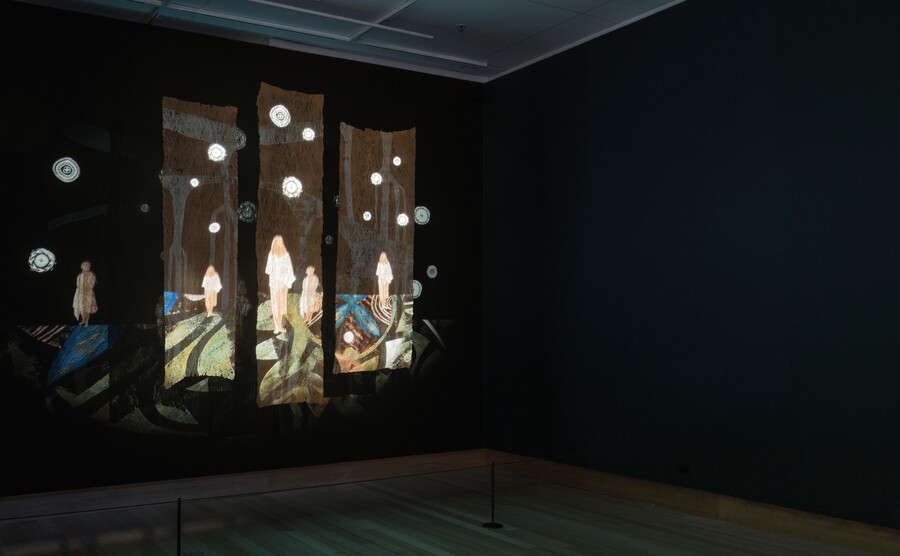
Sue Pearson and Pauline Reynolds Hina’s Granddaughters (still) 2022. Moving image on ’Ahufara tapa, sound and poetry. Courtesy of the artists
The exhibition Made in the Pacific: A Collection of Tāoga highlights the continued strength in culture and traditional art forms. Curated by Cora-Allan, it includes contemporary works by Louisa Afoa, Serene Hodgson, Jimmy Ma’ia’i, Sue Pearson, Pauline Reynolds, Doron Riki-Semu, and a selection of Pacific tāoga generously loaned by Canterbury Museum, with support from the museum’s curator of Māori, Pacific and Indigenous human histories, Hatesa Seumanutafa. We invited Karen Stevenson and Stephanie Oberg to respond to the exhibition, and to consider some of the issues that arise when presenting customary and contemporary works together.
Stephanie Oberg: The title Made in the Pacific reads as a marketing label, a confirmation of origin and authenticity. A playful swipe at cultural consumerism, it leans into the captivating allure of the Pacific. For those of us who live as part of its diaspora, the title hails us.
But the Pacific is a geopolitical construct: a nomenclative collapse of cultural differences and diversity, perpetuated through convenience. Its diaspora is equally ambiguous – a sea of shifting relationships within which we negotiate the contradictions, slippages and cultural tensions on a daily basis.
With such an open title there is the expectation of more: a comprehensive survey perhaps, or the recognisable names of senior artists. Instead, we are granted keyhole access into the hidden, unique histories, complexities and creative endurance of art within the diaspora.
Curated collections are political by nature. Here, Cora-Allan usurps familiar institutional classifications to declare the contents of the exhibition tāoga: treasure, neither consumable fine art nor historical artefact. A customary blessing and the words of a Niue elder activate the space. For at least the life of this exhibition, ancient tools and barkcloth breathe in the context of those who continue to honour their creative legacy.
Karen Stevenson: I was truly excited about the exhibition. Any time Pacific art is on display, I’m happy. This exhibition brought back many memories of researching in the back-rooms of museums, of teaching, of transferring my passion for these arts to my students.
The opportunity to see so many objects from the Canter-bury Museum is incredible. The fact that the Museum holds such an extraordinary collection of Pacific works is still not known to many in Christchurch, and only a small percentage of their collections are ever on display.
This exhibition enables those unfamiliar with Pacific barkcloth to discover the artistry in this cultural production. They are also introduced to contemporary artists who draw their inspiration from these arts. I sincerely hope that we will see more collaborations such as Made in the Pacific in the future. Particularly as, at least in my mind, many of these traditional works sit comfortably in a Gallery context.
When I reached the Gallery the first object I saw was a beautiful hiapo from Niue. Having this piece in such a prominent position seemed appropriate as the curator of the exhibition, Cora-Allan, is herself from Niue.
I looked at the Niue hiapo, just smiling, so happy to see it and then turned to examine a small specimen of ‘native cloth’ from Hawai’i; it was also beautiful. I glanced at the tīputa (ponchos from the Cook Island area) and then to the sleeping cloth from Hawai’i. Seeing its quality and delicate design brought back memories of living in Hawai’i and visiting the Bishop Museum and its stores. My eyes then moved to the piece from Futuna, which is just exquisite. These are masterpieces of the barkcloth tradition.
Seeing these pieces from island groups that are not typically part of ‘our’ conversation (from the Solomon Islands, the Cook Islands, Tahiti, Hawai’i, Futuna, Norfolk, Niue) was particularly pleasing. They were there to expand our knowledge and understanding of an artistic tradition that was the foundation of Pacific cultures.
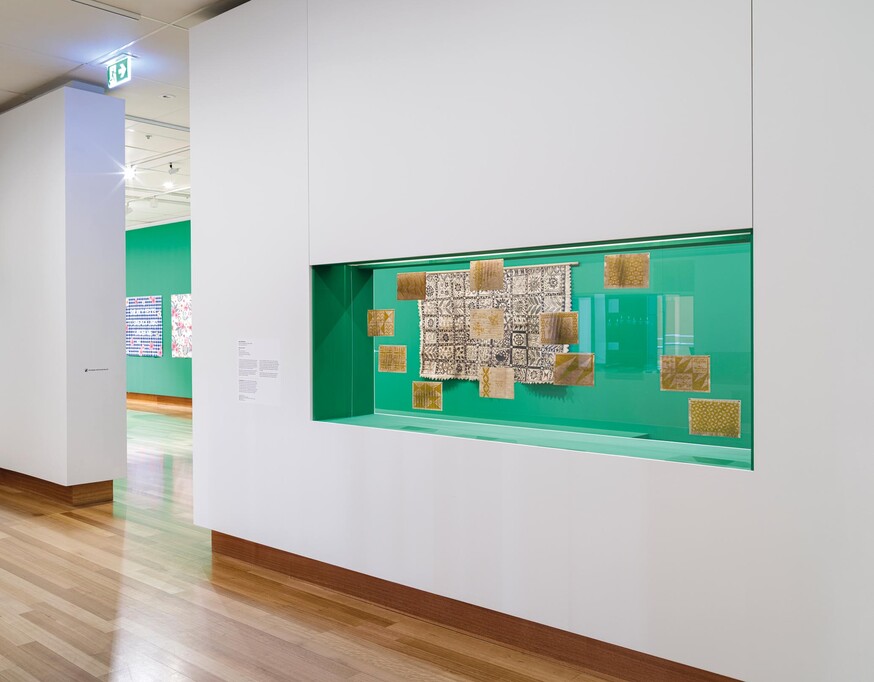
Installation view of Made in the Pacific: A Collection of Tāoga at Christchurch Art Gallery Te Puna o Waiwhetū, 2026, including objects on loan from Canterbury Museum and works by Serene Hodgman (right)
SO: Standing in the Gallery and taking it all in, my initial reaction was a sense of being positioned between two worlds – a liminal space. The temporal divide was accentuated by obvious visual differences, which created a tension not easily resolved. Even using the terms historical and contemporary felt divisive.
The historical works command attention through skilful customary handling, materiality and fabrication, while their contemporary counterparts use a variety of modern mediums, leaning into the conceptual weight of their practice.
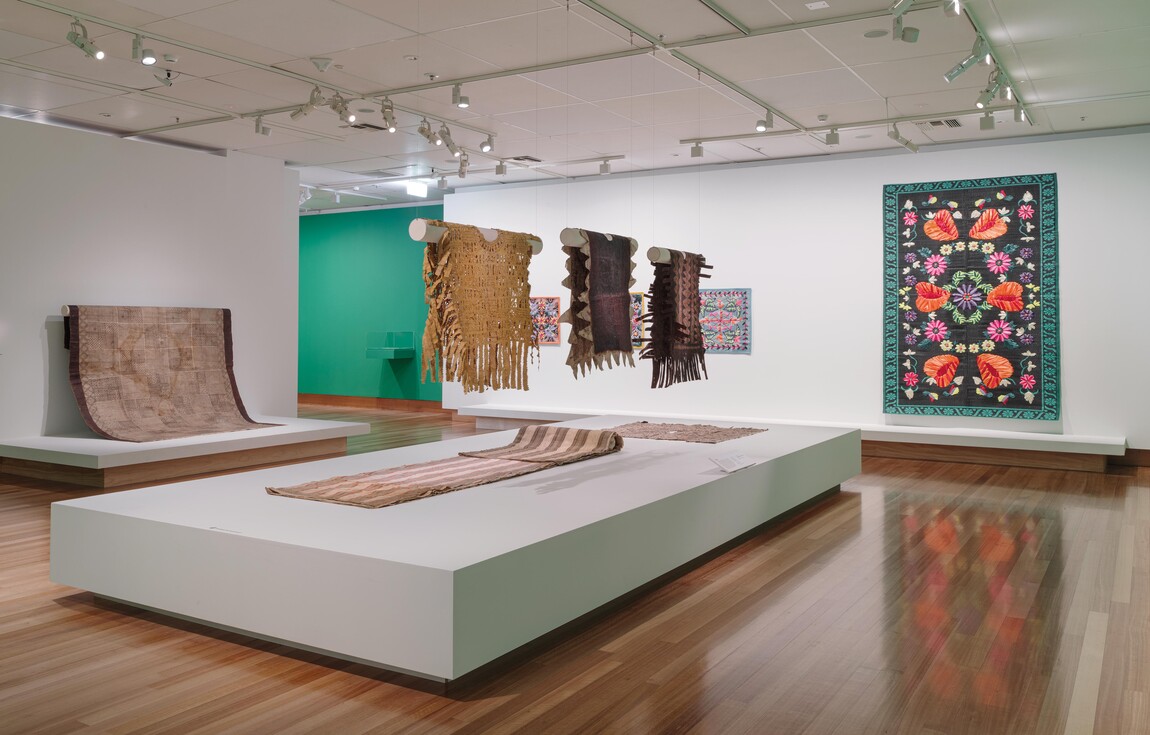
The barkcloths are sublime. This is their Cinderella moment; freed from the backrooms of the museum, con-served, carefully lit and dressed for public presentation, their aged surfaces and patina afford them a commanding presence.
In the centre of the larger hall, I spied three tīputa, (one from the Cook Islands) elevated as though on a stage. These garments hang as empty dresses, slipping between ethnographic specimens and fine-art tropes. Their bodies are absent, but restoration, isolation and subdued lighting amplify their mana and call their ancestral connections symbolically to life.
Against this mastery, the contemporary works initially seem restless. Their materials, politics and individual voices resist the visual coherence offered by customary barkcloth. My eye searches for resemblance, for repeated motifs, material thread capable of closing the gap between them. An instinct, perhaps, but one this exhibition makes difficult to sustain.
KS: One issue is positioning traditional tāoga within the context of an art gallery. There are many who do not think of functional items (objects of adornment) or tools (beaters, stencils) as art, so exhibiting art and artifact together can be problematic. Those problems can soon be erased if context is given. However, the fact that the curatorial statement includes the term ‘craft’ does not help recognise this artistry. I feel it’s a matter of semantics. If we continue to call barkcloth a craft then we will not embrace its artistry. We also need to be given context. We need to learn the importance of these works – their value to their creators 200 years ago and their value to Pacific peoples today.
It is also complex to demonstrate cultural continuity. Cora-Allan asserts that the contemporary works in the exhibition are “in conversation” with the historical treasures on display. This suggests the passing of knowledge generation to generation, and at the same time demonstrates the innovation that accompanies these traditions.
What is missing in this exhibition, for me, is a real sense of both this artistic tradition and its importance to these cultures. First and foremost, although men assisted in the planting and harvesting of the paper mulberry and the creation of the upeti boards, it is an artform controlled by, and made by, women.
Because this cloth was particularly labour intensive it became the economic foundation of Pacific societies. No trade or gift could be enacted without the inclusion of bark-cloth. Additionally, status was signalled by the wearing and distribution of barkcloth. It wove together the social, cultural and political aspects of Polynesian society. Cloth created for chiefs to wear and distribute was of a much finer quality and beautifully designed. Due to its essential role in these cultures, knowledge about its production was passed down through the generations.
SO: In the exhibition, we are well informed about the making of barkcloth, but not quite what it made possible. That dis-tinction is significant. To focus on production without fully articulating barkcloth’s economic, political, social and spiritual authority risks leaving these works suspended either as colonial spoils or as exquisite technical achievements. Their aesthetic appeal is undeniable, but this does not convey their immense cultural currency, the volume of their production and the perpetual sound of beaters pounding, that shaped the daily lives of their makers.
The labour of women produced wealth, settled obligations and materialised relationships. Barkcloth moved between bodies, families and communities. It marked status and mediated between the sacred and everyday. Its surfaces existed within systems of knowledge that extended far beyond what might now be passively described as pattern or decoration.
Placed in the Gallery, however, the historical works arrive carrying another kind of value; age, rarity, conservation and institutional care accumulate around them. Their anonymous makers recede while these tāoga assume the aura of ancestral mastery.
KS: Today, Sāmoa, Tonga and Fiji continue their barkcloth traditions. Most often the cloth we find in the diaspora comes from these island groups. However, in this group of artists, some are learning how to produce and create with paper mulberry. Doron Riki-Semu, Sue Pearson and Pauline Reynolds all create works with political undertones, so one could take a leap that the traditional socio-political aspects of barkcloth are still apparent today.
The importance of cloth is addressed by the video created by Sue and Pauline. Hina’s Granddaughters presents a genealogy of barkcloth, using the voice of Hina, the goddess of the moon and barkcloth. Here we find the relationship between lunar cycles and the times in which one plants and harvests paper mulberry, and when one creates. It visually explains the gathering of materials, the making of cloth, and the knowledge that passes generationally from one of her granddaughters to the next. This video explains the connection and legacy of barkcloth to an ancestral past. I was also intrigued by Sue’s print. Chatting with her I identified it as the “not political one”. She then explained its background – Norfolk pines representing each individual that voted to reinstate the sovereign government that Australia had recently taken away. This work bridged the gap between the past and the present. Sue used a traditional art practice to make a contemporary political statement.
SO: In a room off the main space, Hina’s Granddaughters unlocks this exhibition. It is a collaborative, intergenerational work in which modern and ancient technologies combine: sound reverberates and images flick onto raw barkcloth. A poetic oral history carries us into the intimate realm of inheritance, love and matrilineal stewardship.
Through Hina, we discover the origins of barkcloth, how knowledge is carried through successive generations of women, from the sacred realm of the Atua into the physical world. Here, time refuses a binary construction of past and present. It is genealogical – in the blood. Knowledge travels, is inherited, adapted and carried forward.
Pauline’s expertise in barkcloth fabrication enables her to decode history as evidence of migration and survival. Her ability to duplicate the material practices of her foremothers is an active protest against narratives of cultural loss. Her tīputa installation tracks history genealogically and stands in fierce resistance. Material becomes archive.
These works shift the terms of looking. Sue’s printed barkcloth and conscious revivalism complement this process, expanding the visual lexicon of the exhibition. If contemporary pattern can encode sovereignty, resistance and histories of displacement, what assumptions do we bring to the historical cloth? Its visual language can no longer be presumed benign, simply because we have lost, or were never taught, the ability to read it.
Perhaps reading it as decoration is simply a failure of literacy on the part of the viewer.
KS: Going back and looking again, my focus shifted. I was less interested in what was on display than what wasn’t there. Why wasn’t there a Sāmoan or Tongan barkcloth? My second and third look raised a number of questions. Were the tools supposed to represent that island’s practice and the process of making barkcloth? Also, it is suggest-ed that these works sit in conversation with one another, so what are the relationships between the past and the present?
I found it hard to see a relationship amongst the artists in this exhibition. They do not all work with barkcloth. But what does seem to be a link is the idea of community, of working together, of knowledge sharing and the passing of knowledge (perhaps generationally). Do these contemporary works demonstrate a genealogy of barkcloth and women’s art practices?
SO: Moving further away from the materiality of bark-cloth, the relationships become more oblique. Within the diaspora and in this exhibition cultural and artistic lineage is genealogically anchored and dynamic. Meaning slides and reshapes itself across migratory pathways.
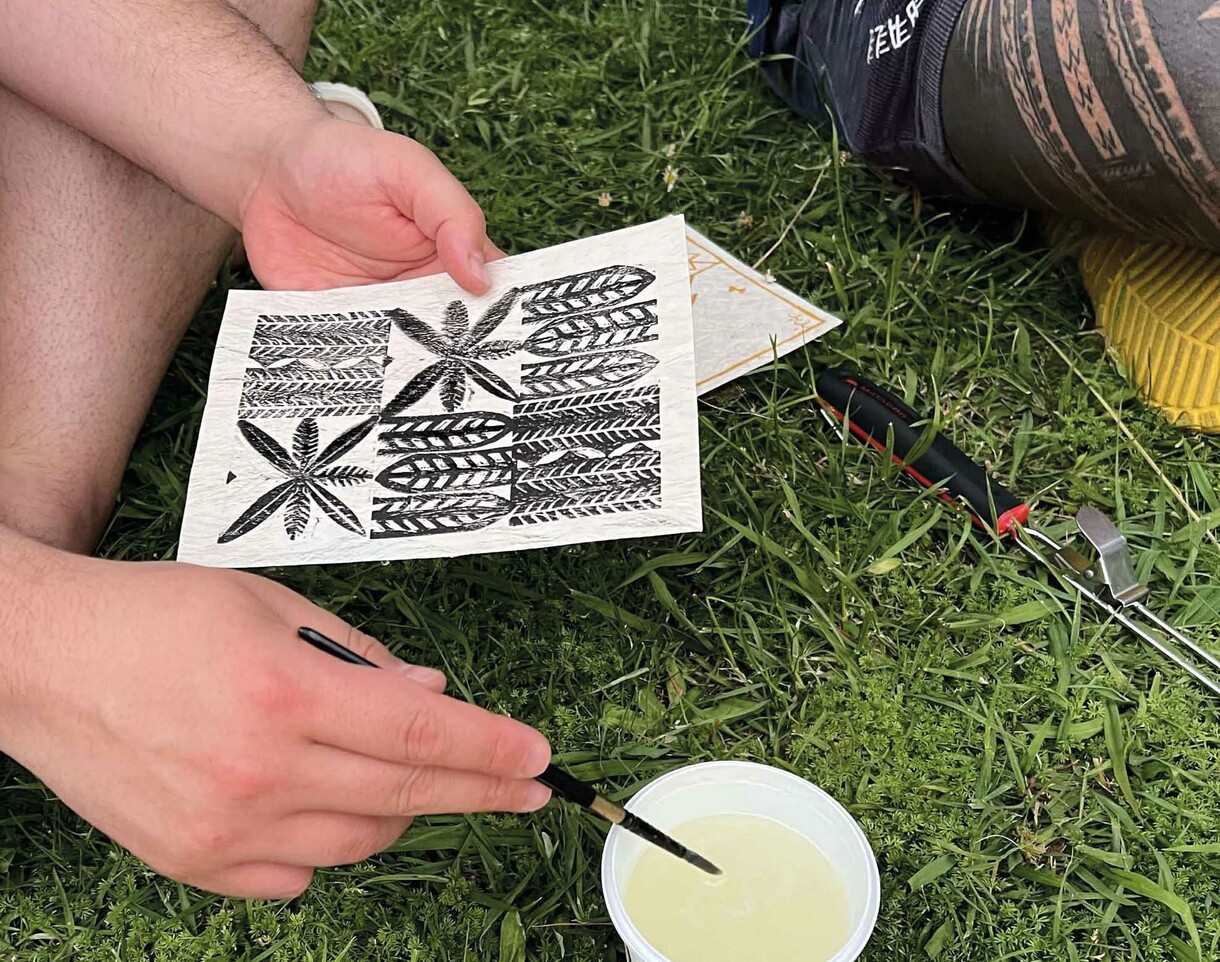
Jimmy Ma’ia’i’s modern kwila upeti board and print become territorial markers, fusing the artist’s ecological concerns with the tensions of urban living, one defined by a Scottish/Sāmoan heritage and a flux of imported influences.
Doron Riki-Semu’s practice pivots the gendered exclusivity of barkcloth protocols. Venting resistance to family, cultural and social taboos, they anchor a safe haven for queer voices and talanoa. Behind museum glass, both artists reveal the shifting concerns and complexities of their lived experience are the history making moments of tomorrow.
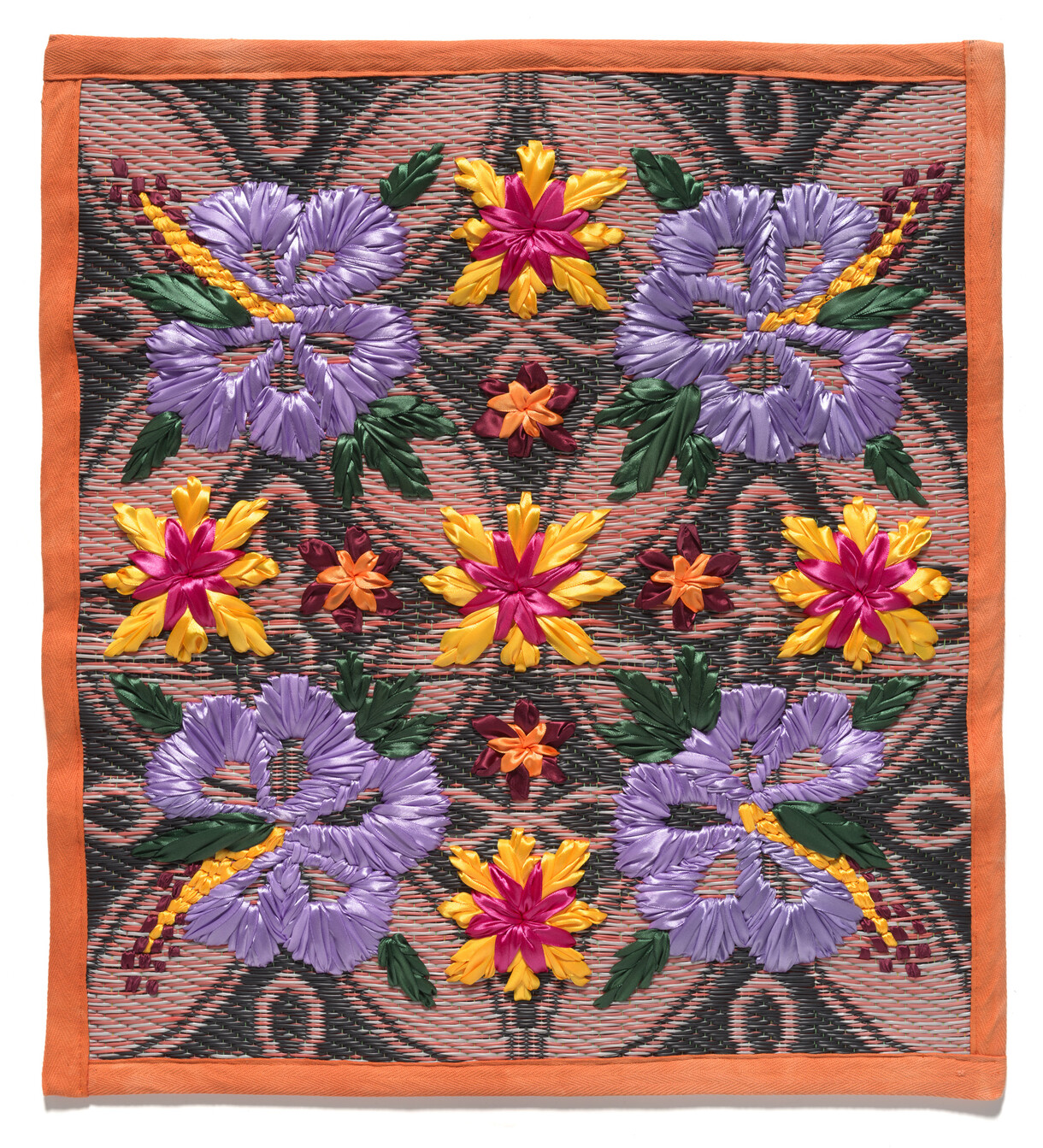
Serene Hodgman’s manufactured mats and commercial fibres are colourful and today are visually identifiable as Pacific. Her tivaevae-style textiles draw on the fibre traditions of Pacific women while responding pragmatically to the demands of family and urban life. Adaptation here is neither cultural failure nor a lesser form of authenticity. It belongs to a much longer history of Pacific makers responding to available materials and changing economies. She states “maybe the moments where we think we are doing the least actually add up to making the best of what little we think we have”.
Louisa Afoa returns us to the domestic and to the unstable boundary between the sacred and the profane. One of barkcloth’s customary functions was as a protective barrier between tapu and noa, protecting the boundaries between the sacred and the everyday. In Essential House-hold Items, Louisa’s camera relocates this negotiation within the contemporary Pacific home.
Crinkled tea towels and ordinary household objects carry an invisible value accumulated through use, memory and familiarity. Her images capture the tactile aspect of cloth without attempting to reproduce it. Her tablecloth works, patterned by colourful grids and typography, map the kitchen table as a site of exchange and reciprocity; a barrier between worlds that must be mediated.
The domestic is not simply mundane. It is where power is negotiated, knowledge exchanged and memory rehearsed. Afoa allows the profound and ordinary to occupy the same surface. The kitchen table is her village centre.
These connections to barkcloth are conceptual rather than material. Both operate between worlds, giving form to relationships and cultural architectures that are otherwise difficult to see.
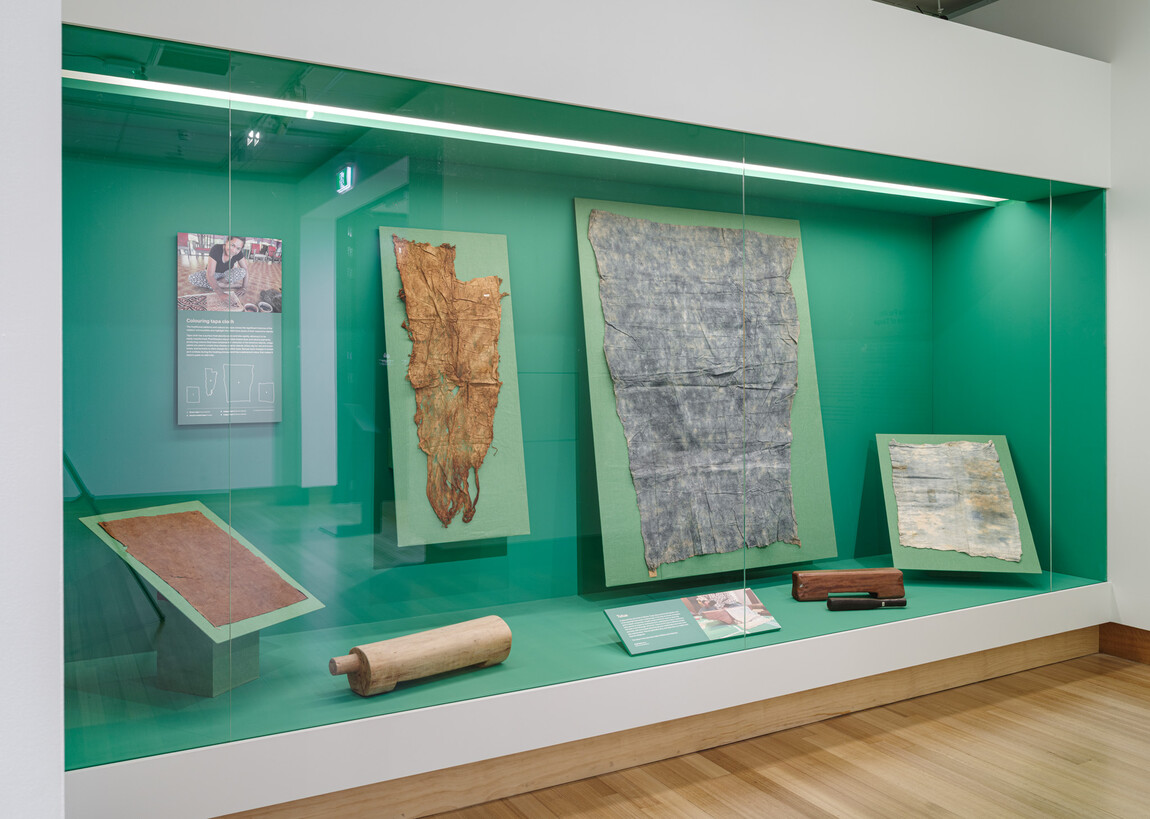
Installation view of Made in the Pacific: A Collection of Tāoga at Christchurch Art Gallery Te Puna o Waiwhetū, 2026, including objects on loan from Canterbury Museum
KS: The connections were vague, the conversations were whispers. However, they were tools, tāoga and art, placed side by side. In addition to all of these questions, I was quite intrigued that the Museum/Gallery binary was turned on its head for this exhibition. The didactic information for the tāoga resembled typical Gallery labels including a title, location and current ownership. However, the contemporary labels gave the viewer information about the artist, their practice, where they live, their occupation and a brief description about the works themselves.
Was this necessary for the visitor to make the leap between art and tāoga? The barkcloth sits in this gallery space so comfortably it begs the question, do these contemporary works hold up against the artistry of the past?
SO: Perhaps the problem is the measure itself. To ask if con-temporary works hold up against the artistry of the past is to acknowledge how unevenly value has already been dis-tributed. The historical barkcloth arrives authenticated by time. Its anonymous makers are protected by the aura of ancestral mastery, while living artists arrive with names, biographies and the expectation that they make their cultural relationship to the past legible. Perhaps this is why I initially found myself caught in the space between.
Looking again, the contemporary works begin to alter the view. Sue Pearson and Pauline Reynolds reveal the capacity of material and pattern to archive history, politics, migration and genealogy. Jimmy Ma’ia’i maps ecological concerns and an inherited visual language onto urban territory. Doron Riki-Semu tests the social and cultural boundaries of customary practice. Serene Hodgman locates continuity in adaptation. Louisa Afoa finds the sacred and the profane negotiating space in the everyday.
The relationships are not always visual. Nor are they necessarily linear.
Rather than requiring the ancestral tāoga to authenticate them, the contemporary works inspire a temporal collapse. They ask us to reconsider what might be politically, spiritually and genealogically encoded in objects too easily admired for their surface artistry. Made in the Pacific leaves the distance between past and present, art and artefact, island and urban exposed. The connections require work. Meaning slips, folds back and sometimes changes according to where we stand.
For at least the life of this exhibition, ancient tools and barkcloth breathe alongside those who continue to negotiate their creative agency. Their contemporary counterparts do not stand in succession waiting to be measured against them. They move around them, away from them and, at times, back through them.
Perhaps they are not separated by the space between at all.
Perhaps that is simply where I was standing.
Related
Exhibition
Made in the Pacific
28 March – 11 October 2026
A selection of Pacific tāoga from the Canterbury Museum in conversation with contemporary artworks that highlight the continued strength in culture and traditional art forms.
Commentary
Awhitu Wānanga
Made in the Pacific: A Collection of Tāoga celebrates Pacific tāoga, bringing together examples made by moana ancestors with new work by their distant mokopuna.
The museum treasures in this exhibition are by makers who gained their knowledge from elders and specialists in their communities. Their work contains precious cultural histories within both the materials and visual language.