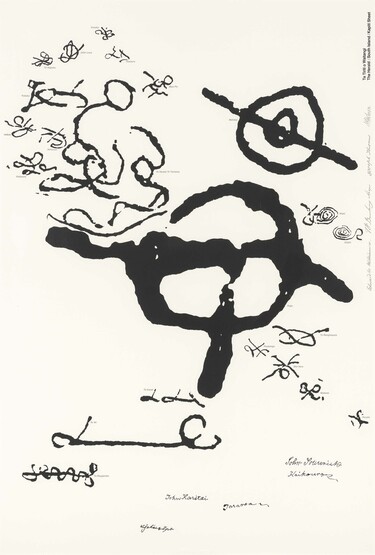
Max Hailstone Te Tiriti o Waitangi: The Herald, South Island/Kapiti Sheet 1990. Silkscreen. Collection of Christchurch Art Gallery Te Puna o Waiwhetū, purchased 1991
Max Hailstone: Te Tiriti o Waitangi: The Herald, South Island/Kapiti Sheet
I have a complicated love/hate relationship with Max Hailstone’s ‘Treaty Posters’. I was a student of Max’s very shortly after he completed this suite of screenprints in 1990 for the 150th anniversary of the signing of te Tiriti o Waitangi. I remember seeing the prints lurking around the design studios but also knew that our art history lecturer Jonathan Mane-Wheoki (Ngāpuhi ki Hokianga, Te Aupouri, Ngāti Kuri) had stepped in at the last minute and organised a tapu-lifting ceremony at the Ilam School of Fine Arts to alleviate some of the controversy around the project.
Max had not consulted Māori at any point and had, to some extent, trivialised the signatures from the Treaty by deploying them as purely formal devices – scaling them up and/or down at random and organising them on the sheet to form compositions ‘pleasing to the eye’. Max’s work here is in line with a mid-century European modernist tradition where Indigenous art was often fetishised and superficially appropriated. But as a student of his in the 1990s, it was clear Max was a bit ‘out of date’, and this project somewhat illustrates that.
Max was born in England in the middle of World War II. He grew up and trained as a graphic designer in this specific context – one in which design had a very real role to play in the reimagining of post-war life. The course Max later ran at Ilam implicitly suggested that design was, first and foremost, for and about culture and society. This was quite unusual by the 1990s, because by then design was widely understood as primarily a tool for business and commerce.
And so, my memories of Max cut both ways. On one hand, these Treaty prints are embarrassing and offensive. But on another they are a highly unusual example (in Aotearoa at the time) of a graphic designer engaging in an autonomous practice with culture and politics at its heart. And despite the obvious failure of this particular gesture, Max showed us that designers could potentially operate outside of the purely mercenary world of late twentieth-century capitalism.