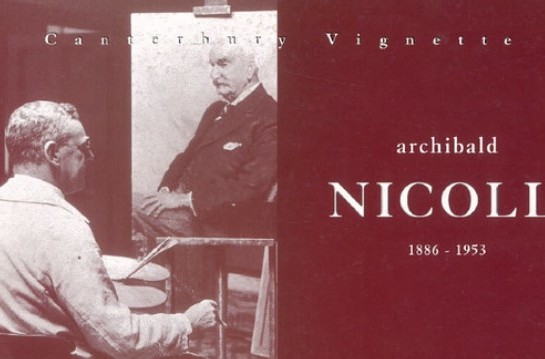
Archibald Nicoll
Aotearoa New Zealand, b.1886, d.1953
Twilight Auckland Waterfront
- 1909
- Oil on canvas board
- Purchased, 1984
- 235 x 315mm
- 84/34
- View on google maps
Location: Ravenscar Gallery
Tags: boathouses, boats, buildings (structures), clouds, Impressionist (style), landscapes (representations), purple (color), reflections (perceived properties), sails (equipment), seas
Painted shortly before he left Aotearoa New Zealand to further his art studies in Britain, Archibald Nicoll’s dramatic painting explores the changing light as the sun sets on Tamaki Makaurau Auckland’s Waitematā Harbour, and highlights his interest in plein air painting. Nicoll’s progressive attitude to painting endeared him to his students at Elam School of Fine Arts but the director of the School, E. W. Payton sounded the concern to the school’s board that “while his own work is very good, his strong mannerisms make him rather dangerous as a teacher of young students”. Nicoll signed up with the New Zealand Expeditionary Force shortly after World War I broke out and was severely wounded during the Battle of the Somme in 1916. In 1920 he was appointed director of the Canterbury College School of Art in Ōtautahi Christchurch and established a successful career as a painter.
(Timeless: Treasures from the Historical Collection 19 September 2026 – 30 May 2027)
This painting depicts Railway Wharf, Auckland.
Exhibition History
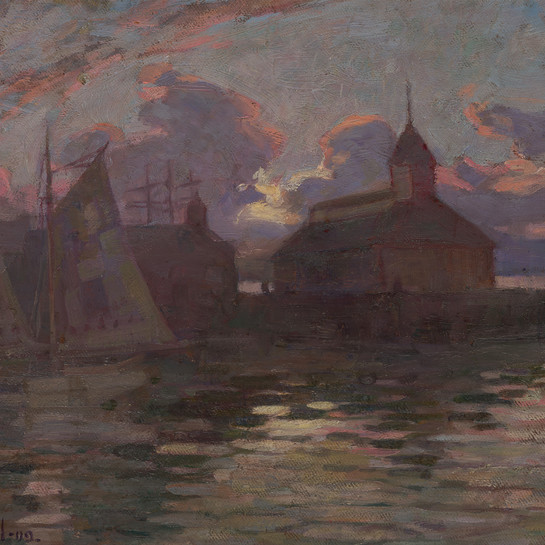
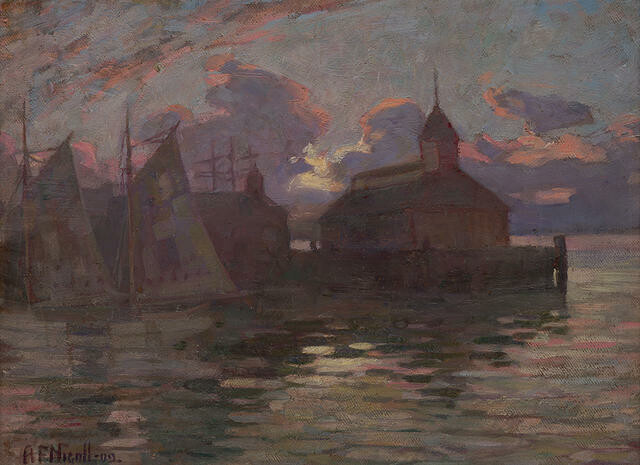
Archibold Nicoll was a progressive young artist when he completed Twilight, Auckland Waterfront in 1909. Small in scale, yet full of energy and verve, it highlights his interest in the immediacy of plein-air painting. He captures the dramatic lighting of a twilight evening with the spontaneity that occurs when painting outdoors directly before the subject. By 1909 the young artist had secured a teaching position at Elam School of Fine Arts in Auckland, where he proved popular with students but not with the director of the school, E.W. Payton, who reported to the board that ‘while his own work is very good, his strong mannerisms make him rather dangerous as a teacher of young students’. Nicoll resigned in 1910 with enough money saved to enable him to travel to Britain where he was able to live and work as an artist.
(March 2018)