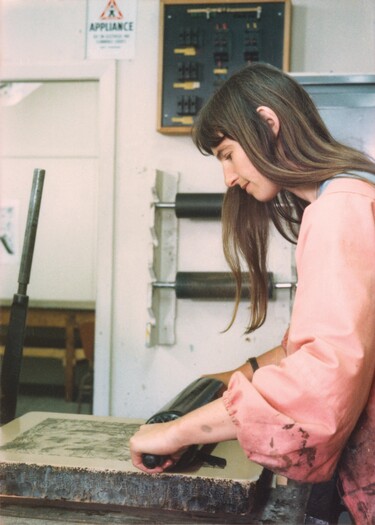
Jule Einhorn rolling ink onto a lithographic stone, Gingko Print Workshop, Christchurch Arts Centre, c. 1981. Gingko Print Workshop and Gallery Archives, Robert and Barbara Stewart Library and Archives, Christchurch Art Gallery Te Puna o Waiwhetū
Stone, Water, Ink and Paper
The Gingko Print Workshop Gift
In 2024, the Gallery received a remarkable archive relating to the Gingko Print Workshop and Gallery including lithographs, etchings, workbooks, papers, photographs, posters and much more. The gift was made by Jule Einhorn, a master printer who, seeing a need for an accessible specialist print studio in Ōtautahi Christchurch, started the Gingko Print Workshop and Gallery at the Arts Centre.
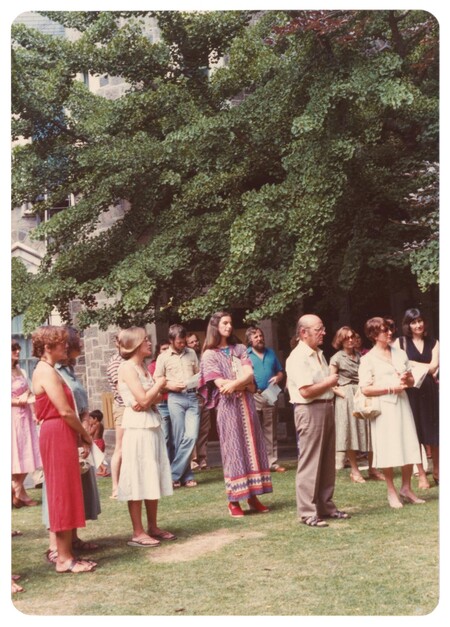
Jule Einhorn (centre) at the opening of the Gingko Print Workshop and Gallery under the gingko tree, Christchurch Arts Centre, 20 December 1980. Gingko Print Workshop and Gallery Archives, Robert and Barbara Stewart Library and Archives, Christchurch Art Gallery Te Puna o Waiwhetū
Established in December 1980, Gingko was one of the earliest print workshops in Aotearoa New Zealand and its aim was to lift the standard of printmaking in this country. This was to be achieved by providing a place where printmakers could work seriously in a well-appointed workshop rather than “potter around”. 1 The workshop also provided a stock of high-quality paper, ink, tools and printing presses, and importantly there was a trained printmaker on hand for advice. Many established artists saw value in the venture with the opening exhibition featuring works by Vivienne Lynn, Robin White, John Drawbridge, Tiffany Thornley, Ralph Hotere, Pat Hanly, Barry Cleavin and Don Peebles among many others who all donated works to raise funds for the venture. Einhorn was the driving force behind the workshop, a non-profit venture which ran on the smell of a turps-soaked rag.
Einhorn’s interest in printmaking began in Te Whanganui-a-Tara Wellington when, as a budding design student in the mid-1960s, designer Jeff Nees encouraged her to attend the industrial and graphic design courses at the Wellington Polytechnic. There she was taught printmaking by John Drawbridge and Kate Coolahan. In 1966 Einhorn was living in New York where she took printmaking classes at the Art Students League under the American / Mexican artist Michael Ponce de Leon. There, Einhorn says, she “…absolutely fell in love with [lithography] because it’s so full of mystery [and] a beautiful, beautiful process.”2 The League workshop allowed students and artists to use the facilities as they required and pay as they go, and it was this operating model that Einhorn later used when establishing the Gingko Workshop back in Ōtautahi.
By 1974 Einhorn had returned to Aotearoa and she began studying printmaking under the elderly Jack Knight at the Ilam School of Fine Arts in Christchurch. Among her contemporaries was fellow printmaker Denise Copland. In her honours year, Einhorn concentrated on lithography, under newly appointed printing lecturer Barry Cleavin. This included researching and experimenting with printing lithographs from cast concrete blocks, which, like the fabled lithography stones of Bavaria, were basically blocks of calcium carbonate.
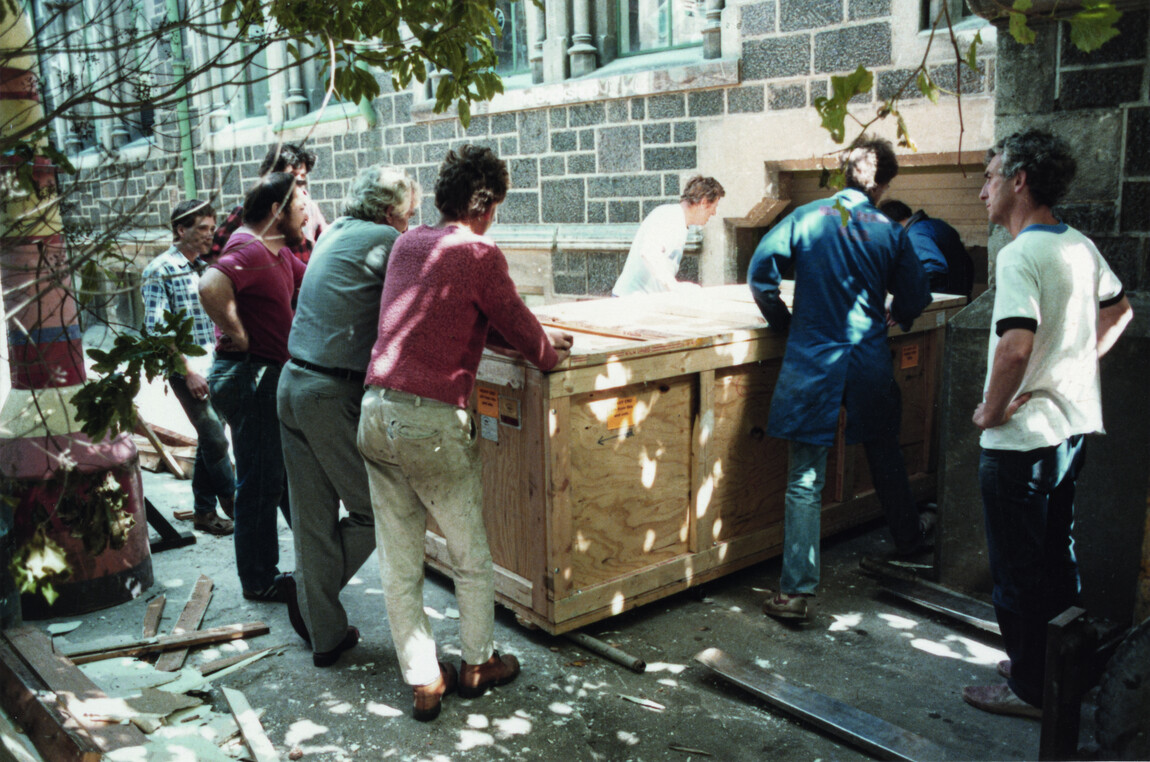
A team of helpers shifting the new lithograph press into the basement of the Gingko Print Workshop, Christchurch Arts Centre, c. 1984. Gingko Print Workshop and Gallery Archives, Robert and Barbara Stewart Library and Archives, Christchurch Art Gallery Te Puna o Waiwhetū
In April 1980, the wheels were set in motion to establish the Gingko Print Workshop. The name chosen refers to the giant gingko tree that sits in the quadrangle outside the old University of Canterbury physics building where the workshop was located. Funding came from the QEII Arts Council and the Arts Centre Trust. Two etching presses and a Victorian era lithographic press were installed in the basement of the building, while on the floor above a gallery space was established to help offset costs. Artists could hire the workshop space at $1 an hour, or $5 for the full day, to print their own editions of etchings and relief prints. However, the lithography side of the workshop was slower to establish.
This all changed in 1984 after Einhorn spent time at one of the world’s most highly regarded lithographic workshops, the Tamarind Institute at the University of New Mexico in the USA. It was an intense eight-week course, and it enabled her to build on her knowledge of lithography and develop her skills under the respected lithographer Lynne Allen.
On her return to Ōtautahi, Einhorn successfully applied for funding from the QE II Arts Council to purchase a state-of-the-art (and very expensive) lithographic press from the company in Alburquerque who designed and built presses for the Tamarind Institute, which was delivered to the Arts Centre and with some difficulty lowered into the depths of the refurbished Gingko Workshop. Einhorn’s aim was to “nurture interest with the artists who have not before experienced this very exciting medium…” and establish “standards of quality, both technical and creative, in contemporary New Zealand print.” The new workshop was “…organised so that the artist (who may be a painter, sculptor or indeed a printmaker) can work in collaboration with the professional printer to make lithography editions.”3
Einhorn says:
The relationship of the professional printer with an artist involves a delicate dance. The artist is often not a printmaker and not familiar with the technicalities of the process. The printer must assist the artist to develop empathy for lithography and what it can offer them as the creative medium. It was an enormous privilege to collaborate with the artists and enjoy their pleasure in achieving new work in another medium.
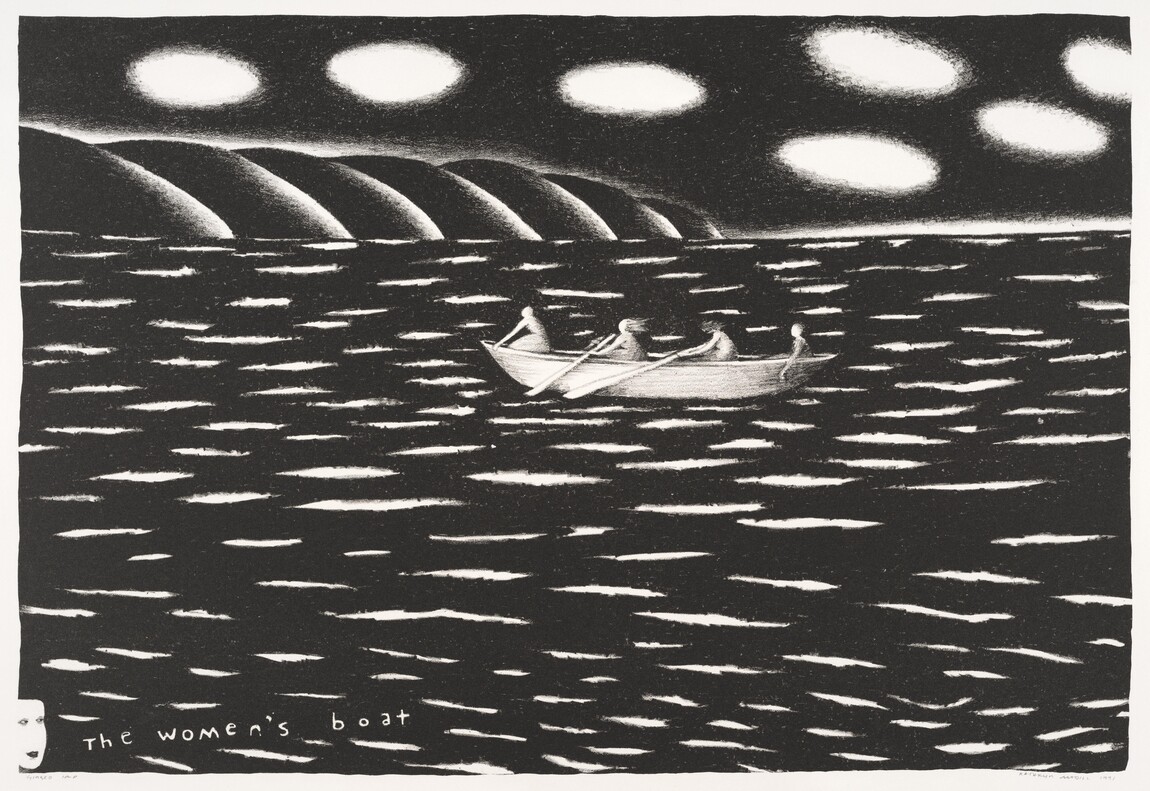
Kathryn Madill The Women’s Boat 1991. Lithograph. Collection of Christchurch Art Gallery Te Puna o Waiwhetū, gift of Jule Einhorn, 2024Stone,
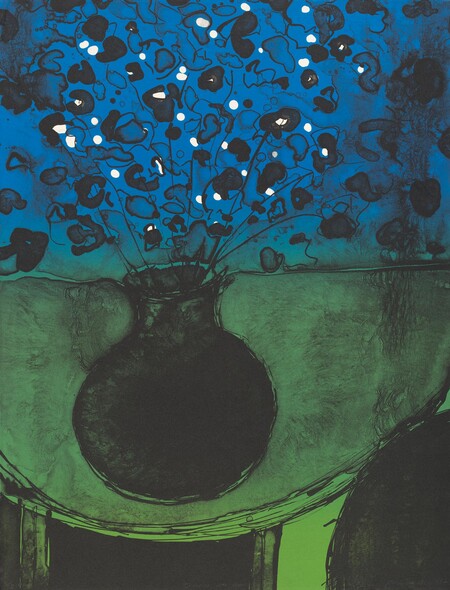
Jule Einhorn Interior with Vase 1984. Lithograph. Collection of Christchurch Art Gallery Te Puna o Waiwhetū, gift of Jule Einhorn, 2024
Above the print workshop, the Gingko Gallery specialised in works on paper and had a lively exhibition programme. Established artists from Ōtautahi and further afield, including Marilynn Webb, Ralph Hotere, Rodney Fumpston, Claudia Pond Eyley, Philippa Blair, Bing Dawe and Nigel Brown, all exhibited there. It also provided an important venue for emerging artists. Regular exhibitions of recent Ilam printmaking graduates were held and for many younger artists, such as local printmakers Jason Greig, Peter Ransom, Kate Unger (née McLean) and Sandra Thomson, it provided a welcome opportunity to hold solo exhibitions early in their careers.
Sadly, in May 1990 the tight financial climate faced by the Arts Centre Trust Board meant that they were unable to continue subsidising the Gingko Workshop and Gallery. Letters in the Gingko archive from artists throughout New Zealand lamented its closure and attest to the positive effects it had on printmaking in Aotearoa. At the time of its closure a newspaper article reported that Gingko had achieved what it had set out to do and nurtured an interest and awareness of original prints among the general public.4 The Gallery was closed but Einhorn continued to operate the press, completing several editions of her own lithographs as well as works by Kathryn Madill. The final Gingko Print Workshop lithographs printed were Bill Hammond’s extraordinary Eating, Smoking, Drinking series in 1992.
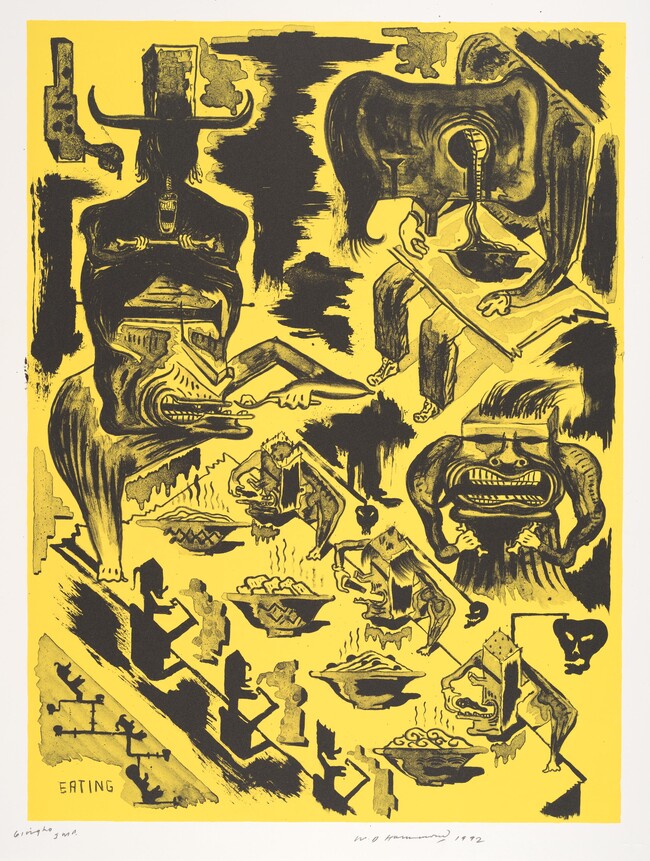
Bill Hammond Eating, Smoking, Drinking 1992. Lithograph. Collection of Christchurch Art Gallery Te Puna o Waiwhetū, gift of Jule Einhorn, 2024
A full set of lithographs printed at Gingko Workshop were included in Einhorn’s recent gift to Christchurch Art Gallery, which features examples by Madill, Greig, Hammond, Michael Reed, Riduan Tomkins, Barry Cleavin and Einhorn herself. Alongside this are some really excellent handprinted posters for various exhibitions held at the gallery. Aotearoa has a proud tradition of print workshops, particularly from the 1980s when several were operating throughout the country. These included Auckland’s Atelier Studio and Muka Studio, The Wellington Media Collective as well as The Limeworks / Papergraphica and El Knoko in Christchurch. The Gingko Workshop and Gallery was an important part of this printing fraternity and we are delighted to house its records and artworks for future generations to enjoy. A selection of Gingko Print Workshop archives will go on display alongside a forthcoming survey of Aotearoa New Zealand printmaking from 1950 to 2000 in late 2027.
Note for printing press spotters: Einhorn deposited the Gingko’s awesome American-built lithographic press in trust to the Ilam Art School where it sits quietly in the beautifully appointed print studio patiently waiting for the next master lithographic printmaker to come along and make some beauty.