Kā Kaupapa o te Wā
What’s On
Made in the Pacific: A Collection of Tāoga
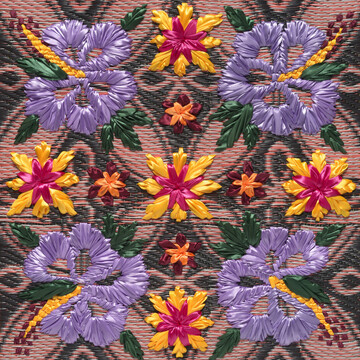
A selection of Pacific tāoga from the Canterbury Museum in conversation with contemporary artworks that highlight the continued strength in culture and traditional art forms.
Mark Adams: A Survey | He Kohinga Whakaahua
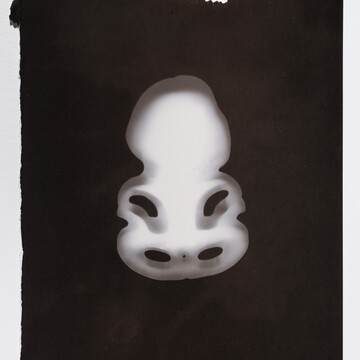
A comprehensive survey spanning the artist's career.
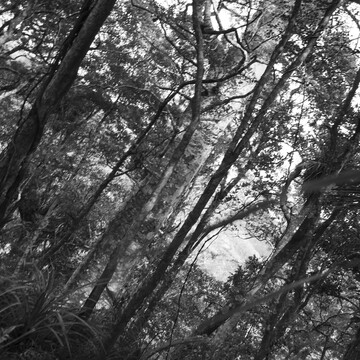
Ana Iti: Ngahere Behind a Pile of Metal
An immersive installation considering the legacies of deforestation and significance of kauri trees.
E tuwhera ana te wharetoi i kā rā e 7 o te wiki, 10am - 5pm
Ka tuwhera ki te 9pm i kā pō Wenerei
Open 7 days, 10am - 5pm
Late night Wednesday until 9pm
Uruka utukore, ahokore utukore
Free entry, free wifi
Bulletin of the National Art Association of New Zealand
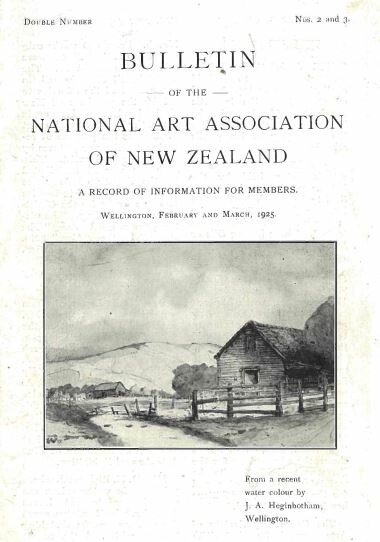
Bulletin of the NAANZ, issues 2 and 3, February and March 1925
Bulletin of the National Art Association of New Zealand
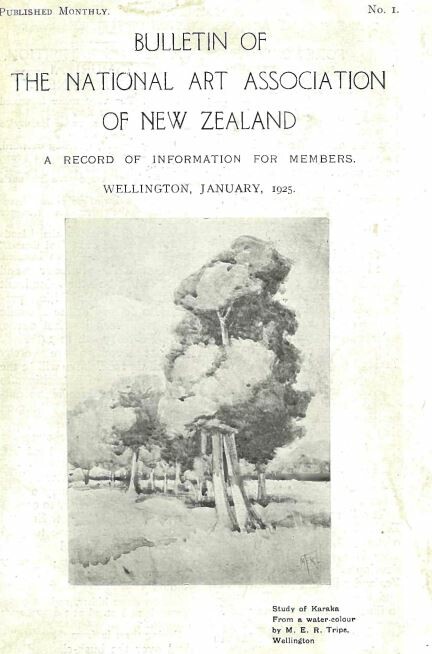
Bulletin of the NAANZ, issue 1, January 1925
Collection
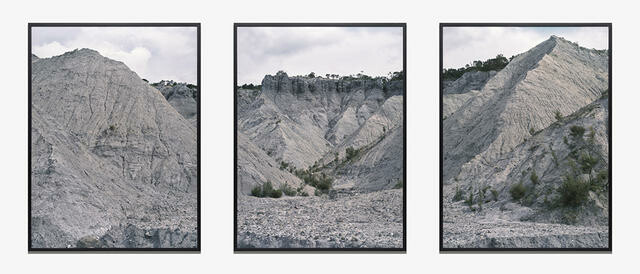
Natalie Robertson The Blue Slip (Barton's Gully), from Mangarara Stream
Natalie Robertson creates photographs and moving images that explore mātauranga Māori through a whakapapa lens. This triptych traces the ongoing loss of land through erosion caused by years of introduced forestry around Mangarara (Barton’s Gully), the upper catchment of the Waiapu River in Te Tairāwhiti Gisborne; it’s a region she has whakapapa links to and has visited regularly throughout her life. Parawhenuamea, the atua of alluvial waters, is a maker of land, carrying sediment loads to the ocean. However, colonial, industrial and economic drivers have intensified the changes to land and ocean in this area and led to extreme coastal erosion – a situation an Indigenous approach to environmental custodianship could have mitigated.
mātauranga Māori ~ Māori knowledge
whakapapa ~ genealogy, lineage, ancestry
atua ~ ancestor with continuing influence, god, deity
He Kapuka Oneone – A Handful of Soil (from August 2024)
Collection
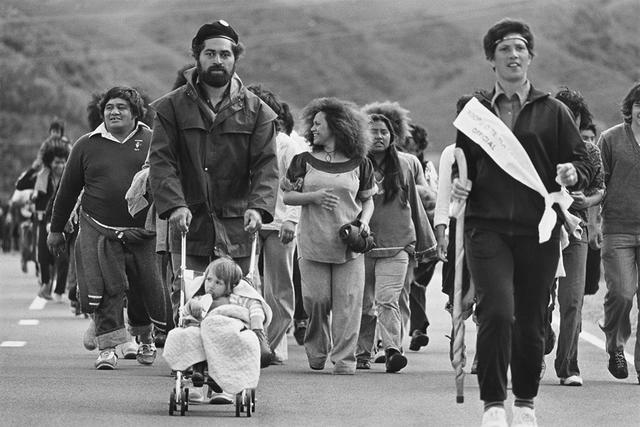
John Miller 1975 Māori Land March, Dave Ruru wheels his daughter Tania along the Wellington motorway south of Porirua, Monday, 13th October, 1975
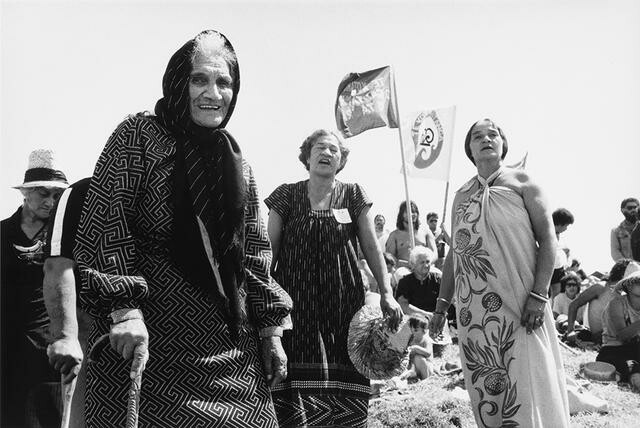
For more than fifty years, photographer John Miller has documented protests and important cultural events across Aotearoa New Zealand. His photographs of protests about issues affecting Māori are iconic, including two hīkoi, thirty years apart, that saw thousands march to Parliament.
On 14 September 1975, fifty marchers left Te Hāpua in Te Tai Tokerau Northland led by 79-year-old Dame Whina Cooper (Te Rarawa, 1895–1994) and Te Roopu Matakite o Aotearoa. The protestors walked the length of Te Ika-a-Māui North Island, staying at marae along the way, and arrived at Parliament in Te Whanganui-a-Tara Wellington on 13 October. Their contingent has grown to 5,000 with a petition of 60,000 signatures. The hīkoi combined the leadership and experience of kaumātua with the radical activism of Ngā Tamatoa to bring Māori issues of land and cultural loss to public attention. The slogan remains galvanising: Not one more acre of Māori land.
hīkoi ~ march, walk
Te Roopu Matakite o Aotearoa ~ a Māori activist group concerned with historic losses of Māori land and retaining control of existing land; the name translates as those with foresight
marae ~ communal meeting places belonging to an iwi, hapū (sub-tribe) or whānau (family) on which the wharenui stands
kaumātua ~ elders, people of status
Ngā Tamatoa ~ a Māori activist group; the name translates as the young warriors
He Kapuka Oneone – A Handful of Soil (from August 2024)
Collection
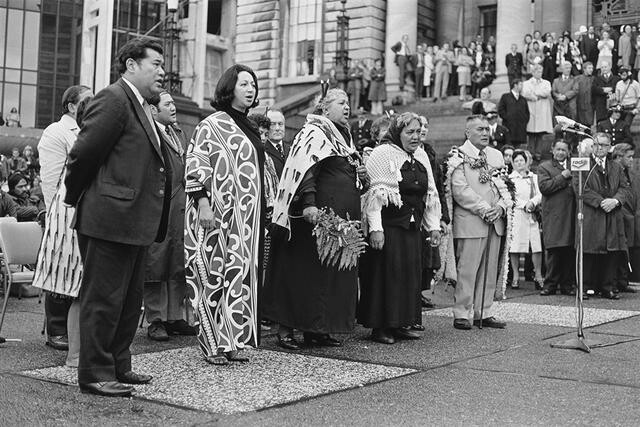
John Miller 1975 Māori Land March, Parliamentary welcome. Left to right: Matiu Rata, Whetū Tirikātene-Sullivan, Hārata Ria Te Uira Solomon, Sally Marshall, Tarawara Kātene.
For more than fifty years, photographer John Miller has documented protests and important cultural events across Aotearoa New Zealand. His photographs of protests about issues affecting Māori are iconic, including two hīkoi, thirty years apart, that saw thousands march to Parliament. On 14 September 1975, fifty marchers left Te Hāpua in Te Tai Tokerau Northland led by 79-year-old Dame Whina Cooper (Te Rarawa, 1895–1994) and Te Roopu Matakite o Aotearoa. The protestors walked the length of Te Ika-a-Māui North Island, staying at marae along the way, and arrived at Parliament in Te Whanganui-a-Tara Wellington on 13 October. Their contingent has grown to 5,000 with a petition of 60,000 signatures. The hīkoi combined the leadership and experience of kaumātua with the radical activism of Ngā Tamatoa to bring Māori issues of land and cultural loss to public attention. The slogan remains galvanising: Not one more acre of Māori land.
hīkoi ~ march, walk
He Kapuka Oneone – A Handful of Soil (from August 2024)

Collection
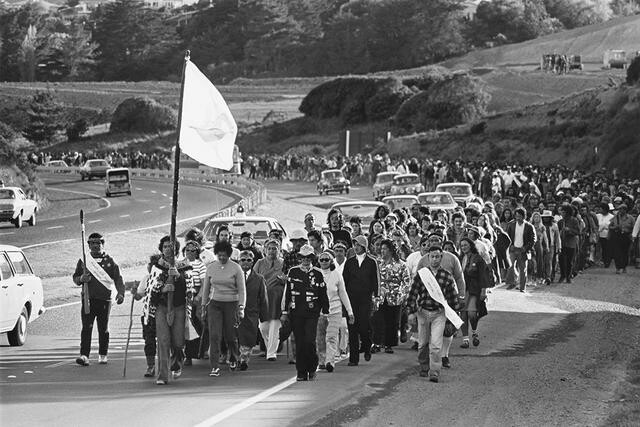
John Miller 1975 Māori Land March Porirua to Wellington motorway
For more than fifty years, photographer John Miller has documented protests and important cultural events across Aotearoa New Zealand. His photographs of protests about issues affecting Māori are iconic, including two hīkoi, thirty years apart, that saw thousands march to Parliament. On 14 September 1975, fifty marchers left Te Hāpua in Te Tai Tokerau Northland led by 79-year-old Dame Whina Cooper (Te Rarawa, 1895–1994) and Te Roopu Matakite o Aotearoa. The protestors walked the length of Te Ika-a-Māui North Island, staying at marae along the way, and arrived at Parliament in Te Whanganui-a-Tara Wellington on 13 October. Their contingent has grown to 5,000 with a petition of 60,000 signatures. The hīkoi combined the leadership and experience of kaumātua with the radical activism of Ngā Tamatoa to bring Māori issues of land and cultural loss to public attention. The slogan remains galvanising: Not one more acre of Māori land.
hīkoi ~ march, walk
He Kapuka Oneone – A Handful of Soil (from August 2024)
Collection