Collection
The Mouse-trap

Petrus van der Velden The Mouse-trap

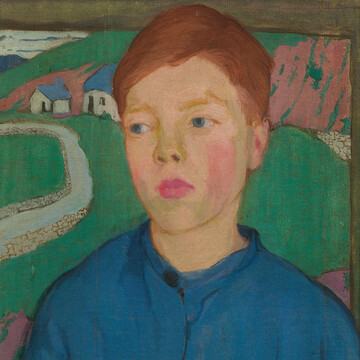
The Dutch painter Petrus van der Velden arrived in Christchurch in 1890 for what was intended to be a short visit to New Zealand. Staying longer than he had planned, he made an impact on the local scene as a ‘real artist’ from old Europe in their midst.

This painting was shown by a Christchurch art dealer in 1893, and described by a reporter:

The picture is entitled ‘The Mouse-trap’, and represents a boy holding the trap with a mouse in it which he has just caught. The face of the boy is beautifully painted, the expression of pleasure being very cleverly caught.

(Beasts, 2015)

Collection
Hill Country 2

Margaret Ryley Hill Country 2

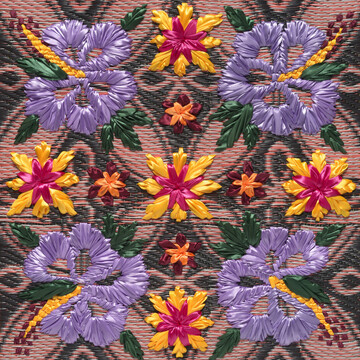
This stoneware pieces by local artist Margaret Ryley conveys the colour and movement of the windswept Waitaha Canterbury landscape. Talking about Hill Country 2, the artist has said: I didn’t think my work reflected the earth at all until I moved out here to Rangiora again […] from Picton coming back before you get to Kaikōura you’re looking at the rolling hills and suddenly you’re back in Canterbury and the tawny colours of the grasses and the way the wind catches them on the hillsides and then perhaps with a little bit of the sea on the left. I was absolutely captivated by them and at the same time I came to live under six walnut trees and I burnt the branches and the ash from the walnut trees [which] gave exactly the effect that I wanted.

He Kapuka Oneone – A Handful of Soil (from August 2024)

Collection
River Pool, Somerset

Frances Hodgkins River Pool, Somerset

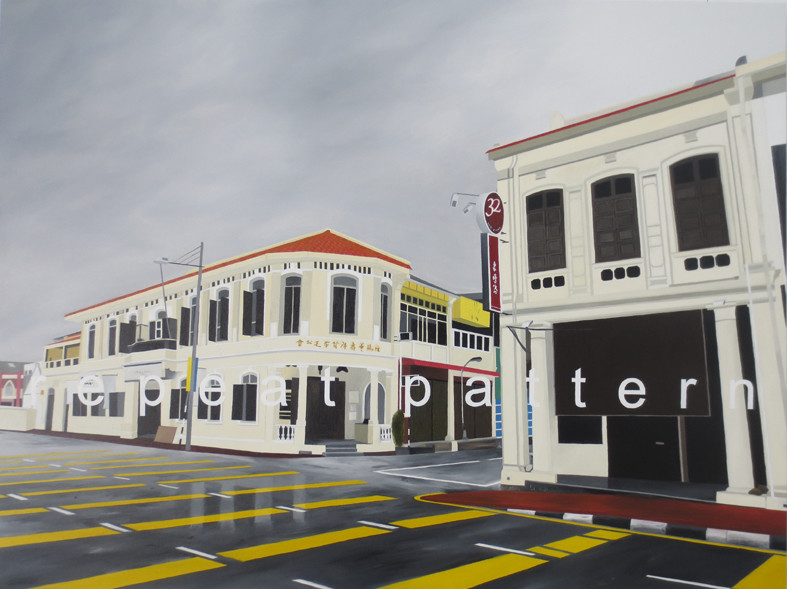
This work belongs to a small group of related compositions from the same viewpoint, thought to have been painted by Frances Hodgkins while she stayed at The Croft, a cottage in Somerset owned by the writer Geoffrey Gorer. Completed in Hodgkins’ distinctive style, in which form and colour are blended to create an intense and lyrical impression of place, it rewards sustained viewing with a gradual unfolding of content – trees, reflective water, a model boat. Considered one of New Zealand’s greatest painters, Hodgkins pursued her practice with originality and tenacity, noting: “[I]t is so easy to paint like your master & to think other people’s thoughts, the difficulty is to be yourself, assimilate all that is helpful but keep your own individuality, as your most precious possession – it is one’s only chance.”

(Unseen: The Changing Collection, 18 December 2015 – 19 June 2016)

Collection
Red house

Stephen Bambury Red house

Stephen Bambury has said of the titles he gives his works: “I like to put down a scent that can be followed.” In this case, that trail leads us towards the Russian painter Kazimir Malevich (1879–1935), who in 1932 painted a work he named Red House. Malevich’s suprematism – geometric forms painted in a limited palette to represent the supremacy of ‘pure feeling’ – sought to reset the ‘givens’ of painting and perception, recognising how the relationship between two-dimensional objects on a pictorial plane could suggest movement, volume and symbolic meaning. On longer looking, the initial flatness of Bambury’s simplified house motif – which recurs frequently throughout his practice – gives way to a sense of perspectival depth, opening the image up to considerations of shelter and containment.

(Unseen: The Changing Collection, 18 December 2015 – 19 June 2016)

Collection
50s Models Series

Vivian Lynn 50s Models Series

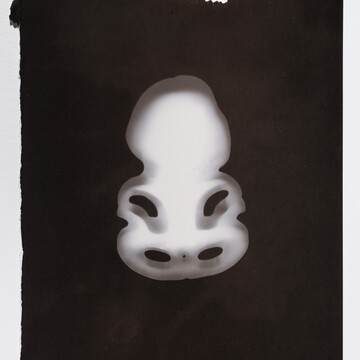
Christchurch Art Gallery Te Puna o Waiwhetū acknowledges the significant contribution made to art, culture and political thought by artist Vivian Lynn, who died on 1 December 2018. Best known for her large-scale sculptural installations, Lynn also produced a major body of subtle yet hard-hitting works on paper (her 50s Models Series you see here is a significant example). She was one of the first New Zealand artists to address feminist issues and the lived experience of women in her work.

Lynn studied at the University of Canterbury’s art school in the late 1940s. She found it on the cusp of change, its student body increasingly interested in modern art. She said later that it was there she learned to see; most importantly, she said, her conviction that she was, and would be, an artist was upheld.

Through her long career Lynn was interested in the social and political construction of female identity. She employed many metaphors and substitutes for the female body in her work. In later life, she wrote that her practice drew on her personal experience. Rejecting the idea of a stable enduring inner self, she said she was “in favour of a corporeal, visceral, neural, erotic mind self in the world, where identity emerges, ebbs, flows and mutates from behaviour in the lived space we inhabit. No awful inner self but an epidermal self, where, as Sappho said, ‘a subtle fire has stolen beneath my flesh’.”

(We do this, 12 May 2018 - 26 May 2019)

Load more