Kā Kaupapa o te Wā
What’s On
Mark Adams: A Survey | He Kohinga Whakaahua
A comprehensive survey spanning the artist's career.
Ana Iti: Ngahere Behind a Pile of Metal
An immersive installation considering the legacies of deforestation and significance of kauri trees.
Kā Whakatauraki: The Promises
A landmark exhibition bringing together the ten Ngāi Tahu land sale purchase deeds.
E tuwhera ana te wharetoi i kā rā e 7 o te wiki, 10am - 5pm
Ka tuwhera ki te 9pm i kā pō Wenerei
Open 7 days, 10am - 5pm
Late night Wednesday until 9pm
Uruka utukore, ahokore utukore
Free entry, free wifi
Collection
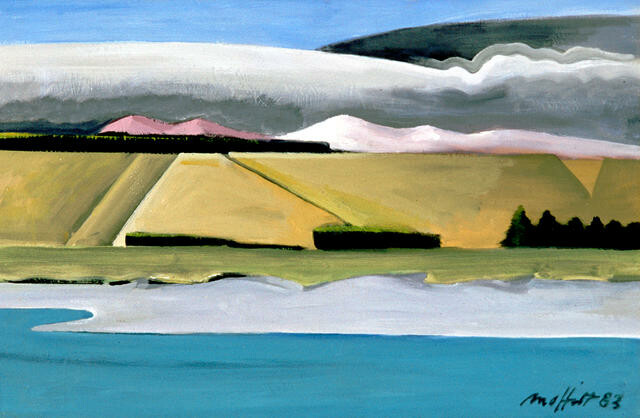
Trevor Moffitt Rakaia Series No. 37
Trevor Moffitt had a deep love for inland Canterbury that was in part fostered by his obsession with fishing. In the mid 1970s he purchased a bach at Lake Clearwater, inland from the Canterbury town of Ashburton. This became his favourite spot to retreat from city life and experience the outdoors. In 1982, after the death of his wife, Alison, Moffitt began the series that this work is from. He said in an interview:
'After Alison died I’d had enough of people, so I went out and painted the Rakaia River series. I had just been emotionally drained. […] The best thing I could do was go off on the weekend and paint the river. I poured all my grief and tears into depicting the waters of the Rakaia.'
In the vast emptiness, 8 January - 21 August 2016
Collection
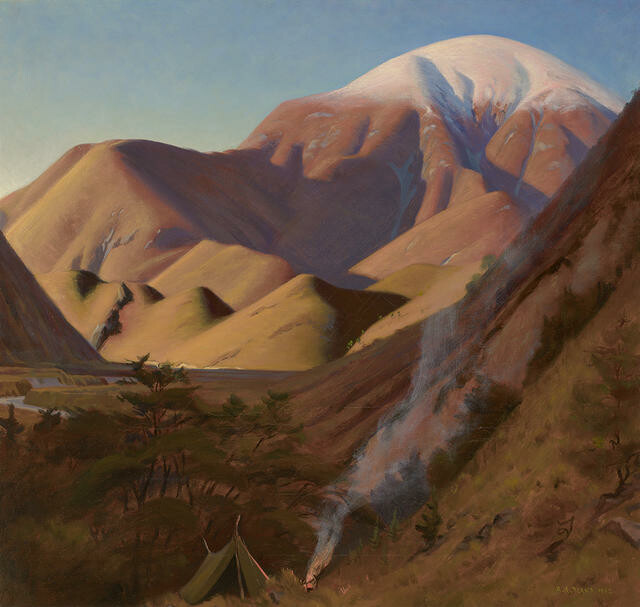
Austen A Deans Camp in the Kowai
For Austen Deans, painting was an expression of his love of the outdoors and, in particular, the Canterbury high country. Born at Riccarton House, Christchurch in 1915, he grew up on the family farm near Sheffield in North Canterbury (and near Kowai, the subject of this 1952 painting). He trained at the Canterbury College School of Art between 1934 and 1938, where he continued his interest in the outdoors through membership of the College tramping club. He once said that he had 'rather wished to be a mountain guide', but his mother dissuaded him from that early ambition. Though he loved sculpture, he specialised in painting because it allowed him to work outdoors rather than being tied to a city studio. Deans was the last of a generation of painters, which also included Doris Lusk and Bill Sutton, whose work was strongly focused on the Canterbury landscape. He is most well-known for his paintings of Mt Peel and the surrounding area, where he lived and worked for over 60 years. 'It was really my attraction to the mountains that started me painting' he said, 'and it's never left me'.
(Turn, Turn, Turn: A Year in Art, 27 July 2019 – 8 March 2020)
Collection
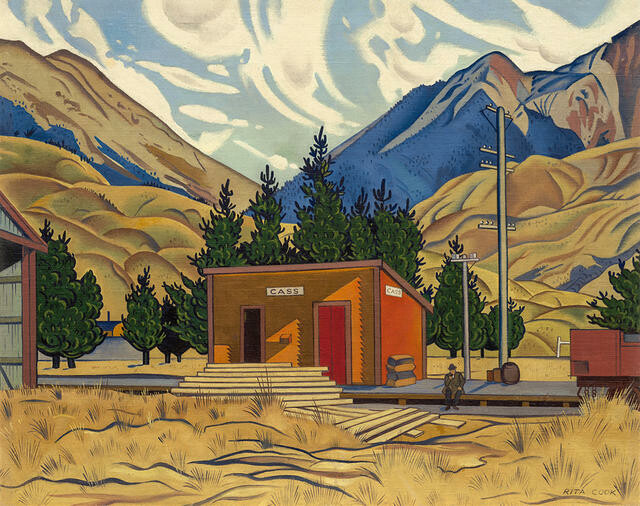
Rita Angus Cass
In the autumn of 1936, Rita Angus, with artist friends Louise Henderson and Julia Scarvell, took a ten-day sketching trip to Cass – a remote railway stop on the Midland Line between Ōtautahi Christchurch and Te Tai Poutini West Coast. Angus completed several works in oil and watercolour in the following months, all showing her attentiveness to human presence in the sweeping landscape. Cass, her best-known work, includes railway sheds, a stationary wagon, telegraph poles and stacked timber, as well as a solitary waiting passenger. Other finished works from this visit featured a derelict musterers’ hut and the Canterbury College Biological Station with a passing steam engine.
(He Kapuka Oneone – A Handful of Soil, 2025)
Collection
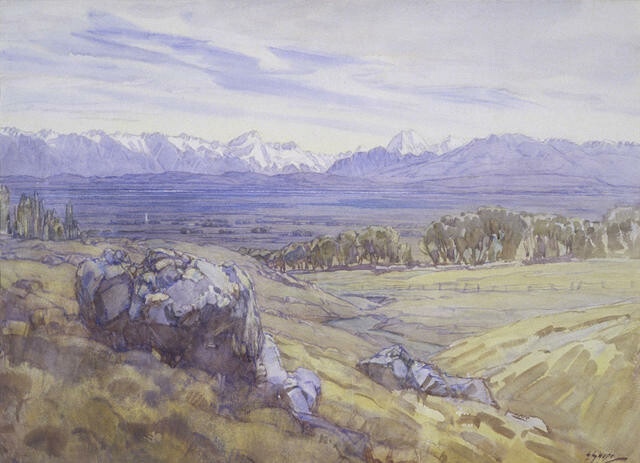
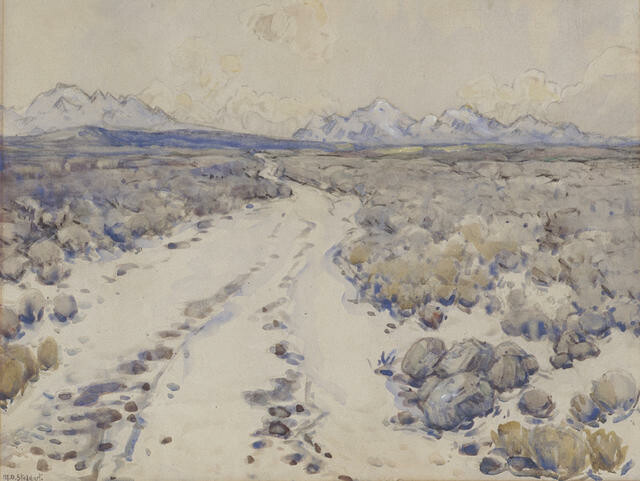
Esther Studholme Hope Mackenzie Country
The viewpoint Esther Hope chose for this work allowed her to show the vast expanse of the Mackenzie Country, which stretches out before the viewer towards the Southern Alps. This region was a favourite subject of Hope’s, one that she returned to throughout her career.
She said that “this land is a part of me … I have never regretted my choice of environment [and] have always felt a strong feeling of primitiveness [here].” Hope’s mature style is seen here, with broad wet washes of colour confidently used.
Hope was born near Geraldine, South Canterbury. She was first introduced to painting through her mother, Emily Studholme, an accomplished amateur artist. She also took lessons from Edwyn Temple and Margaret Stoddart. In 1912 Hope left New Zealand for England where she enrolled at the Slade School of Art, London. In 1919 she returned to New Zealand, married Henry Norman Hope and settled at the Grampians Station in the Mackenzie Country.
Collection
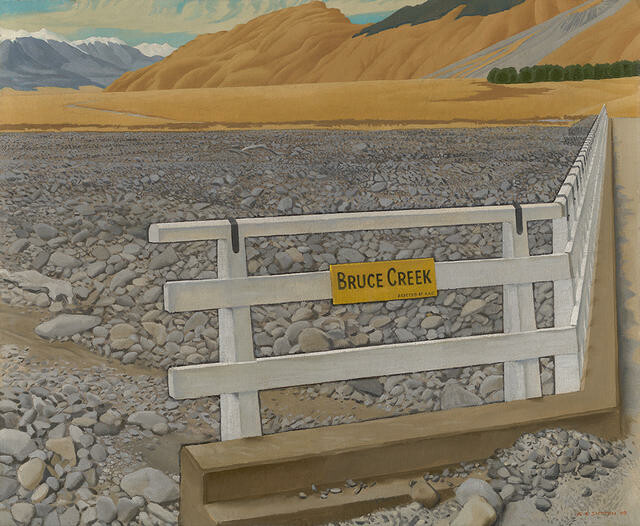
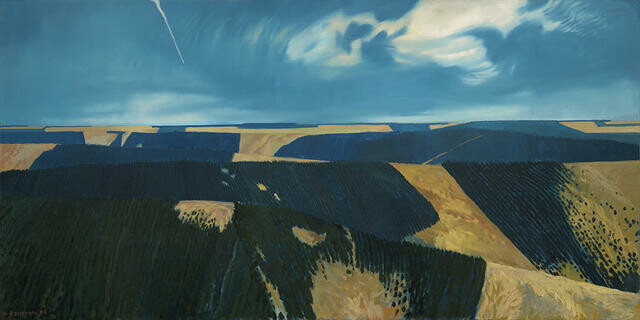
Bill Sutton Dry September
Bill Sutton began his long affiliation with the upper Waimakariri River area in his teenage years during the Great Depression, he and his elder brother Len spending several Christmases at Bealey with an aunt and uncle who had taken work there as a roadman. He later described the place getting under his skin as he and Len explored the area’s windblown tussocky hills and dry riverbeds. Soon after, in 1936, a single-lane bridge was opened on State Highway 73 across Bruce Creek, a flood-prone tributary previously crossable only by ford. Sutton returned to the region after two years’ art study and travel in London and Europe in 1947–9, bringing memory along with fresh eyes for a familiar landscape.
(From Here on the Ground, 18 May – 17 November 2024)
Collection
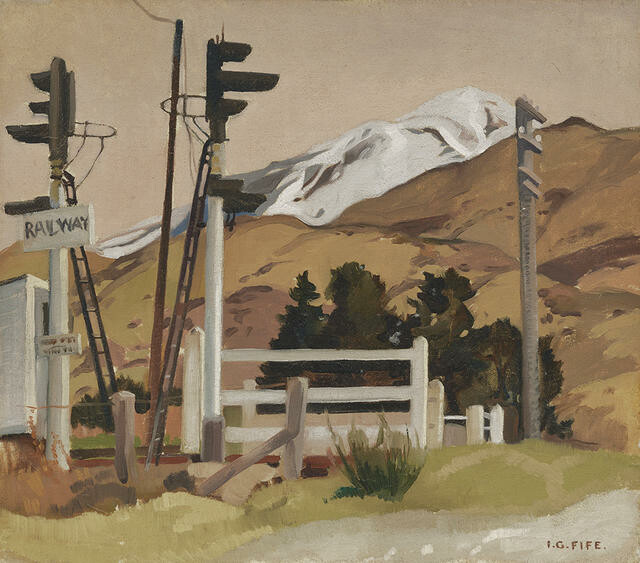
Ivy Fife Railway Crossing, Canterbury
Many artists of Ivy Fife’s generation enjoyed escaping Ōtautahi Christchurch for the exceptional natural beauty of the plains, mountains and coastlines that surround the city. Fife wrote of her sketching trips to Cass: I set out laden with canvases, easel, and well stocked paint box. Train or bus travel was my only means of transport, so large paintings were out of the question. Struggling on to the midnight goods train (the “Perishable” as it was called) and at Springfield transferring to the guard’s van of a slower train and arriving at Cass about 2 or 3 a.m. pitch black morning and very still and frightening although it was exciting. Some of us used to rent an old house up there and really roughed it. The foothills of the mountains were a great draw, cold mountainous streams splashing over interesting rocks. It was fun sitting on a rock in mid stream and painting a watercolour – just dipping one’s brush in the stream. My feet used to get numb with the cold water. Then the mountains – great heavy mounds of rock, heavy and grand cloud formations changing the appearance of everything so quickly; one just had to go for the basics.
(He Kapuka Oneone – A Handful of Soil, 2025)
Collection
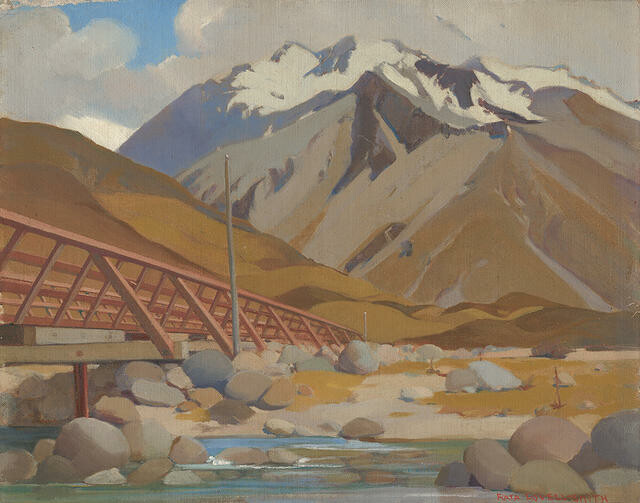
Rata Lovell-Smith Bridge, Mt Cook Road
Rata Lovell-Smith was a central figure in the development of the distinctive aspect of Aotearoa New Zealand’s twentieth-century art history that is often referred to as Canterbury regionalism. She, along with artists such as Rita Angus, Olivia Spencer Bower and Bill Sutton, focused on features common in the Waitaha Canterbury High Country: the bright, hard light, the nor’west winds and the resulting high cloud formations, swathes of tussock grasses and the breathtaking mountainous backdrop beyond the plains. These artists often emphasised human-made structures, such as this bridge on the road up to Aoraki Mount Cook.
He Kapuka Oneone – A Handful of Soil (from August 2024)
Collection
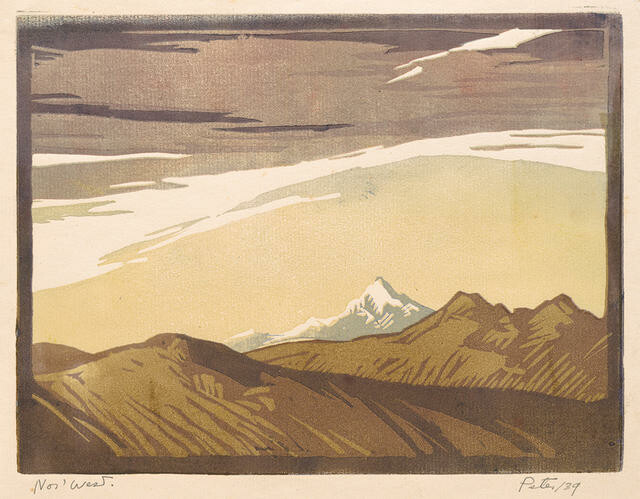
Juliet Peter Nor’west
According to Kāi Tahu, within the story of the creation of Te Waipounamu (the South Island), Aoraki was an atua, or demi-god, who left the home of his father, Raki, in the heavens and voyaged with his brothers to visit Raki’s first wife Poharora o Te Po. They set out to return to his father, but there was a fault in the karakia (prayer) for their return. Aoraki’s canoe – Te Waka o Aoraki – was stranded, and Aoraki and his brothers turned to stone, becoming the mountains of Kā Tiritiri o Te Moana, the Southern Alps.
'This work is interesting because it offers an unusual perspective on Aoraki [Mount Cook] – but Aoraki is full of different perspectives in Kāi Tahu culture. The mountain is, above all, a symbol of our tribal and regional identity. That’s got nothing much to do with its location – although that obviously commands cultural attention – but mainly because of its centrality in the Te Waipounamu creation story. And it is a distinctive creation story, part of a creation myth which has survived here in the remote outskirts of Polynesia while it has been lost at the centre where it came from. Aoraki made us distinctive, and it makes all people distinctive that live under its span. Juliet Peter’s depiction of it is unusual, but every way you look at Aoraki you’ve got a different perspective.' —Sir Tipene O’Regan
(He Rau Maharataka Whenua: A Memory of Land, 17 September 2016 – 18 February 2017)