
Kā Kaupapa o te Wā
What’s On
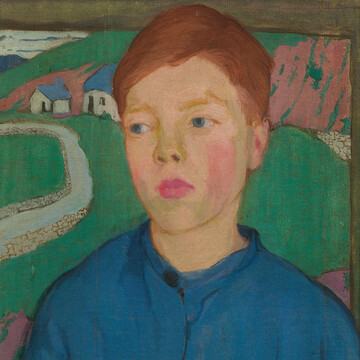
Edith Collier: Early New Zealand Modernist
A rare opportunity to view the work of one of Aotearoa New Zealand’s most adventurous and experimental modernist artists.
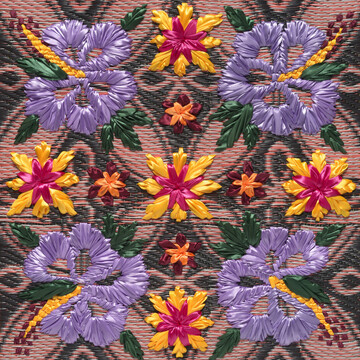
Made in the Pacific: A Collection of Tāoga
A selection of Pacific tāoga from the Canterbury Museum in conversation with contemporary artworks that highlight the continued strength in culture and traditional art forms.
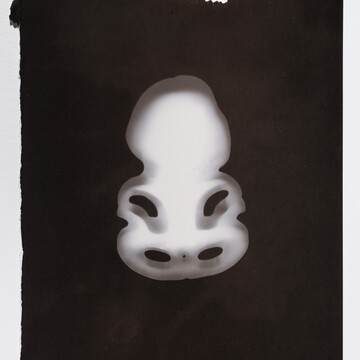
Mark Adams: A Survey | He Kohinga Whakaahua
A comprehensive survey spanning the artist's career.
E tuwhera ana te wharetoi i kā rā e 7 o te wiki, 10am - 5pm
Ka tuwhera ki te 9pm i kā pō Wenerei
Open 7 days, 10am - 5pm
Late night Wednesday until 9pm
Uruka utukore, ahokore utukore
Free entry, free wifi
Collection
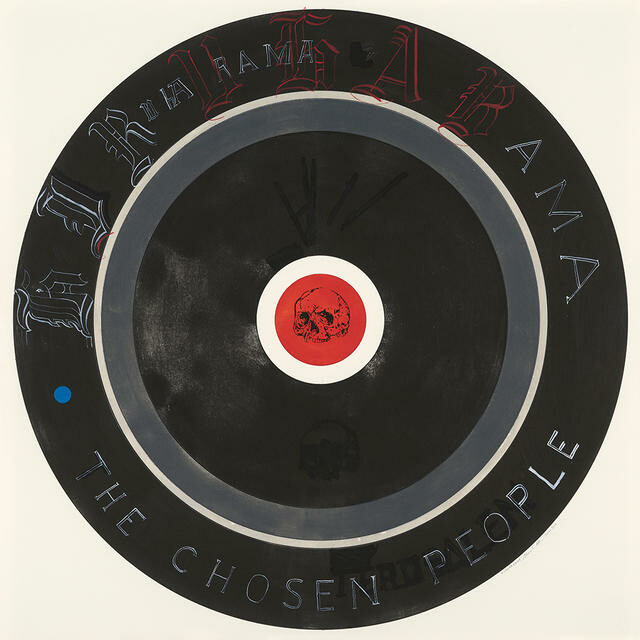
Shane Cotton Hiruhārama
From a distance, these ten works by Shane Cotton have a strongly graphic quality. They look like a row of archery targets, or a series of pulsing GPS locator beacons zeroing in on a significant location. But when you get up close, the surfaces of Cotton’s circular forms appear softly weathered, as if the pressure of the world around them has worn them away slightly. You become aware of the small painted motifs within the concentric circles—heads, texts, bars, dots, smaller targets, ancient presences. And suddenly, rather than looking like something that belongs to space, like the trajectory of an arrow or the flight plan of a plane, you see that the works might equally be concerned with time, that the bands of colour might be read as the rings of a tree or as a model of eternal return.
The works themselves took several years to make. In 2009, Cotton spent a couple of weeks in Israel working with the Gottesman Etching Center to produce the circular forms. (The colours are drawn from the Israeli and Palestinian national flags, as well as the tino rangatiratanga flag and Cotton’s impressions of the landscape.) They’re monoprints, which means they exist as single images pulled from the printing press—essentially, they’re printed paintings. When Cotton got back to New Zealand, he put the sheets away for three years, finally adding the smaller motifs over the etched surface by hand.
The heads in the images are toi moko, or mokomokai, preserved and tattooed Māori heads. Cotton has worked for many years now from a copy of a photograph of Horatio Gordon Robley, a colonial soldier and artist who fought in the New Zealand wars, with his collection of heads displayed on a wall behind him. It’s a horrific image, a deeply shocking one. “I wanted to see whether I could take a heavily laden image from our history and say something different with it. […] I think they’re really about what it means to have and hold on to a memory or retain a likeness, which is also what painting was historically about. So I thought I’d start painting them and see what happened.”
(Your Hotel Brain 13 May 2017 - 8 July 2018)
Collection
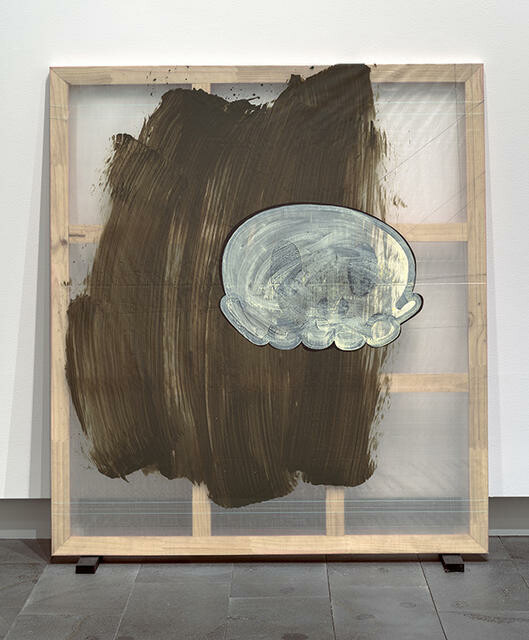
Tjalling de Vries Dead Head
Intrigued by the deceptions inherent in the act of painting, Tjalling de Vries often exposes tricks of the trade that usually pass unnoticed, while incorporating falsehoods of his own – like painted-on masking tape, counterfeit spills or creases and intricately layered surfaces designed to confuse and misdirect the eye. In Dead Head, transparent polyethylene takes the place of a canvas support, destabilising the picture plane as a site of illusion and suspended disbelief and allowing a view ‘through’ the painting to the wooden stretcher behind.
(Unseen: The Changing Collection, 18 December 2015 – 19 June 2016)
Collection
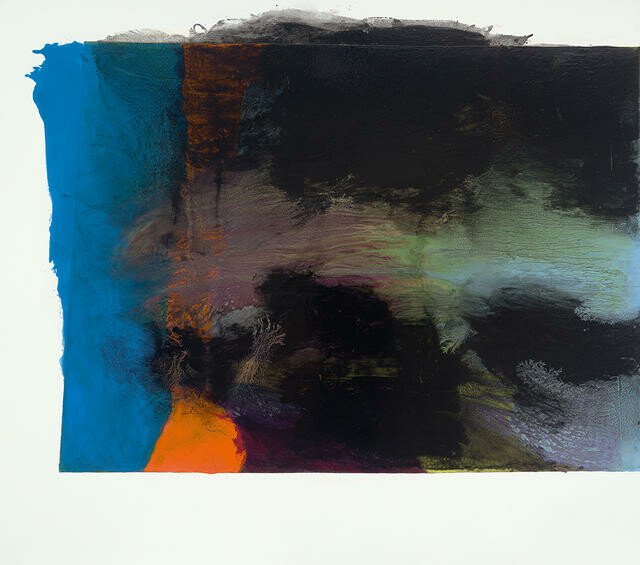
Marie Le Lievre Cerulean Slipping
Ōtautahi Christchurch-based artist Marie Le Lievre’s Cerulean Slipping invites the viewer into the mysterious exploratory pleasures of her painting process. Employing crisp, hard edges alongside blurred boundaries and well-orchestrated liquid merge, it blends semi-controlled and unpredictable procedures. The result hints at mapping, rivers and flood plains, as well as chemical reactions or microscopic examination, while at the same time suggesting a multi-layered imaginative state.
(Perilous: Unheard Stories from the Collection, 6 August 2022- )
Notes
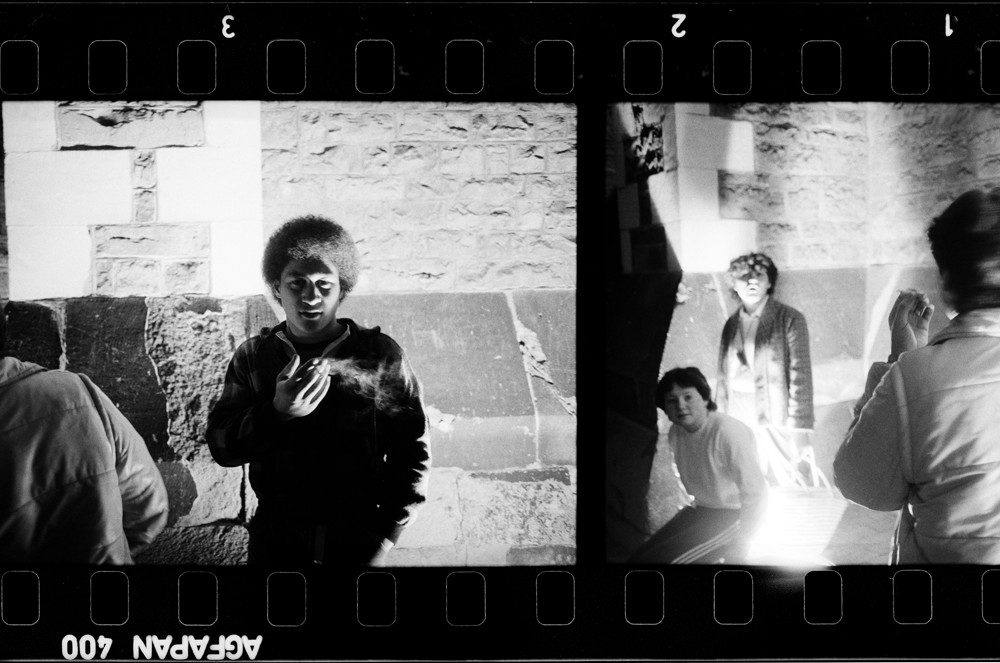
Meet Me in the Square
Now's a good time to make Friends with the Gallery. We're offering Friends 20%* off our new book of photographs of 1980s Christchurch by David Cook.
Notes
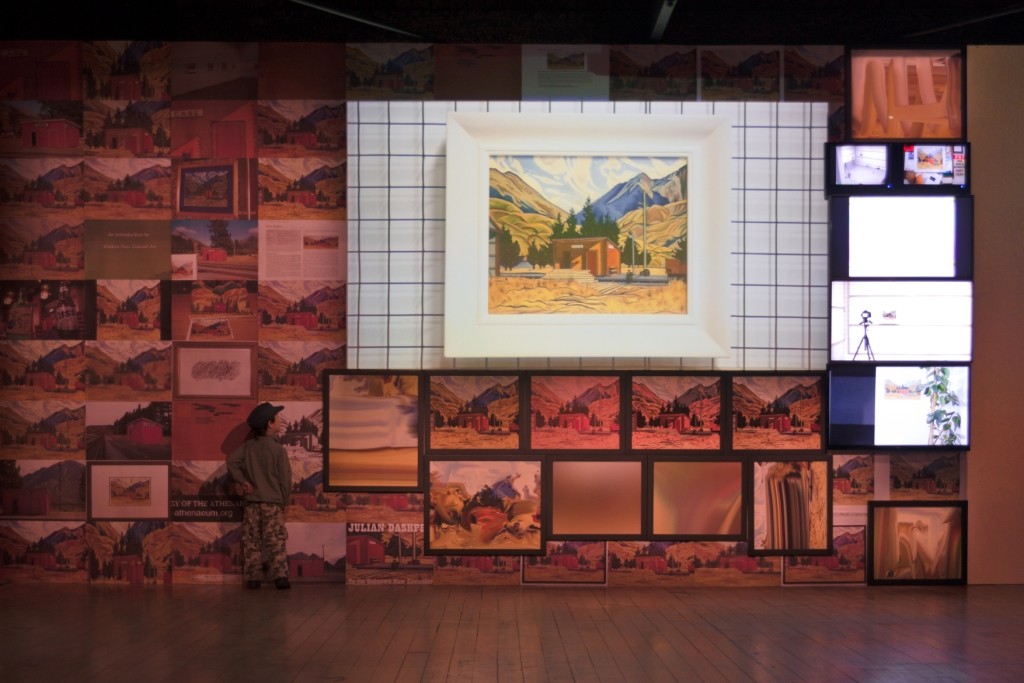
Coming to your coffee table soon
On perusing Thames & Hudson's glossy new art publication, we saw a familiar name.
Notes
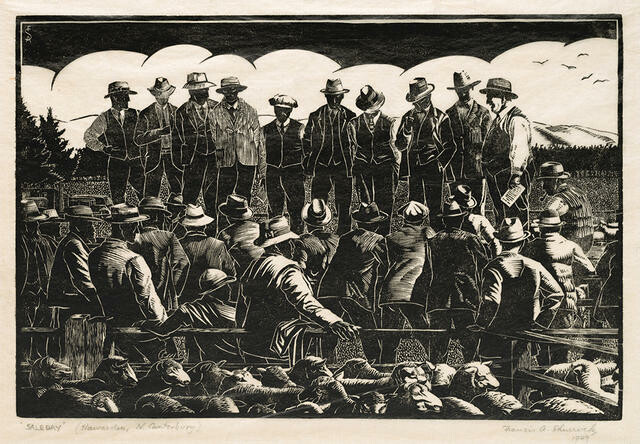
Closed but still on Sale
This week, more great product has been added to our online, pre-Christmas Sale.
Notes
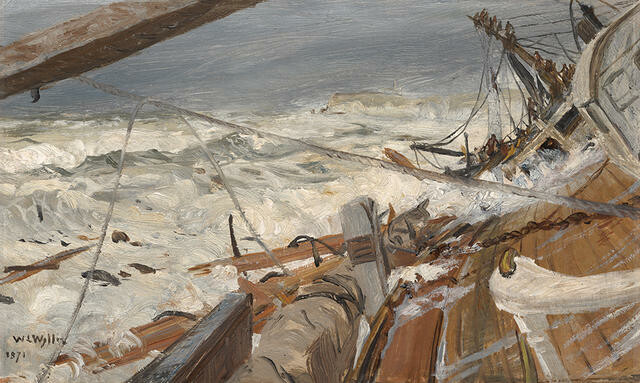
The Sloping Deck
Although one of the smallest oil paintings in the permanent collection William Wyllie's The Sloping Deck is a powerful and terrifying image of a ship being wrecked on rocks.