Notes
Introducing our new foyer partner... Bayleys Knight Frank

Introducing our new foyer partner... Bayleys Knight Frank

Here at the Gallery we’re committed to working with like-minded businesses to support creative Christchurch. That’s why we’ve teamed up with Bayleys Canterbury—they get it.

Collection
Everything Old is New Again

Séraphine Pick Everything Old is New Again

For the past few years, Séraphine Pick has been trawling the internet for figures in particular poses – “second-hand life models”, as they’ve been described – reassembling them in new configurations on the canvas. In this work, people are texting on their phones and hunched over laptops, while a vaguely 1960s-looking rock band fronted by a female guitarist plays on blasted and barren ground. Figures in a variety of historical attire rise like wraiths at the edges of the image. Pick’s monumental work explores both the cyclical nature of time and the increasing crisis of the contemporary. Everything that’s old is new again looks like a depiction of the end of the world, and perhaps like a kind of 1960s utopianism coming round again… but it also looks like right now.

(Now, Then, Next: Time and the Contemporary, 15 June 2019 – 8 March 2020)

This work comprises three panels. Each panel measures 2500 x 1800 mm and the entire work therefore measures 2500 x 5400mm.

Collection
Te Mahara

Ngataiharuru Taepa Te Mahara

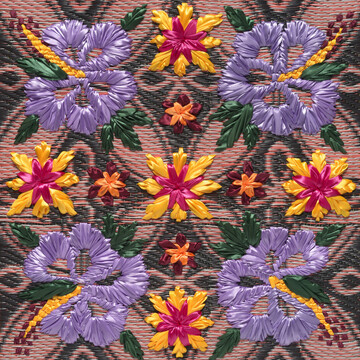
Kōwhaiwhai are the painted designs seen on the rafters of wharenui. The designs are organic and filled with great visual energy. Each design relates to a particular narrative significant to the people of a given place, acting as both an artform and archive or storytelling device. This work by Ngataiharuru Taepa references traditional puhoro kōwhaiwhai patterns representing speed, strength and agility. A child of the 1970s, Taepa expands on traditional and modernist Māori art legacies to identify the contemporary Māori experience, while remaining aligned with the visual lexicon and conceptual views of his predecessors.

(Living Archives, 25 October 2025 – 8 March 2026)

Director's Foreword
William Wegman: Being Human

William Wegman: Being Human

It’s a busy time at the Gallery, as we prepare for the opening of William Wegman: Being Human. Wegman is a very significant American artist and this is his first and only show in New Zealand, so we are thrilled to have such a thorough representation of his work on show here at Christchurch Art Gallery Te Puna o Waiwhetū. Wegman, who is famous for working with his Weimaraner dogs, was part of the late 1960s and early 1970s American conceptualist movement, and has produced a huge body of work that examines the human condition through photography and video. Wegman was also one of the earliest artists to see popular culture as a platform for expanding artistic practice and gaining critical attention (he co-produced the hugely influential 1988 re-release music video for New Order’s ‘Blue Monday’ – at the time a record-breaking entry in New Zealand’s charts).

Interview
John Simpson

John Simpson

Early in 2017, Professor John Simpson, the former head of the School of Fine Arts at the University of Canterbury, approached the Gallery’s then director, Jenny Harper, with a proposition: he had been considering the future of the art collection he had accumulated over the past six decades, and wished to know whether the Gallery would be interested in selecting a group of works for a gift. My colleague Ken Hall and I visited John one afternoon in March. It quickly became apparent to us that the collection was significant and that the offer was particularly generous. Interestingly, we discovered that the works variously represented John’s own artistic interests and his national and international artworld connections. As such, they told a story of art and art history that usefully expanded the local account.

Interview
Accidents and Variations

Accidents and Variations

Lara Strongman: Let’s talk about the process of making the works for this exhibition. Can you describe how you produced them?

Julia Morison: I’ve never actually made ceramics before. I read Edmund de Waal’s The Hare with Amber Eyes, which is about a netsuke set that is passed through several generations. De Waal is a ceramicist and he talks in this book about objects and porcelain in such a visceral way—basically he seduced me into picking up a ball of clay and playing with it. For a long time I haven’t had the use of my hands [because of arthritis], so I thought that playing with clay might actually help strengthen them.

Commentary
Portraits for the Million

Portraits for the Million

Scottish-born brothers John Tait (1836–1907) and Alexander Tait (1839–1913) established themselves as photographers in gold rush Hokitika in about 1866, the period in which Catton’s The Luminaries is set. While building up a broader picture of photographers for the Hidden Light: Early Canterbury and West Coast Photography book and exhibition, I recalled an interview with the novelist at around the time of her 2013 Man Booker Prize success, and her mention of having restricted her reading for a year before starting the novel to nothing published after 1866, giving the National Library’s Papers Past credit as a vital source. The trails and condensed stories of many of the photographers in Hidden Light were largely brought together via this same indispensable means.

Commentary
Anthropomorphism

Anthropomorphism

Artist William Wegman has been photographing his Weimaraners in endless humanoid situations for more than four decades. Starting with Man Ray in the 1970s, Fay Ray in the 1980s and her subsequent offspring ever since, Wegman’s most popular artistic foil has been his pet dogs. For a number of reasons, this has occasionally meant his work has been thought of as naïve or sentimental – a trivial comic enterprise not too dissimilar to Anne Geddes’s notorious baby photos.

Load more