Artist Profile
Rooted in the Land

Rooted in the Land

This article was written prior to the passing of Fred Graham on 9 May 2025. The author, Te Uru Contemporary Gallery and Christchurch Art Gallery acknowledge this loss with deep sadness. Moe mai rā e te Rangatira.

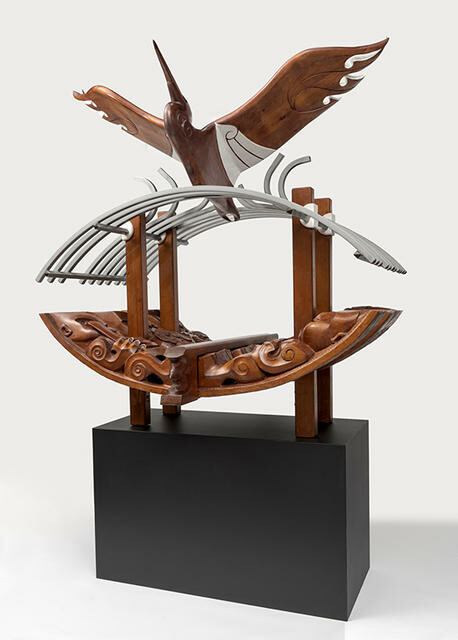
In 2024 I was fortunate to work with senior Māori artist Fred Graham (Ngāti Korokī Kahukura, Tainui) and his whānau to present Fred Graham: Toi Whakaata / Reflections at Te Uru Contemporary Gallery in Tāmaki Makaurau Auckland. Reflecting on Graham’s career, the exhibition brings together works made over the course of almost fifty years between 1965 and 2013. 

Commentary
Peter Robinson

Peter Robinson

Te kaiora āhuatanga ōkiko engari anō te hākirikiri katakata, ko ngā mahi konumohe papaangi – wahie – tahuna ki roto i tēnei whakaaturanga he mea karanga whakahoki ki ngā whakapāpātanga ki mua a Robinson ki ngā rawa tāwhaiwhai ngana pērā i te kōmama me te whītau. Engari kia whakaritea ki te tērā pea whakameremere hītōria o ētahi mahi tawhito ake, ko ēnei “tuhinga waro” he pukuhohe mōkinokino, ahakoa ka hē pea kia whakamāori i tēnei tū whakapū – whakatapeha hei pāraharaha tūturu.

Commentary
As far as the hawk-eye can see

As far as the hawk-eye can see

I doubt that any printer’s first book has proved more wholly apposite than Pathway To The Sea, printed by Alan Loney in 1975 at his newly founded Hawk Press. There is propriety in the contributors. The writer, Ian Wedde, achieved prominence as a poet and critic, as Loney has; the cover artist, Ralph Hotere, believed strongly in the crosspollination of art and literature, as Loney does. And there is propriety in the title, which poetically evokes Loney’s trajectory in Aotearoa New Zealand. Born in 1940 in Te Awakairangi Lower Hutt, he came to printing through poetry. In 1971, he typeset his first collection, The Bare Remembrance, at Trevor Reeves’s Caveman Press in Ōtepoti Dunedin. Hawk Press was set up at Te Onepoto Taylors Mistake and later travelled with Loney from Ōtautahi Christchurch to the Kāpiti Coast and Ōkiwi Eastbourne. After its closure in 1983, he established further presses in Te Whanganui-a-Tara Wellington and Tāmaki Makaurau Auckland. In 1998, he left Aotearoa, crossing Te Tai-o-Rehua Tasman Sea and alighting in Naarm Melbourne, where he settled permanently in 2001.

Interview
Gold, Chalk and Rabbit-Skin Glue

Gold, Chalk and Rabbit-Skin Glue

Bulletin talks to Anne-Sophie Ninino, a French-trained conservator based in Ōtautahi Christchurch with international experience in museum conservation and a specialisation in gilding, frame and heritage restoration.

Commentary
Foreigners Everywhere

Foreigners Everywhere

Stranieri Ovunque - Foreigners Everywhere is the title and theme of the International Exhibition curated by Adriano Pedrosa for the sixtieth Venice Biennale. As a necessary condition of such projects, the theme works as a signal, provocation and rationale for the amassing of globally disparate works of art and sets the tone of this highly politicised event. Foreigners Everywhere is a particularly intriguing premise for drawing the work of eight Māori artists into the urgent political concerns currently playing out at the Biennale. While much is being made of this unprecedented situation – and rightly so – the celebrations at home have yet to turn to a critical examination of how the work of these artists operates in that context.

Collection

Robyn Kahukiwa Girl in a Bush Shirt

This work was displayed with this label to mark the death of the artist in April 2025.

It is with great sorrow that we acknowledge the passing of one of Aotearoa New Zealand’s preeminent artists, Robyn Kahukiwa. For over five decades Kahukiwa was uncompromising in her commitment to articulating the realities of life for Māori, including the relentless impacts of colonisation, and the strength, resilience and resistance maintained in response. Her books, drawings, prints and paintings were underpinned by a deep love for her whakapapa, as she sought to uplift her people, particularly wāhine Māori, through her work.

Kahukiwa was born in Australia and moved to Aotearoa aged nineteen. Her early work was informed by her experiences teaching art at Mana College in Porirua in the 1970s and early 1980s, and focused on cultural dislocation and the struggles of young, urban Māori. 'Girl with a Bush Shirt' is one of several works produced during this time that capture a sense of estrangement or inner conflict.

In 1983 one of Kahukiwa’s best-known series of works, 'Wahine Toa', toured the country. The exhibition and the accompanying publication honoured the women of Māori myth whose stories had so often been minimised or erased. The mana of Māori women and children continued to be a central theme within Kahukiwa’s work.

Kahukiwa’s posters and book illustrations were how many New Zealanders experienced her work for the first time and were particularly meaningful for Māori in their thoughtful representations of Māori life and culture. Her children’s books such as Taniwha are still read in schools and homes around Aotearoa.

Kahukiwa has left behind an extraordinary legacy for her mokopuna and all New Zealanders and we are honoured to be kaitiaki for several of her works.

Load more