Collection
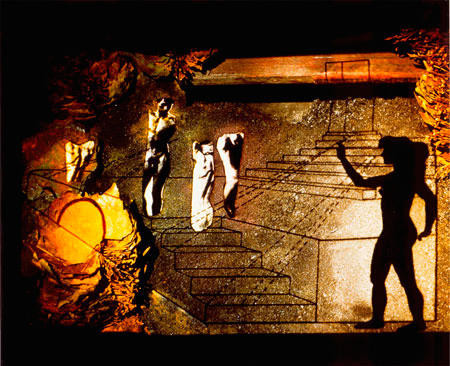
Sword Lily (Gladiolus)

Margaret Dawson Sword Lily (Gladiolus)

Margaret Dawson has lived and worked in Christchurch since the late-1970s. Her work uses photography as a means to explore identity and gender roles through carefully constructed images of herself and others. Marching Girl and Interior with Venetians were both from the Dreams and Illusions series, in which the artist used her own body as a way to show the mutability of the self and representation. One moment, a woman in marching costume strides out of the photograph, and the next, she is an anxious figure shown in her domestic setting. Taking on these two personas implies that images we see of others are similarly fleeting and unreliable; that we can all be seen in many different lights and perspectives. Sword Lily (Gladiolus) further exposes the construction of the photograph, with the backdrop hung from the washing line in the backyard, as the figure performs a sword swallowing trick.

(Perilous: Unheard Stories from the Collection, 6 August 2022- )

Collection
Consuming the Veneer

Margaret Dawson Consuming the Veneer

Margaret Dawson has lived and worked in Ōtautahi Christchurch since the late 1970s. Her work uses photography as a means to explore identity and gender roles through carefully constructed images of herself and others. This work is from the Marg N L Persona series, using her own body as way to show the mutability of the self and representation. Here, a woman bites down hard on the auto-release cable for the camera. Snap. In the background we can just make out the headlands and Lyttleton Harbour, as seen from Governors Bay wharf. Other works in the series show the same woman, yet she is wildly unrecognisable. Margaret suggests that the images we see of others are similarly fleeting and unreliable; that we can all be seen in many different lights and perspectives.

(Perilous: Unheard Stories from the Collection, 6 August 2022- )

Collection
4902 VISTA VOLLEY

Bridget Reweti 4902 VISTA VOLLEY

Te Rua-o-te-Moko Fiordland and Kā Puna-karikari-a-Rākaihautū Southern Lakes of Te Waipounamu South Island have been popular tourist destinations since the mid-nineteenth century. Commercial photographers of the time, such as the Burton Brothers, relied heavily on views of these iconic landscapes to make commercially attractive photographs to sell to customers. In this selection of photographs from Bridget Reweti’s Summering on Lakes Te Anau and Manapouri series, she responds to the Burton Brothers’ 1889 photographs from Wintering on Lakes Te Anau and Manapouri. Reweti reclaims them through a different lens informed by the awareness that these sites hold significance and memories for mana whenua, Kāi Tahu. She hand-coloured each photograph with whenua given to her by locals in each location, reconnecting her images with the experience of being present in the land, rather than ‘snapped and trapped’ views separated from their physical and cultural context.

mana whenua ~ Māori with authority over particular land or territory

Kāi Tahu ~ tribal group of much of Te Waipounamu South Island

whenua ~ ground, soil

He Kapuka Oneone – A Handful of Soil (from August 2024)

Collection
4893 DREAM GOOD DREAMS

Bridget Reweti 4893 DREAM GOOD DREAMS

Te Rua-o-te-Moko Fiordland and Kā Puna-karikari-a-Rākaihautū Southern Lakes of Te Waipounamu South Island have been popular tourist destinations since the mid-nineteenth century. Commercial photographers of the time, such as the Burton Brothers, relied heavily on views of these iconic landscapes to make commercially attractive photographs to sell to customers. In this selection of photographs from Bridget Reweti’s Summering on Lakes Te Anau and Manapouri series, she responds to the Burton Brothers’ 1889 photographs from Wintering on Lakes Te Anau and Manapouri. Reweti reclaims them through a different lens informed by the awareness that these sites hold significance and memories for mana whenua, Kāi Tahu. She hand-coloured each photograph with whenua given to her by locals in each location, reconnecting her images with the experience of being present in the land, rather than ‘snapped and trapped’ views separated from their physical and cultural context.

mana whenua ~ Māori with authority over particular land or territory

Kāi Tahu ~ tribal group of much of Te Waipounamu South Island

whenua ~ ground, soil

He Kapuka Oneone – A Handful of Soil (from August 2024)

Collection
4877 NO BAD ANGLES

Bridget Reweti 4877 NO BAD ANGLES

Te Rua-o-te-Moko Fiordland and Kā Puna-karikari-a-Rākaihautū Southern Lakes of Te Waipounamu South Island have been popular tourist destinations since the mid-nineteenth century. Commercial photographers of the time, such as the Burton Brothers, relied heavily on views of these iconic landscapes to make commercially attractive photographs to sell to customers. In this selection of photographs from Bridget Reweti’s Summering on Lakes Te Anau and Manapouri series, she responds to the Burton Brothers’ 1889 photographs from Wintering on Lakes Te Anau and Manapouri. Reweti reclaims them through a different lens informed by the awareness that these sites hold significance and memories for mana whenua, Kāi Tahu. She hand-coloured each photograph with whenua given to her by locals in each location, reconnecting her images with the experience of being present in the land, rather than ‘snapped and trapped’ views separated from their physical and cultural context.

mana whenua ~ Māori with authority over particular land or territory

Kāi Tahu ~ tribal group of much of Te Waipounamu South Island

whenua ~ ground, soil

He Kapuka Oneone – A Handful of Soil (from August 2024)

Load more