Lisa Reihana - A Māori Dragon Story
Lisa Reihana - A Māori Dragon Story
A Māori Dragon Story is a 1995 audiovisual work by Lisa Reihana that was acquired by Te Puna o Waiwhetū Christchurch Art Gallery in 2021. The artwork is a stop-motion animation with wooden figures, and just over sixteen minutes long. It explores an ancestral narrative of a Te Waipounamu taniwha.
Title cards show character names and descriptions in white text on a pounamu-like background while taoka pūoro (māori musical instruments) play.
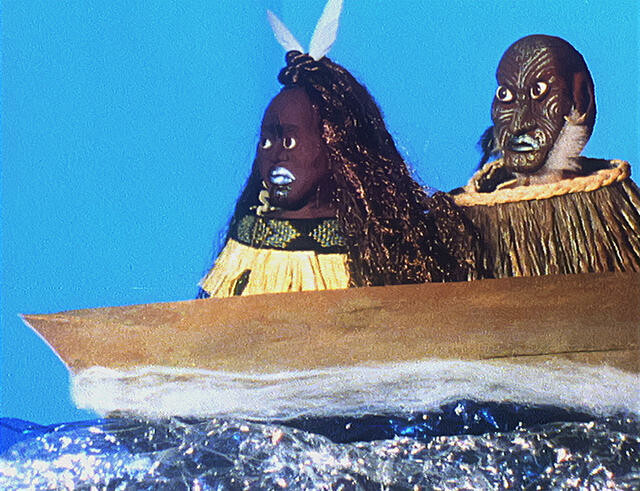
Te Ake, the chief is introduced first: bald and frowning, he has a mataora (full facial tattoo) and beard, big, painted eyes, a pounamu necklace and wears a kākahu (cloak) with a woven band.
Hine Ao, his daughter, has a moko kauae - chin tattoo - long dark hair adorned by two feathers in a V, eyes like her father’s and a kākahu made from plant fibres.
Tūrakipō is another chief. He is angular, with a pounamu tiki necklace, pāua triangles for eyes, and no mouth but metallic moko instead. His kākahu has feathers.
Irirangi is a tohuka – a spiritual expert. He has pāua semicircles for eyes with moko down the centre of his face. His kākahu is high on his shoulders.
Tautini is another tohuka. He has painted eyes with lighter green irises, a single pounamu earring, a kina on his head, and a black, shiny mataora across his face. His kākahu is red with wool tassels.
A title card reads ‘A Māori Dragon Story’.
Another reads ‘Waitaha Lore, From the South Island, Adapted from Taniwha Tradition, Retold by Teone Tikao’. The story begins with a map of Aotearoa.
The view shifts from Te Pātaka o Rākaihautū, Banks Peninsula, out to a crinkly blue cellophane moana. A waka -boat - with Hine Ao in front and Te Ake behind her paddles through the water.
Hine Ao tests the current and directs the waka, pointing her kotiate, a wooden weapon. Red-brick-coloured cliffs rise above a pale shoreline with figures and a fish rack. We hear a karaka, a ceremonial call performed by a women. The waka beaches.
Turakipo greets his visitors and they press noses in a hoki, traditional greeting . He is enchanted by Hine Ao. His pāua eyes become spinning shells as sparkles sound. He moves to touch her. Recoiling, she raises her kotiate. Turakipo withdraws, spiral eyes gone. She disapproves. She and her father leave.
Turakipo raises his taiaha – a long wooden weapon. From his taiaha electricity ripples out across the sea where Hine Ao and Te Ake travel. The sea becomes stormy. The electricity strikes Hine Ao dead.
At the marae of Te Ake, three mourning figures witness him bringing his daughter home. Her father’s moans join the chorus of grief. He watches as her body is burned in a pyre. Kawakawa branches shake and night falls. Hine Ao’s ashes are placed in a carved red box (waka koiwi). Te Ake waves his daughter’s kotiate in pain and vengeance.
In the blue-black night Te Ake visits with the tohuka, Tautini and Irirangi. Kawakawa shakes as drums sound. The men converse. Irirangi points to an ancestor on a wall panel of the house. Images of fire, kawakawa, and the figure on the wall flash intermittently. Te Ake waits. Leaves fall. Te Ake acknowledges the tohuka and exits. The music stops.
In a cave Te Ake pulls Hine Ao’s box of ashes out and speaks over it, waving her kotiate. The box shakes open and its contents spill out, writhing. He remembers his daughter dying, and Turakipo. Crab claws, eyes, a bird skull, and an image of a woman move in the sand. The picture becomes half woman, half fish. Hine Ao’s face looks at her father in the cave.
By the red cliffs of Turakipo’s home, he walks to the shore as a fishing canoe sets out. From the cave, Te Ake guides the taniwha with Hine Ao’s head and a long tuna-like tail slithers through the water. The fishhook of the waka sinks. The taniwha catches it.
Real human hands cut into the taniwha’s tail and eat greedily. Turakipo’s sandaled feet walk to his beach. His people lie dead, poisoned by the flesh of the taniwha.
Drums kick in as he runs to them. He cries out in pain. Māori instruments play and Hine Ao’s face is shown before a cave.
A title card reads; ‘Hine Ao’s name as a taniwha; Te Wahine-maru-kore. Her spirit remains at Ohikuparuparu, Sumner, Te Waipounamu.’
Music continues to play as the credits run.
Related
Collection
Lisa Reihana A Māori Dragon Story
He pūrākau tā Lisa Reihana 'A Māori Dragon Story' nō Waitaha e pā ana ki te pūhaehae me te whai utu. Hai tā te pūkeka o Kāi Tahu, hai tā Teone Taare Tikao, ka tūtaki atu a Hine Ao nō Akaroa me tōna hākoro, me Te Ake, ki te rakatira, ki a Tūrakipō nō Ōpāwaho, i Ōhikaparuparu. Ināianei, koia rā te paenoho kai te takutai, e tūtata ana e kīia ana ko Sumner. Nō te whakanautaka a Hine Ao i te mātoro a Tūrakipō i a ia, ka mātukutia ia e Tūrakipō kia mate. Tiwhatiwha kau ana a Te Ake, ā, ka tahuri ia ki te ako i te mahi mākutu hai kaki i te mateka o tana tamāhine. Ka tākina e Te Ake tētahi karakia hai whakaara ake i a Hine Ao hai taniwha nunui, ko Te Wahine-maru-kore tōna ikoa. Ka kau atu anō ia ki Ōhikaparuparu, i reira kā tākata o Ōpāwaho e kai ana i tōna kiko, nāwai ka mate. I a Tikao e kōrerorero ana ki a Herries Beattie i te kahuru tau o 1920, ka whakamārama atu ia kai Akaroa tonu a Te Wahine-maru-kore me tōna hoa, me Te Rangi-orahina, e noho ana, ā, ko tā rāua he tiaki i kā “tākata pai ki te moana”. Heoti, ka mea atu hoki ia, “nō nā tata nei, kāore au kia roko kōrero mō ēnei taniwha nei, ā, kua wehe pea rāua i te nohoka mai o te Pākehā.” Mā te karetao me te hākori tēnei pūrākau e tuaritia nei, ā, he tauira tōmua a 'A Māori Dragon Story' nō tā Lisa mahi ata nekeneke e hihiri ana, e auaha ana.
Lisa Reihana’s ‘A Māori Dragon Stor’y is a Waitaha tale of jealousy and revenge. In one version of the kōrero by Kāi Tahu scholar Teone Taare Tikao, he explains how Hine Ao of Akaroa and her father Te Ake met with rakatira Tūrakipō of Ōpāwaho at Ōhikuparuparu, now the nearby seaside suburb of Sumner. When Hine Ao rejected advances from Tūrakipō, he called on his powers as a tohuka to curse her to death. Devastated, Te Ake learnt the art of mākutu to avenge the loss of his daughter. Te Ake recited a karakia that awakened Hine Ao as a giant taniwha named Te Wahine-maru-kore. She swam back to Ōhikuparuparu where the Ōpāwaho people feasted on her flesh and subsequently died. In conversation with Herries Beattie in the 1920s, Tikao explained that Te Wahine- maru-kore still lives in Akaroa Harbour with her companion Te Rangi-orahina and together they safeguard “friendly people on the sea”. However, he goes on to say, “I have not heard of these taniwha lately, and perhaps they have gone now the Pākehā is here.” Sharing this dramatic story through puppetry and animation, ‘A Māori Dragon Story’ is an early example of Lisa’s dynamic and innovative moving image practice.
(Whāia te Taniwha, 20 September 2025 – 15 February 2026)
Exhibition
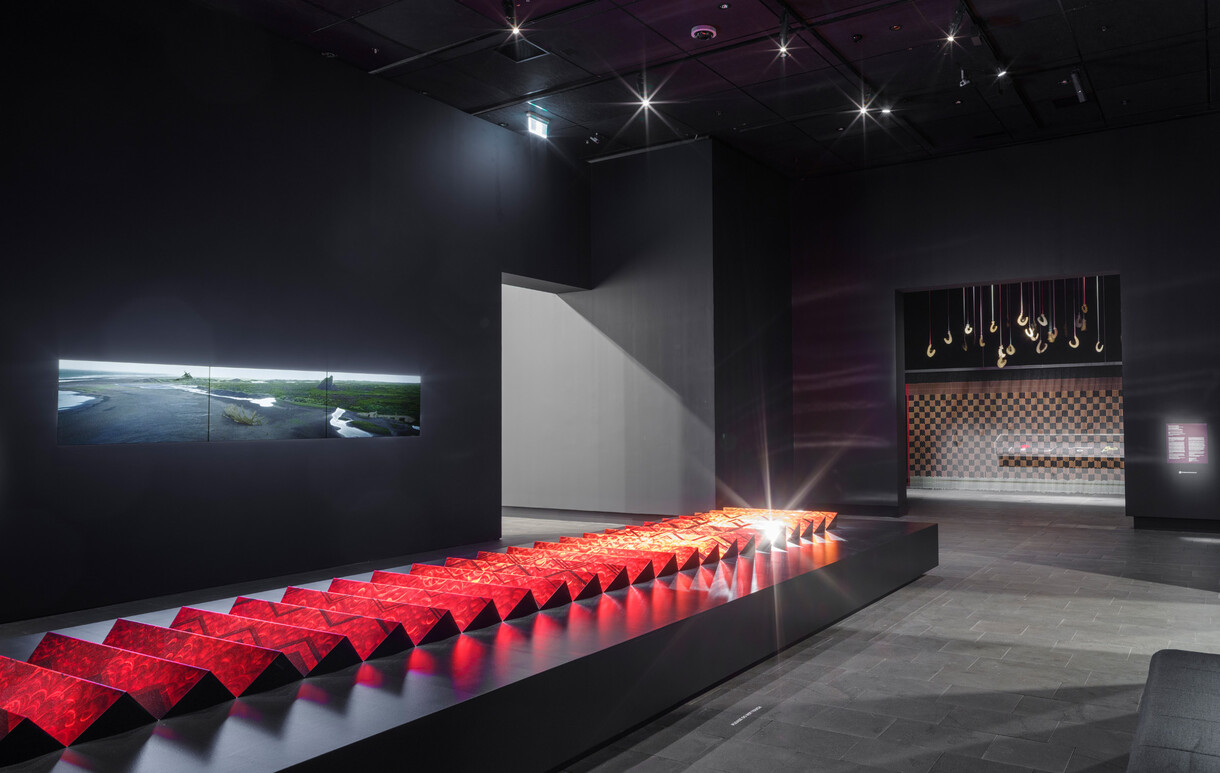
Whāia te Taniwha
20 September 2025 – 15 February 2026
Māori artists consider the enduring relevance of taniwha in Aotearoa.