Edna Pahewa
Aotearoa New Zealand
Te Arawa,
Māori
Sam Pahewa
Aotearoa New Zealand
Te Whānau ā Apanui,
Māori
Miria Heavey
Aotearoa New Zealand
Te Whānau ā Apanui,
Māori
Niho Taniwha
- 2021
- Plastic, wood; niho taniwha pattern
- Collection of Te Roopu Raranga Whatu o Aotearoa
- 1590 x 800 x 40mm
- L03/2022
Exhibition History
Related
film
Niho Taniwha
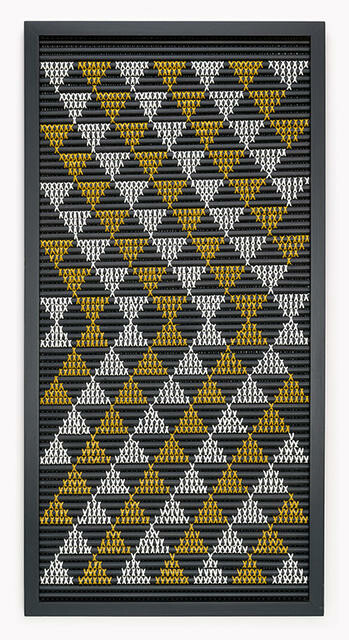
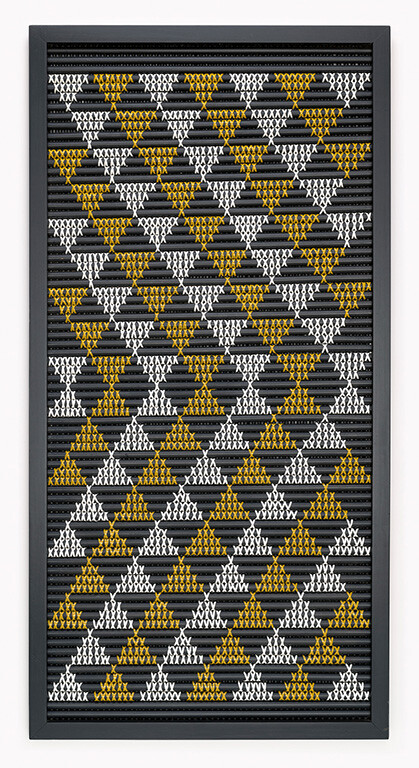
Niho Taniwha is a tukutuku panel woven by Edna Pahewa (Te Arawa), Sam Pahewa (Te Whānau ā Apanui), and Miria Heavey (Te Whānau ā Apanui) in 2021. It belongs to the collection of Te Roopu Raranga Whatu o Aotearoa, the National Māori Weavers and is cared for by Te Puna o Waiwhetū Christchurch Art Gallery.
Tukutuku are decorative panels often used to line walls in between the carved pillars of wharenui. This tukutuku panel is portrait-oriented and rectangular. It sits in a black frame. It is made from black wooden horizontal laths, or dowels, called kaho. The kaho have been woven together with strands of bright yellow and white plastic that are a few millimetres thick. The weaving creates a striking design of alternating black, white and yellow triangles, known as a niho taniwha pattern.
Meaning ‘taniwha teeth’, niho taniwha is also the title of the work. The pattern forms a mirrored top and bottom half, divided horizontally. The edges of the plastic would feel firm, while the rounded face of the kaho would make a series of gentle bumps.
Black triangles are formed by the negative space between each white and yellow triangle. Each triangle is four kaho tall, and the white or yellow ones are made up of horizontal rows of woven ‘x’s – seven ‘x’s on the bottom layer, then five, three and one at the top. On the bottom half, the top of one triangle sits between the bottom corners of two triangles on the row above. The bottom row has seven triangles, alternating white, yellow with black negative space in between, the second row has six also alternating white yellow white yellow. The next pair of rows start with yellow then white. The rows alternate this way up the work. For two rows in the middle of the panel the bottom triangles with their tips pointing up meet the tips of the triangles on the upper half which point down. These triangles form a series of seven alternating white and yellow hourglass shapes.
The alternating triangles form long diagonals of colour on the work that join in the middle to form a secondary pattern of large arrows pointing to the right.
Traditionally, tukutuku panels are woven from natural materials such as harakeke or kiekie instead of plastic. The different patterns used within tukutuku panels each have their own associated kōrero. For example, niho taniwha patterns are often used to represent whakapapa, leadership and self-determination. In some places, niho taniwha are also connected to tohorā and makō and their depiction acknowledges these relations as guardians.