Kā Kaupapa o te Wā
What’s On
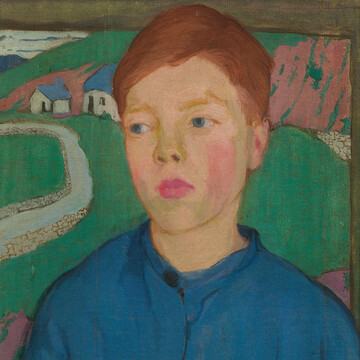
Edith Collier: Early New Zealand Modernist
A rare opportunity to view the work of one of Aotearoa New Zealand’s most adventurous and experimental modernist artists.
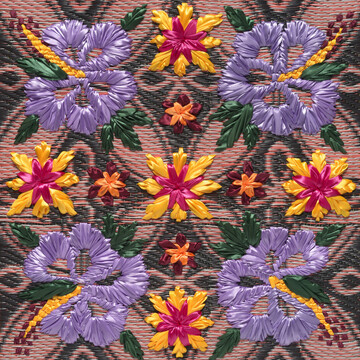
Made in the Pacific: A Collection of Tāoga
A selection of Pacific tāoga from the Canterbury Museum in conversation with contemporary artworks that highlight the continued strength in culture and traditional art forms.
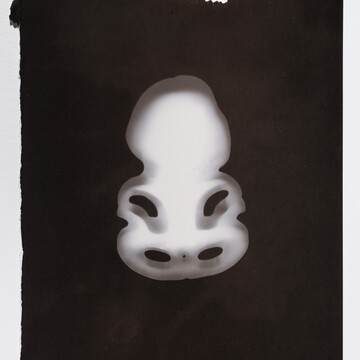
Mark Adams: A Survey | He Kohinga Whakaahua
A comprehensive survey spanning the artist's career.
E tuwhera ana te wharetoi i kā rā e 7 o te wiki, 10am - 5pm
Ka tuwhera ki te 9pm i kā pō Wenerei
Open 7 days, 10am - 5pm
Late night Wednesday until 9pm
Uruka utukore, ahokore utukore
Free entry, free wifi
Collection
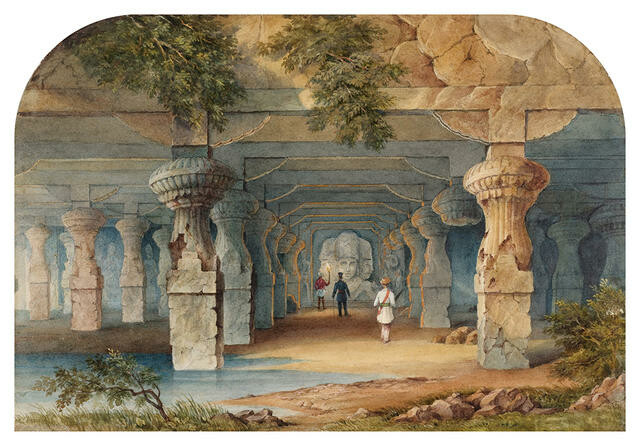
William Daniell, Thomas Daniell The Shiva Cave, Elephanta Island.
Thomas and William Daniell visited Bombay (Mumbai) in 1793 in the final months of their seven-year Indian stay, and met Scottish-born artist James Wales, who became their guide to nearby Elephanta Island and its rock-hewn caves, an ancient former Hindu Shiva temple. The Daniells worked in partnership, William drawing outlines with a camera obscura, and Thomas completing works in watercolour.
(Out of Time, 23 September 2023 – 28 April 2024)
Collection
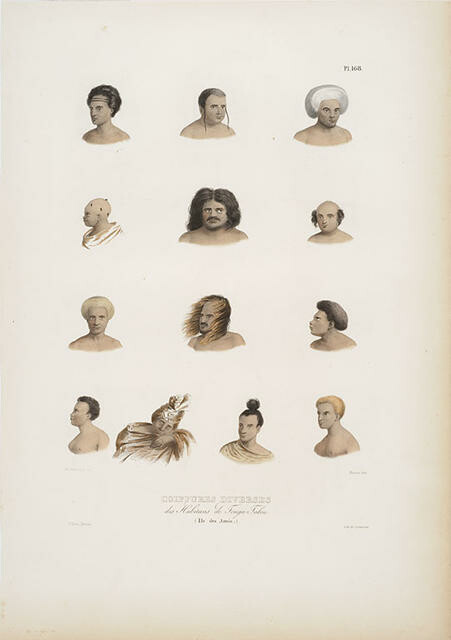
Louis Auguste de Sainson Coiffures diverses des habitans de Tonga Tabou, lle des Amis
Louis Auguste de Sainson was the official artist aboard Captain Dumont d’Urville’s Astrolabe. He spent three months in New Zealand in 1827 on a maritime mapping survey between Tasman Bay and the Bay of Islands, followed by a month in Tonga. A substantial publication on d’Urville’s 1826–29 voyages through Asia and the Pacific was published in Paris in 1833, profusely illustrated by lithographic prints after de Sainson’s drawings.
D’Urville and his crew had close contact with people they met, including the Totaranui chief Tehinui (or Tehi-Noui) and his travelling companion Kokiore (or Koki-Hore) depicted in print 2, who were sketched by de Sainson after coming aboard at Palliser Bay (near present-day Wellington). Tehinui and Kokiore at first both intended to reach Europe, but instead disembarked at Tolaga Bay, later finding their own way home. In summarising his portrait sketching process, de Sainson later recalled: “What I was doing caused a lot of laughter; every minute they tried to escape me.” (Kā Honoka, 18 December 2015 – 28 August 2016)
Collection
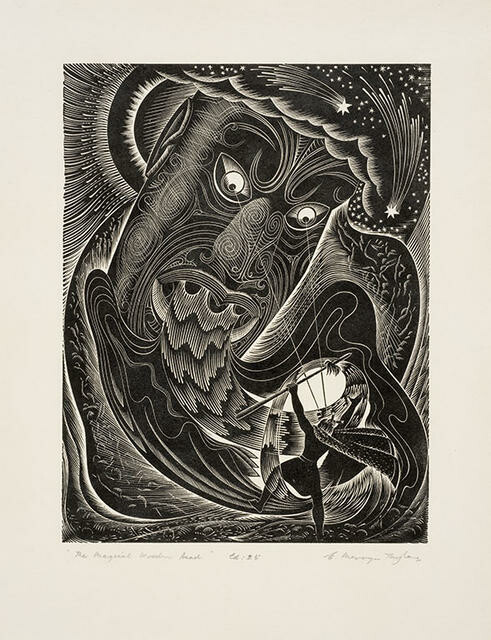
E. Mervyn Taylor The Magical Wooden Head
New Zealand’s most respected wood engraver, E. Mervyn Taylor remains renowned for his delicately engraved and beautifully designed prints. He was drawn to Māori mythology for much of his subject matter, in particular George Grey’s collected legends published as Polynesian Mythology in 1855.
In this work he depicts the myth of the Ma- ori sorcerer Hakawau defeating a carved magical wooden head whose stare will cause death to anyone who looks at it. As with his contemporary British artists, Taylor’s wood engravings were also used for illustrative purposes, and in 1946 he produced a limited edition book of his wood engravings through Christchurch’s Caxton Press – which can be seen elsewhere in the exhibition.
The Golden Age 18 December 2015 – 1 May 2016
'A book of wood engravings' by E Mervyn Taylor is in the Robert and Barbara Stewart Library and Archives and can be viewed by appointment
Collection
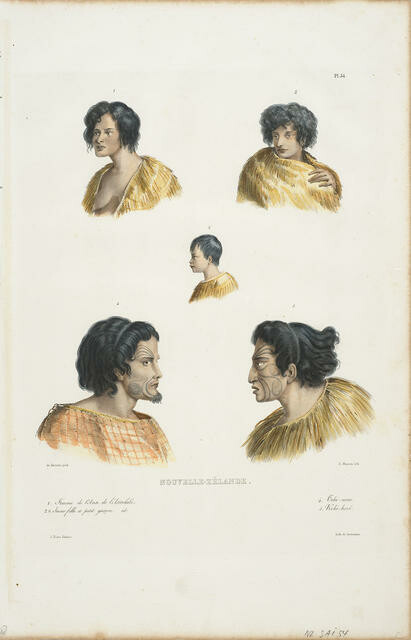
Louis Auguste de Sainson Nouvelle-Zélande
Louis Auguste de Sainson was the official artist aboard Captain Dumont d’Urville’s Astrolabe. He spent three months in New Zealand in 1827 on a maritime mapping survey between Tasman Bay and the Bay of Islands, followed by a month in Tonga. A substantial publication on d’Urville’s 1826–29 voyages through Asia and the Pacific was published in Paris in 1833, profusely illustrated by lithographic prints after de Sainson’s drawings.
D’Urville and his crew had close contact with people they met, including the Totaranui chief Tehinui (or Tehi-Noui) and his travelling companion Kokiore (or Koki-Hore) depicted in print 2, who were sketched by de Sainson after coming aboard at Palliser Bay (near present-day Wellington). Tehinui and Kokiore at first both intended to reach Europe, but instead disembarked at Tolaga Bay, later finding their own way home. In summarising his portrait sketching process, de Sainson later recalled: “What I was doing caused a lot of laughter; every minute they tried to escape me.” (Kā Honoka, 18 December 2015 – 28 August 2016)
Collection
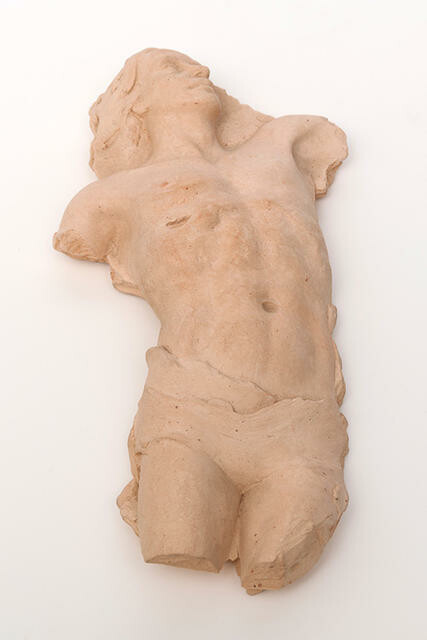
Ria Bancroft Resurrection Tabernacle screen doors (Cathedral of the Blessed Sacrament)
In 1980, Christchurch artist Ria Bancroft (1907-1993) presented the Gallery with two fine plaster castings and two terracotta model fragments from one of her most important commissions, The Bronze Tabernacle Screen Doors for the Cathedral of the Blessed Sacrament. Commissioned February 1975, the Bronze Doors were dedicated by Archbishop Angelo Acerbi Apostolic Pro-Nuncio to New Zealand on June 12, 1977.
When commissioned, the doors were just one part of a large project being undertaken by the Catholic Church in their redesign and restoration programme of the Cathedral of the Blessed Sacrament.
There is more information on the Tabernacle Commission in the supplement section of Bulletin No.11, September/October 1980.