
Kā Kaupapa o te Wā
What’s On
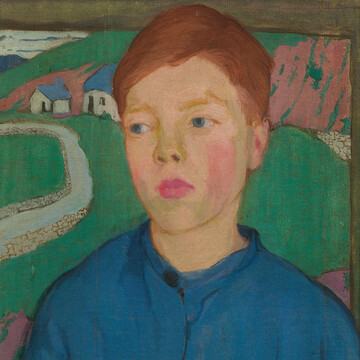
Edith Collier: Early New Zealand Modernist
A rare opportunity to view the work of one of Aotearoa New Zealand’s most adventurous and experimental modernist artists.
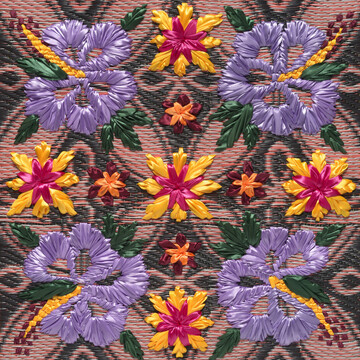
Made in the Pacific: A Collection of Tāoga
A selection of Pacific tāoga from the Canterbury Museum in conversation with contemporary artworks that highlight the continued strength in culture and traditional art forms.
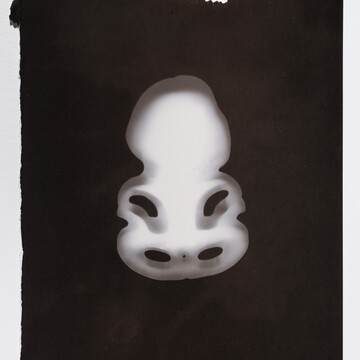
Mark Adams: A Survey | He Kohinga Whakaahua
A comprehensive survey spanning the artist's career.
E tuwhera ana te wharetoi i kā rā e 7 o te wiki, 10am - 5pm
Ka tuwhera ki te 9pm i kā pō Wenerei
Open 7 days, 10am - 5pm
Late night Wednesday until 9pm
Uruka utukore, ahokore utukore
Free entry, free wifi
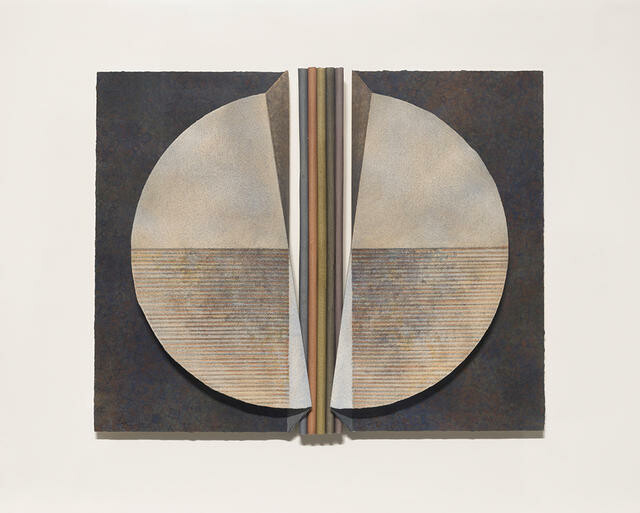
Collection
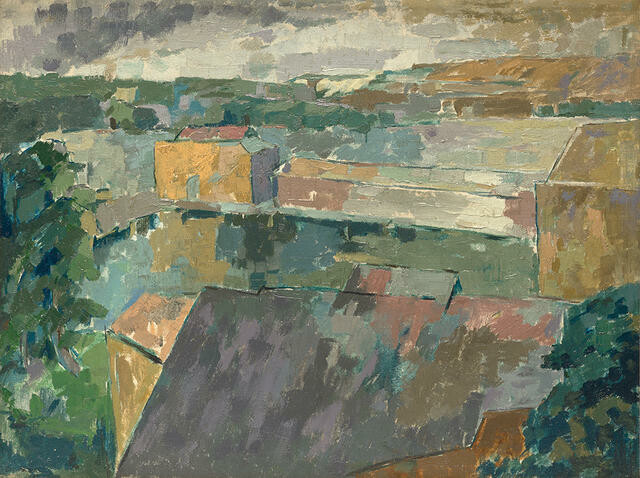
Don Peebles Sydney Harbour
Don Peebles travelled to Sydney in 1950, in search of a more modern art training than was available to him in Wellington. (‘Nothing much was going on in Wellington other than us being taught to draw a foot that looked like a foot,’) he said. His teacher John Passmore (1904–1984) introduced his students to early twentieth-century European modernism: Bonnard and Picasso, Cézanne and cubism. ‘That was modernism to me. That was the latest thing as far as I knew in those days.’ Passmore also encouraged his students to paint around the waterfront, a regular subject for his own work in the early 1950s. Sydney Harbour reveals Peebles moving towards the abstraction that would characterise his mature work, but not yet completely there (he made his first completely abstract work a few years later in London). A Cézanne-esque concern for planes, facets and the structure of forms is evident, even while buildings, water and distant hills remain visible.
(March 2016)
Collection
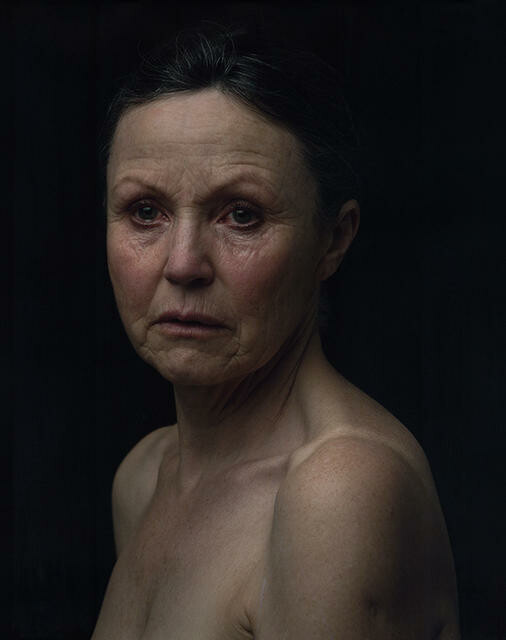
Roberta Thornley Crying my Mother's Tears (Meme)
Roberta Thornley made this portrait of her mother after her youngest sister left home. “A house of five girls suddenly empty. It was the first time I had really noticed her vulnerability. I think she had spent thirty years coming home from work to a house full of us, and this was the end of it.” Photographing her mother with bare shoulders, Thornley avoided any reference to time or place, instead allowing her mother’s body to tell the story. As a child, she had liked to run her fingers along the permanent dent a bra strap had left in her mother’s skin. Now, that same mark made her uneasy. “I noticed her thinning skin, which triggered a memory of her franticly mopping up blood from the shin of my grandmother’s leg after she had caught her ninety-year-old paper-thin skin on a rose thorn in the garden. My mother, with her very black hair, was ageing. Near the end of what seemed to be a very long time making this photograph, she cried. She was carrying generations of tears from my grandmother Meme through to me.”
(We do this, 12 May 2018 - 26 May 2019)
Collection
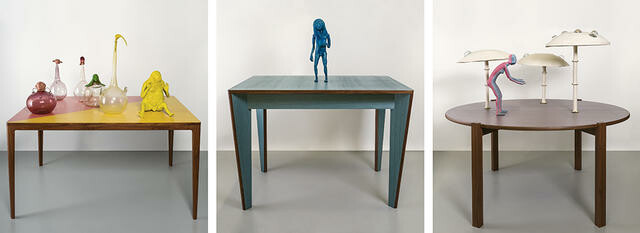
Francis Upritchard rainwob ii
The work on the three tables at the centre of this room is part of a series of sculptures artist Francis Upritchard has described as “an attempt at an unsuccessful utopia”. Like the flipped-back word in its title, it seems to set off in one direction – towards a kind of visionary, psychedelic paradise – but overturns our expectations to arrive somewhere much less certain. Locked away in intensely private reveries, the delicate, marionette-like figures that inhabit it are curiously enigmatic: part-primeval bog people, part-countercultural prophets, they live out their radiant existences somewhere between the ancient unknowable past and the distant unknowable future.
(Unseen: The Changing Collection, 18 December 2015 – 19 June 2016)
Collection
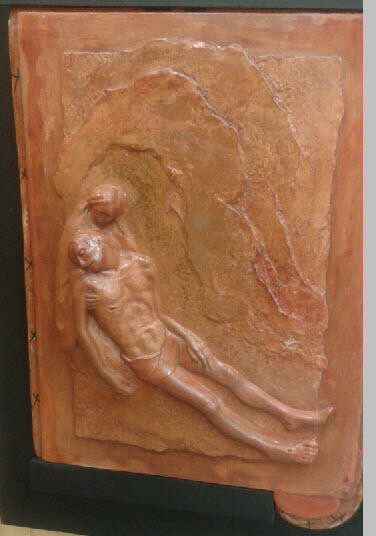
Ria Bancroft Foundry plaster for ‘Pieta’ - Tabernacle screen doors for Cathedral of the Blessed Sacrament
In 1980, Christchurch artist Ria Bancroft (1907-1993) presented the Gallery with two fine plaster castings and two terracotta model fragments from one of her most important commissions, The Bronze Tabernacle Screen Doors for the Cathedral of the Blessed Sacrament. Commissioned February 1975, the Bronze Doors were dedicated by Archbishop Angelo Acerbi Apostolic Pro-Nuncio to New Zealand on June 12, 1977.
When commissioned, the doors were just one part of a large project being undertaken by the Catholic Church in their redesign and restoration programme of the Cathedral of the Blessed Sacrament.
There is more information on the Tabernacle Commission in the supplement section of Bulletin No.11, September/October 1980.
Collection
![Nouvelle-Zélande - coffre en bois sculpté [Plate 59]](/media/cache/d2/0d/d20d3e71824f4f302a9ddce9f4f594ca.jpg)
Louis Auguste de Sainson Nouvelle-Zélande - coffre en bois sculpté [Plate 59]
Louis Auguste de Sainson was the official artist aboard Captain Dumont d’Urville’s Astrolabe. He spent three months in New Zealand in 1827 on a maritime mapping survey between Tasman Bay and the Bay of Islands, followed by a month in Tonga. A substantial publication on d’Urville’s 1826–29 voyages through Asia and the Pacific was published in Paris in 1833, profusely illustrated by lithographic prints after de Sainson’s drawings.
D’Urville and his crew had close contact with people they met, including the Totaranui chief Tehinui (or Tehi-Noui) and his travelling companion Kokiore (or Koki-Hore) depicted in print 2, who were sketched by de Sainson after coming aboard at Palliser Bay (near present-day Wellington). Tehinui and Kokiore at first both intended to reach Europe, but instead disembarked at Tolaga Bay, later finding their own way home. In summarising his portrait sketching process, de Sainson later recalled: “What I was doing caused a lot of laughter; every minute they tried to escape me.” (Kā Honoka, 18 December 2015 – 28 August 2016)
Collection
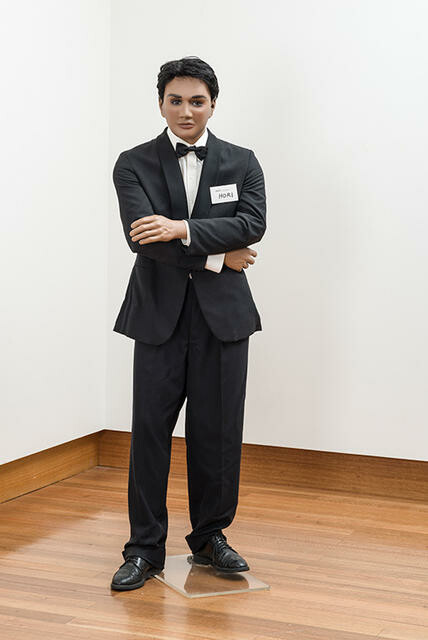
Michael Parekowhai Poorman, Beggarman, Thief (Poorman)
Tinker, tailor, soldier, sailor, rich man, poor man, beggar man, thief – the old children’s counting game predicted the calibre of husband a girl might marry. Michael Parekōwhai selected the three least desirable options as the titles for three Māori mannequins in dinner suits, with Poorman shown here. The corporate name badge introducing him as ‘Hori’ – a racist slur used to denigrate Māori – suggests how such stereotypes are used to jam people into prescribed roles, regardless of their abilities or potential. Don’t be fooled by his still, synthetic smoothness though; Poorman is no dummy. He’s a shrewd reminder to check our preconceptions at the door.
(Dummies & Doppelgängers, 2 November 2024 – 23 March 2025)