Kā Kaupapa o te Wā
What’s On
Mark Adams: A Survey | He Kohinga Whakaahua
A comprehensive survey spanning the artist's career.
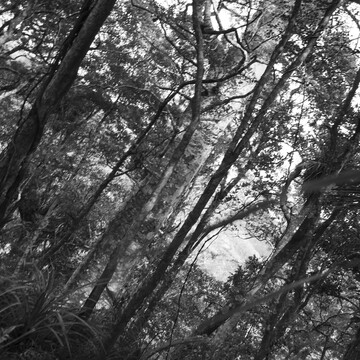
Ana Iti: Ngahere Behind a Pile of Metal
An immersive installation considering the legacies of deforestation and significance of kauri trees.
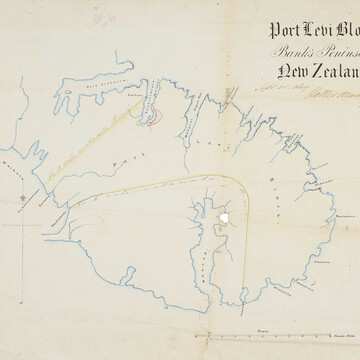
Kā Whakatauraki: The Promises
A landmark exhibition bringing together the ten Ngāi Tahu land sale purchase deeds.
E tuwhera ana te wharetoi i kā rā e 7 o te wiki, 10am - 5pm
Ka tuwhera ki te 9pm i kā pō Wenerei
Open 7 days, 10am - 5pm
Late night Wednesday until 9pm
Uruka utukore, ahokore utukore
Free entry, free wifi
Collection
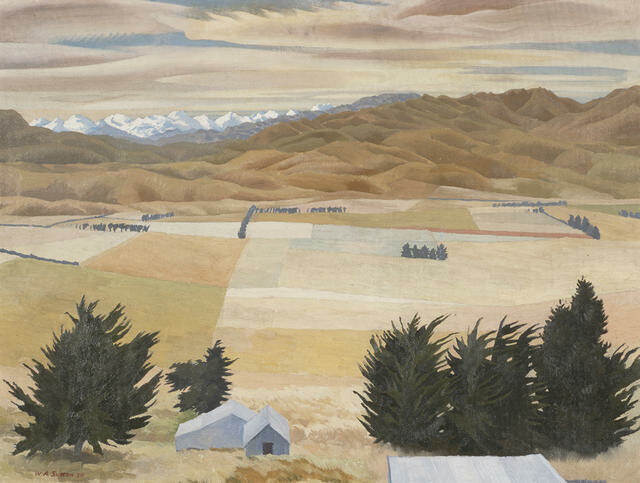
Bill Sutton Hills and Plains, Waikari
Living in Ōtautahi Christchurch for most of his life, Bill Sutton was an artist who identified deeply with the surrounding Waitaha Canterbury landscape. He would often escape the city for sketching trips to Horomaka Banks Peninsula or inland towards the High Country. Works such as this highlight his interest in regionalism and the distinctive features of this land. Here, he focuses on the abstract patterns of paddocks and shelter belts with the dramatic backdrop of the foothills and Kā Tiritiri-o-te-moana Southern Alps in the distance. The sky is painted to show the unique cloud formations resulting from the celebrated nor’west winds of Waitaha.
He Kapuka Oneone – A Handful of Soil (from August 2024)
Collection
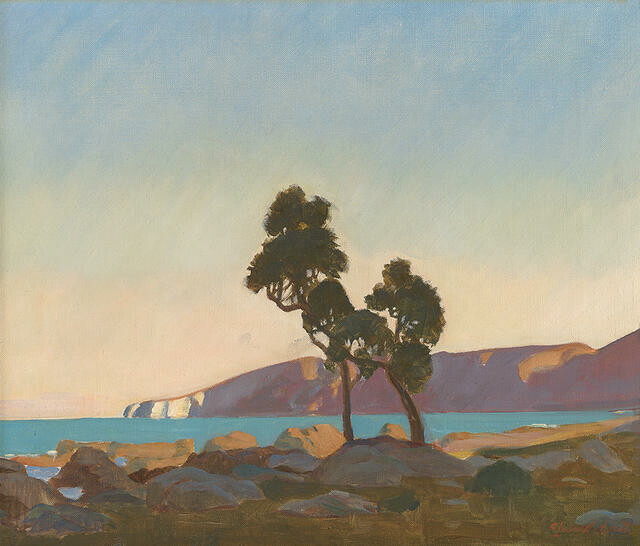
Colin S. Lovell-Smith Evening
With the arrival of the motorcar, Otama-a-kura / Goose Bay (south of Kaikōura) became a popular camping spot for summer visitors. Christchurch-born couple Colin and Rata Lovell-Smith stayed there regularly throughout the 1930s, joining the throng heading north each season to camp, fish and relax – and, for these two, to paint. The results of Colin’s labours include this pared back evening coastal scene at Haumuri Point; and a painterly record of civil engineering works disturbing the usually tranquil Otumatu (near Goose Bay) during the completion of the Main Trunk Line in 1939.
Collection
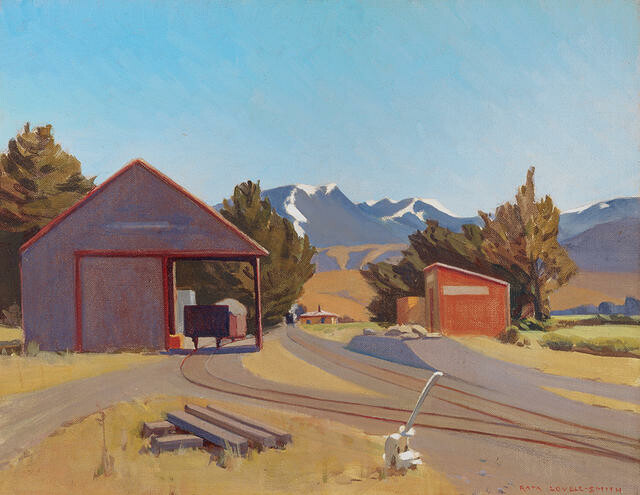
Rata Lovell-Smith Hawkins
By 1933 Rata Lovell-Smith was at the forefront of what became known as Canterbury Regionalism, a style of painting that focused on the unique features of the Waitaha Canterbury landscape. She was one of the region’s most progressive painters, and Hawkins, which focuses on the small White Cliffs Branch railway station, highlights her distinctive, sharp style of landscape painting. A reviewer at the time glowingly commented on her work, writing: She glories in the colour contrasts of the New Zealand landscape. […] Here are no subtleties but a series of vivid and simplified impressions of her native country. […T]here can never be any doubt about the locality of Mrs Lovell-Smith’s landscapes. It is a little as though she had never got over her first impression of violent tone and colour contrasts, and in a state of beatific astonishment had set herself to establish that impression at the expense of anything that tended to modify it.
(He Kapuka Oneone – A Handful of Soil, 2025)
Collection
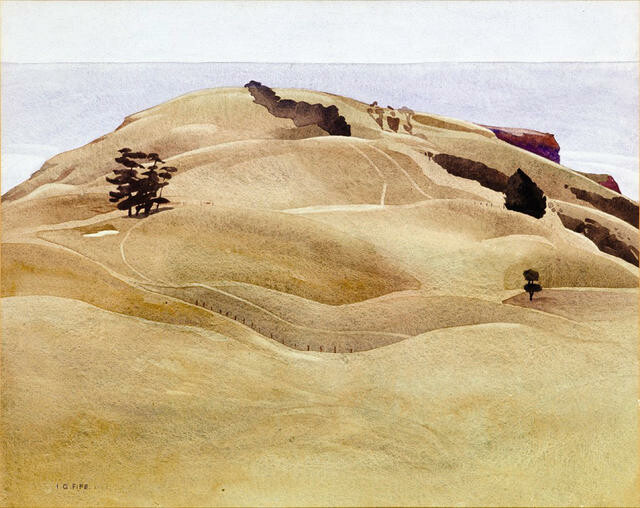
Ivy Fife The Long Lookout
'Tu-Te-Raki-Whanoa, the son of Aoraki, is the atua [demi-god] who shapes the wrecked waka to ready it for people. His first great task is to defeat the south-easterly winds roaring along the side of the wreck. He invents peninsulas. He rakes all the rubbish of the wreckage and piles it up like a gigantic break water. Thus you have the Canterbury Plains and a sheltered place for his next invention, Whakaraupō [Lyttelton Harbour] and Akaroa Harbour. He then depresses his heel and creates Waihora [Lake Ellesmere], later claimed by the exploring ancestor, Rākaihautū, as Te Kete ika o Te Rākaihautū [the fish basket of Rākaihautū].' —Sir Tipene O’Regan
(He Rau Maharataka Whenua: A Memory of Land, 17 September 2016 – 18 February 2017)
Collection
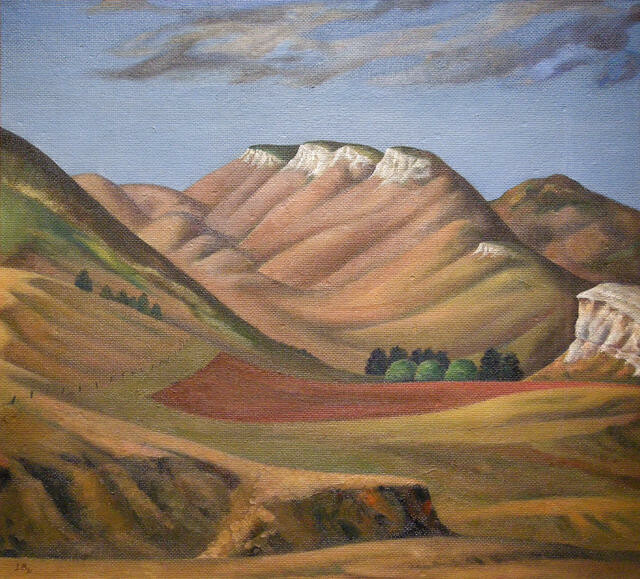
Leo Bensemann Canterbury Spring
In 1930s New Zealand there was wide discussion about what was unique about the New Zealand situation; what it was that made us different from the rest of the world. Artists and writers began exploring ways to identify our national identity. A number of artists began painting the Canterbury High Country, most famously Rita Angus and her landscape painting of the railway station at Cass. One reviewer in 1936 observed that there was a new quality in the landscapes exhibited in Christchurch that seemed ‘to consist in a removal of the romantic mists which used to obscure mountains and the Canterbury countryside generally. The light now is clear and hard, the colours are in flat planes, and the effect is of seeing the country through a gem-like atmosphere. There is also a new romantic standpoint – an insistence on the isolation and brooding loneliness of the hills.’ It’s a statement that certainly rings true with the Canterbury paintings of Rita Angus, Leo Bensemann, Louise Henderson, Rata Lovell-Smith and Bill Sutton.
(March 2018)
Collection
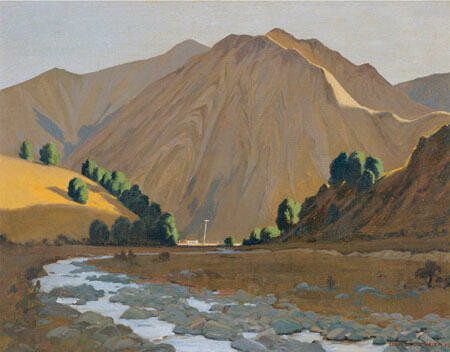
Colin S. Lovell-Smith Sunset, Craigieburn
Colin Lovell-Smith often went on painting trips with his wife, Rata Lovell-Smith, who was also a landscape painter. Craigieburn is in Kā Tiritiri-o-te-moana Southern Alps, about 100 kilometres northwest of Ōtautahi Christchurch. Set beside a small riverbed close to the main road, the painting focuses on the steep eroded slopes of the Craigieburn Range. Lovell-Smith has paid close attention to the landform details, capturing the distinctive qualities of the Waitaha Canterbury mountain region. Shades of ochre are subtly orchestrated with the soft grey of the predominant greywacke rocks.
(He Kapuka Oneone – A Handful of Soil, 2025)
Collection
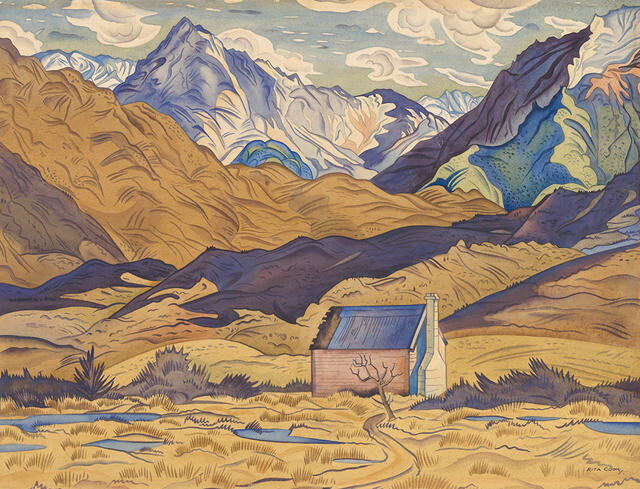
Rita Angus Mountains, Cass
One of Rita Angus’s most accomplished watercolours, Mountains, Cass highlights the artist’s interest in capturing unique aspects of the Aotearoa New Zealand landscape. She was captivated by elements of the high country in Waitaha Canterbury, including, here, the bright, harsh light, a humble musterer’s hut and the sun-browned tussock cloaking the hills. The mountain slope beyond the hills features subtle shades of blue-green with simplified dark green dashes for the trees, revealing the influence of ukiyo-e prints.
(Dear Shurrie: Francis Shurrock and his contemporaries, 8 March – 13 July 2025)