Collection
Untitled (Head)

Shane Cotton Untitled (Head)

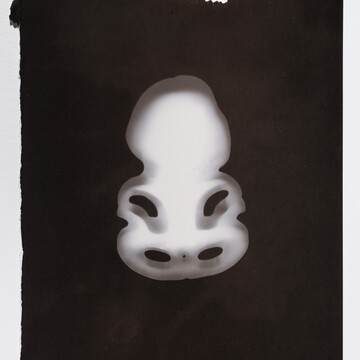
From a distance, these ten works by Shane Cotton have a strongly graphic quality. They look like a row of archery targets, or a series of pulsing GPS locator beacons zeroing in on a significant location. But when you get up close, the surfaces of Cotton’s circular forms appear softly weathered, as if the pressure of the world around them has worn them away slightly. You become aware of the small painted motifs within the concentric circles—heads, texts, bars, dots, smaller targets, ancient presences. And suddenly, rather than looking like something that belongs to space, like the trajectory of an arrow or the flight plan of a plane, you see that the works might equally be concerned with time, that the bands of colour might be read as the rings of a tree or as a model of eternal return.

The works themselves took several years to make. In 2009, Cotton spent a couple of weeks in Israel working with the Gottesman Etching Center to produce the circular forms. (The colours are drawn from the Israeli and Palestinian national flags, as well as the tino rangatiratanga flag and Cotton’s impressions of the landscape.) They’re monoprints, which means they exist as single images pulled from the printing press—essentially, they’re printed paintings. When Cotton got back to New Zealand, he put the sheets away for three years, finally adding the smaller motifs over the etched surface by hand.

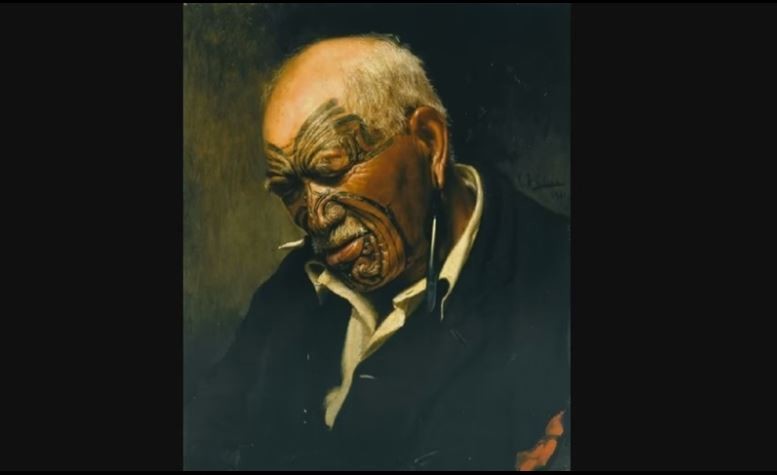
The heads in the images are toi moko, or mokomokai, preserved and tattooed Māori heads. Cotton has worked for many years now from a copy of a photograph of Horatio Gordon Robley, a colonial soldier and artist who fought in the New Zealand wars, with his collection of heads displayed on a wall behind him. It’s a horrific image, a deeply shocking one. “I wanted to see whether I could take a heavily laden image from our history and say something different with it. […] I think they’re really about what it means to have and hold on to a memory or retain a likeness, which is also what painting was historically about. So I thought I’d start painting them and see what happened.”

(Your Hotel Brain 13 May 2017 - 8 July 2018)

Collection
Untitled (Head 4)

Shane Cotton Untitled (Head 4)

From a distance, these ten works by Shane Cotton have a strongly graphic quality. They look like a row of archery targets, or a series of pulsing GPS locator beacons zeroing in on a significant location. But when you get up close, the surfaces of Cotton’s circular forms appear softly weathered, as if the pressure of the world around them has worn them away slightly. You become aware of the small painted motifs within the concentric circles—heads, texts, bars, dots, smaller targets, ancient presences. And suddenly, rather than looking like something that belongs to space, like the trajectory of an arrow or the flight plan of a plane, you see that the works might equally be concerned with time, that the bands of colour might be read as the rings of a tree or as a model of eternal return.

The works themselves took several years to make. In 2009, Cotton spent a couple of weeks in Israel working with the Gottesman Etching Center to produce the circular forms. (The colours are drawn from the Israeli and Palestinian national flags, as well as the tino rangatiratanga flag and Cotton’s impressions of the landscape.) They’re monoprints, which means they exist as single images pulled from the printing press—essentially, they’re printed paintings. When Cotton got back to New Zealand, he put the sheets away for three years, finally adding the smaller motifs over the etched surface by hand.

The heads in the images are toi moko, or mokomokai, preserved and tattooed Māori heads. Cotton has worked for many years now from a copy of a photograph of Horatio Gordon Robley, a colonial soldier and artist who fought in the New Zealand wars, with his collection of heads displayed on a wall behind him. It’s a horrific image, a deeply shocking one. “I wanted to see whether I could take a heavily laden image from our history and say something different with it. […] I think they’re really about what it means to have and hold on to a memory or retain a likeness, which is also what painting was historically about. So I thought I’d start painting them and see what happened.”

(Your Hotel Brain 13 May 2017 - 8 July 2018)

Collection
Untitled (Head 5)

Shane Cotton Untitled (Head 5)

From a distance, these ten works by Shane Cotton have a strongly graphic quality. They look like a row of archery targets, or a series of pulsing GPS locator beacons zeroing in on a significant location. But when you get up close, the surfaces of Cotton’s circular forms appear softly weathered, as if the pressure of the world around them has worn them away slightly. You become aware of the small painted motifs within the concentric circles—heads, texts, bars, dots, smaller targets, ancient presences. And suddenly, rather than looking like something that belongs to space, like the trajectory of an arrow or the flight plan of a plane, you see that the works might equally be concerned with time, that the bands of colour might be read as the rings of a tree or as a model of eternal return.

The works themselves took several years to make. In 2009, Cotton spent a couple of weeks in Israel working with the Gottesman Etching Center to produce the circular forms. (The colours are drawn from the Israeli and Palestinian national flags, as well as the tino rangatiratanga flag and Cotton’s impressions of the landscape.) They’re monoprints, which means they exist as single images pulled from the printing press—essentially, they’re printed paintings. When Cotton got back to New Zealand, he put the sheets away for three years, finally adding the smaller motifs over the etched surface by hand.

The heads in the images are toi moko, or mokomokai, preserved and tattooed Māori heads. Cotton has worked for many years now from a copy of a photograph of Horatio Gordon Robley, a colonial soldier and artist who fought in the New Zealand wars, with his collection of heads displayed on a wall behind him. It’s a horrific image, a deeply shocking one. “I wanted to see whether I could take a heavily laden image from our history and say something different with it. […] I think they’re really about what it means to have and hold on to a memory or retain a likeness, which is also what painting was historically about. So I thought I’d start painting them and see what happened.”

(Your Hotel Brain 13 May 2017 - 8 July 2018)

Collection
Emperor 2

Gretchen Albrecht Emperor 2

This oval painting suggests space in which emotion is contained, a signature format for this abstract artist. Radiating colour emits an aura of intensity and physical energy, countered by rectangular shapes evoking order and balance. With its colour field of rich tones and underlying theme of emotion, this work reaches out to the viewer; the colour, form, gesture and idea all mixing to create a unified expression.

Gretchen Albrecht graduated from the Elam School of Fine Arts, University of Auckland in 1963. In 1981 she was awarded the Frances Hodgkins Fellowship at the University of Otago. Albrecht has exhibited in New Zealand and internationally for more than 35 years. Her recent work has appeared in exhibitions in both Europe and the United States, including the exhibition Decades at the Robert Steele Gallery in New York. A retrospective exhibition of oval and hemisphere paintings, accompanied by recent works on paper and editions, was shown at the Dunedin Public Art Gallery and City Gallery Wellington in 2005.

Commentary
Radical freedoms

Radical freedoms

The recent furore around Eleanor Catton's comments in the wake of the NZ Post Book Awards, and the tone of the subsequent debate that ensued, has prompted us to think again about the role of the public intellectual in New Zealand. In our role as visual archivists of this city, and this country, critical reflections on the contemporary are something we frequently expect of artists. But to what degree do artists exercise their individual freedom to radically question community values? And who claims this role for artists and in what situations?

Article
An invitation to participate

An invitation to participate

You might be well aware of fanzines as a form of analogue self-publishing in and around your own arts community. Or they might be somewhat peripheral to the particularity of your engagement with the arts.

For the uninitiated, the word fanzine is often shortened to zine, and is pronounced 'zeen', as in 'magazine'. This abbreviation doesn't merely signal a growing ubiquity, or an economy of syllables for those (like myself) who say or write the word a lot, it also speaks to the shift away from fandom to a growing eclecticism – bringing the lie to anyone attempting to describe zines as a genre.

Load more