Kā Kaupapa o te Wā
What’s On
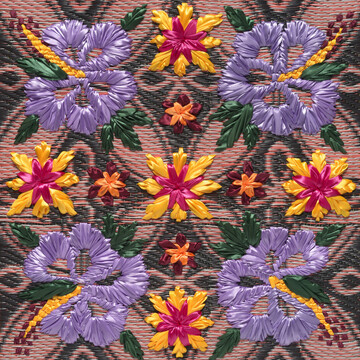
Made in the Pacific: A Collection of Tāoga
A selection of Pacific tāoga from the Canterbury Museum in conversation with contemporary artworks that highlight the continued strength in culture and traditional art forms.
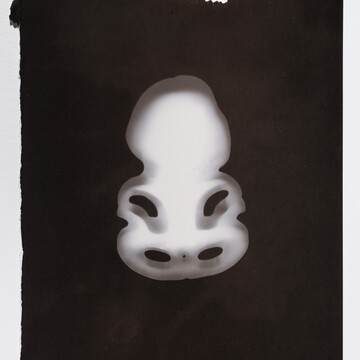
Mark Adams: A Survey | He Kohinga Whakaahua
A comprehensive survey spanning the artist's career.
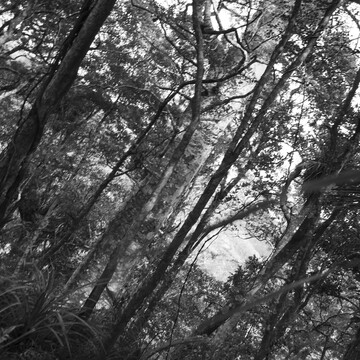
Ana Iti: Ngahere Behind a Pile of Metal
An immersive installation considering the legacies of deforestation and significance of kauri trees.
E tuwhera ana te wharetoi i kā rā e 7 o te wiki, 10am - 5pm
Ka tuwhera ki te 9pm i kā pō Wenerei
Open 7 days, 10am - 5pm
Late night Wednesday until 9pm
Uruka utukore, ahokore utukore
Free entry, free wifi
Collection
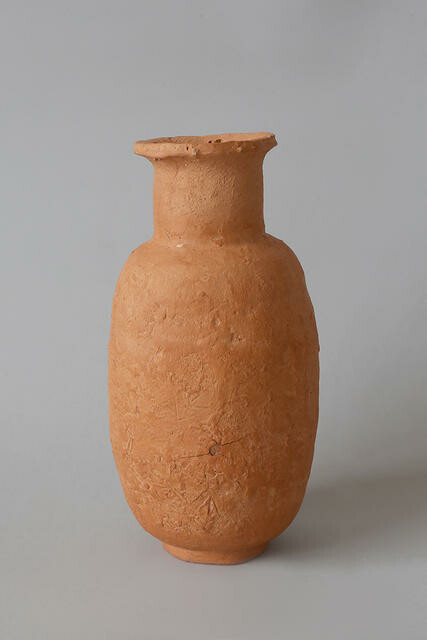
Daegan Wells Manapouri Vessel 1
Daegan Wells sourced the clay for Manapouri Vessel 1 at the shoreline of Lake Manapouri in Fiordland National Park. The artist moved to the area with his family in 1996 when his stepfather worked on the Manapōuri hydropower project. He recalls falling through a seam of clay on Frasers Beach as a child, and has returned to that same location to excavate this clay – drawing on his childhood memory as well as the sociopolitical history of the lake. Manapouri translates as anxious or sorrowful heart, and the lake was named by Māori for the two sisters, Moturua and Koronae, whose tears of grief are said to have created it. In the lead up to the 1972 election, Lake Manapouri dominated headlines as concerned locals protested against the proposed raising of the lake level to enable expansion of the hydropower scheme. The campaign launched by the Save Lake Manapouri Committees demonstrated the efficacy of grassroots protest in influencing Government policy and came to symbolise a sea change in New Zealanders' personal engagement with public environmental policy. Manapouri Vessel 1 was made during Wells’s tenure as the Olivia Spencer Bower Artist in Residence Ōtautahi. Wells had recently been exposed to the work of artist Yvonne Rust, and this roughly formed work is a celebration of Rust’s advocacy for the use of local clays and robust forms.
Melanie Oliver (2021)
Collection
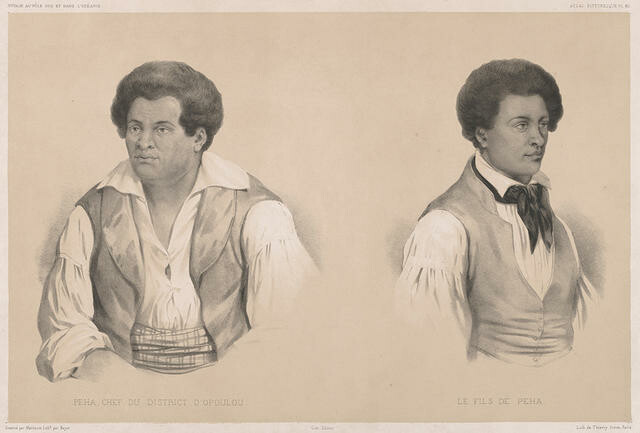
Jacques Marie Eugène Marescot-Duthilleul, Adolphe Jean-Baptiste Bayot Peha, Chef du District d'Opoulou/Le Fils de Peha
Jacques Marescot-Duthilleul’s double portrait of chief Pe’a and his son was published in France in 1842, from sketches made during a six-day visit to Apia on Upolu, Samoa in 1838. Pe’a was matai (principal chief) of Apia, recorded in captain Dumont d’Urville’s journal as ‘Pea-Pongui’. Tragically, Marescot-Duthilleul died during the return voyage in 1839.
(Out of Time, 23 September 2023 – 28 April 2024)
Collection
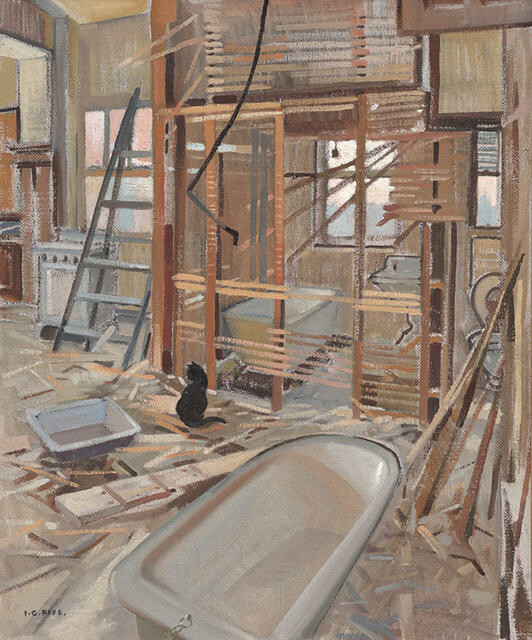
Ivy Fife The Last Tenant
Ivy Fife was strongly drawn to line and structure. Her landscape works often include trains, gates, farm buildings and railway signals, and she painted large shipping crates stacked on train wagons at Lyttelton port. When her old flat in St Elmo Courts – a 1930s high rise that stood not far from here – was being remodelled, she seized the opportunity to record the process. Here, light floods through a space that bristles with exposed wooden framing, creating a composition full of sharp angles and shadows. This chaotic scene is watched over by the artist’s cat; a small reminder of the apartment’s previous life.
(Absence, May 2023)
Collection
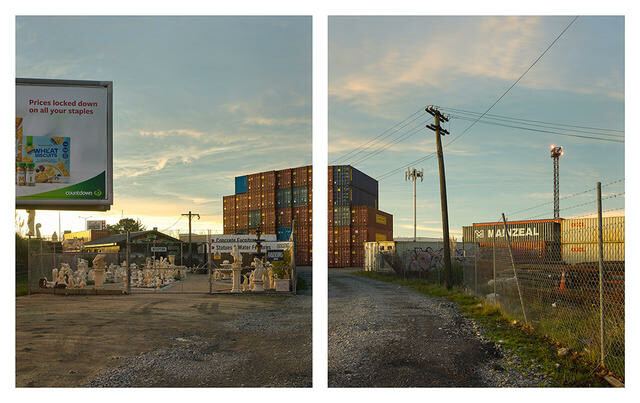
Tim J. Veling View from Waltham Road of Former Christchurch Gasworks Site (after Rita Angus and Glenn Busch)
Collection
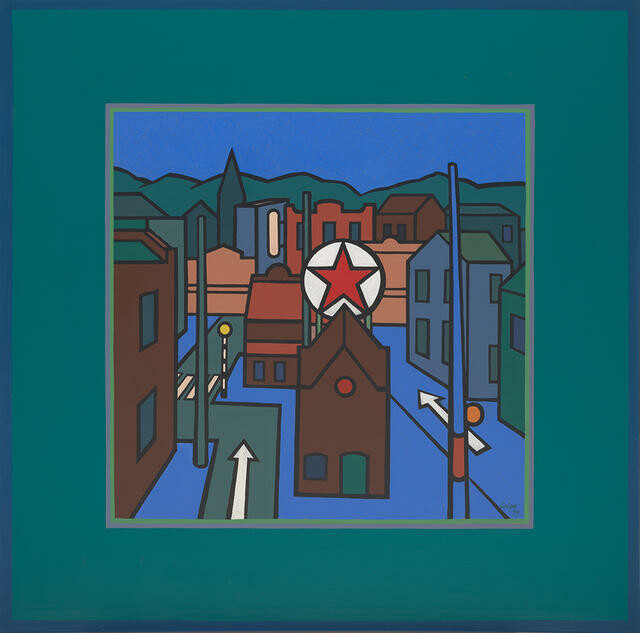
John Coley Townscape with Star
To mark the death of the artist in March 2026, this work was exhibited with this label:
We were very saddened to hear of the recent passing of artist and educator and former director of this institution John Coley. Born in Te Papaioea Palmerston North, John arrived in Ōtautahi Christchurch to take up studies at Canterbury College School of Art in 1955. While there he lived and painted at an infamous flat on Armagh Street, and his friends and flatmates included Pat Hanly, Gil Tavener (Hanly), Ted Bracey, Quentin Macfarlane, Hamish Keith, Ted Bullmore, Bill Culbert, Trevor Moffitt and Margaret Hudson-Ware. Like many artists of his generation he initially balanced his art-making with teaching and was a regular exhibitor at the famous Group Shows in Christchurch from 1960 to 1977.
In 1980 John was appointed director of this Gallery’s predecessor, the Robert McDougall Art Gallery, where he advocated for the gallery as an active space, not just somewhere where pictures were put on the walls. He believed that art education could extend the role of the Gallery. He also made a number of inspired acquisitions for the Gallery’s collection, including Colin McCahon’s 'As there is a Constant Flow of Light we are born into the Pure Land' in 1982; this was not a popular decision at the time, and he was forced to withstand intense public criticism. At the time John described McCahon’s painting as “…a fine memorable painting, an important acquisition for the city and one which I am convinced will be fully justified by the passing of time.” 'As there is a Constant Flow of Light…' quickly became a treasured work in the Gallery’s collection.
Throughout the 1990s John was a vocal advocate for the construction of a new gallery building in Christchurch – strongly favouring a central city location over Hagley Park, his view was simply that the city was where the people were. After his retirement in 1995 he enjoyed painting full-time, and made the move to Te Makaurau Auckland with his wife Fay to be nearer family. Always cheerful and engaging John maintained a strong interest in the Gallery and made a point of visiting whenever he returned to Christchurch to say hello to staff and discuss any recent acquisitions and exhibitions that interested him. Our thoughts are with Fay and the Coley family at this sad time.