Kā Kaupapa o te Wā
What’s On
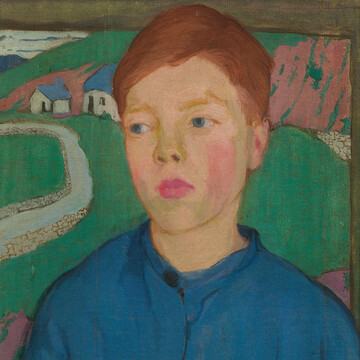
Edith Collier: Early New Zealand Modernist
A rare opportunity to view the work of one of Aotearoa New Zealand’s most adventurous and experimental modernist artists.
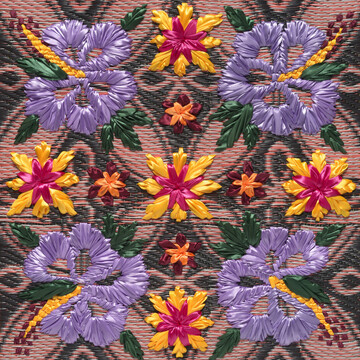
Made in the Pacific: A Collection of Tāoga
A selection of Pacific tāoga from the Canterbury Museum in conversation with contemporary artworks that highlight the continued strength in culture and traditional art forms.
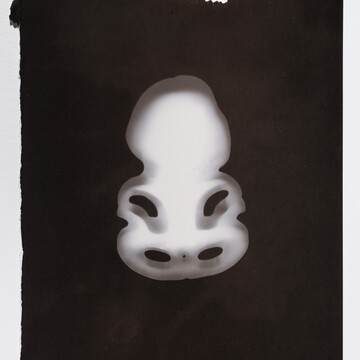
Mark Adams: A Survey | He Kohinga Whakaahua
A comprehensive survey spanning the artist's career.
E tuwhera ana te wharetoi i kā rā e 7 o te wiki, 10am - 5pm
Ka tuwhera ki te 9pm i kā pō Wenerei
Open 7 days, 10am - 5pm
Late night Wednesday until 9pm
Uruka utukore, ahokore utukore
Free entry, free wifi
Collection
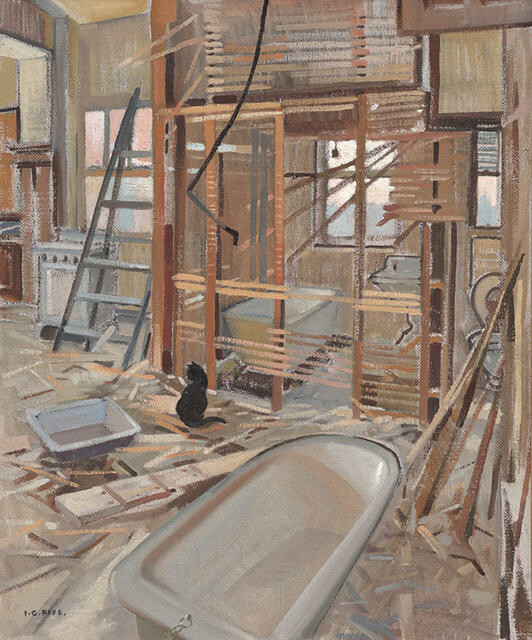
Ivy Fife The Last Tenant
Ivy Fife was strongly drawn to line and structure. Her landscape works often include trains, gates, farm buildings and railway signals, and she painted large shipping crates stacked on train wagons at Lyttelton port. When her old flat in St Elmo Courts – a 1930s high rise that stood not far from here – was being remodelled, she seized the opportunity to record the process. Here, light floods through a space that bristles with exposed wooden framing, creating a composition full of sharp angles and shadows. This chaotic scene is watched over by the artist’s cat; a small reminder of the apartment’s previous life.
(Absence, May 2023)
Collection
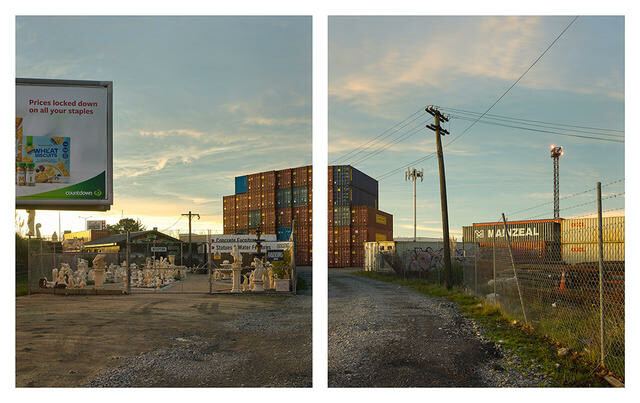
Tim J. Veling View from Waltham Road of Former Christchurch Gasworks Site (after Rita Angus and Glenn Busch)
Collection
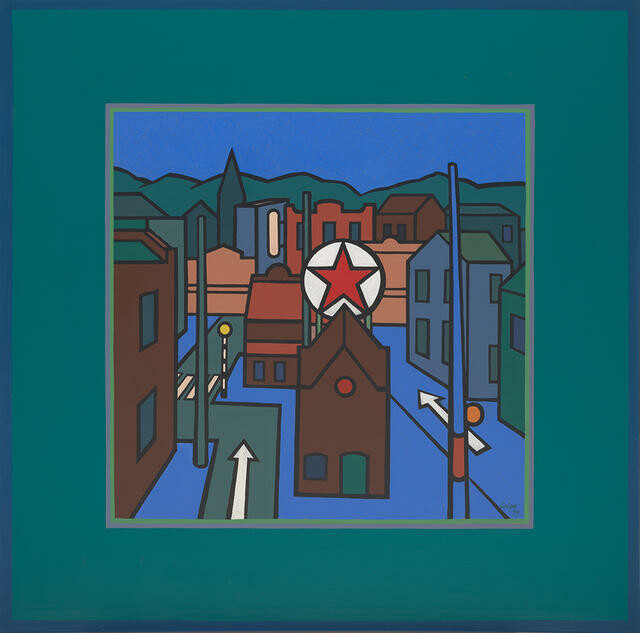
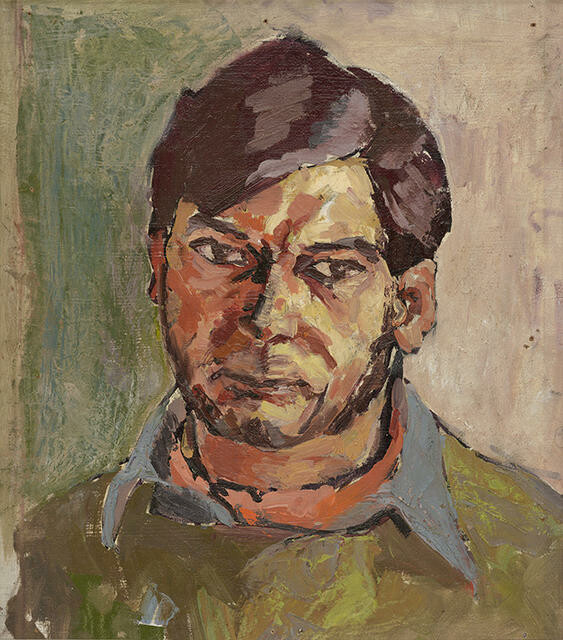
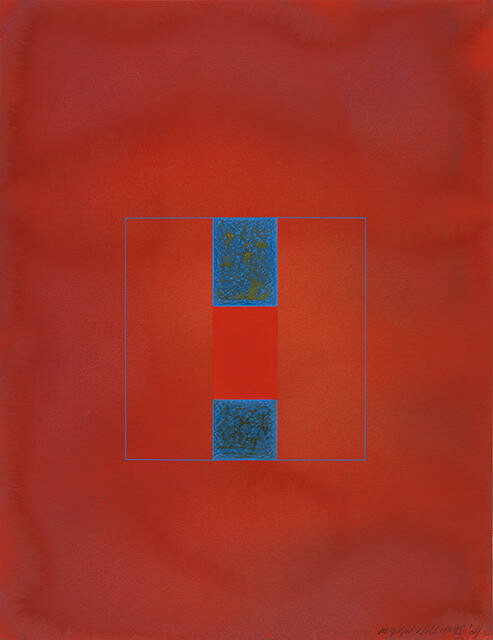
John Coley Townscape with Star
To mark the death of the artist in March 2026, this work was exhibited with this label:
We were very saddened to hear of the recent passing of artist and educator and former director of this institution John Coley. Born in Te Papaioea Palmerston North, John arrived in Ōtautahi Christchurch to take up studies at Canterbury College School of Art in 1955. While there he lived and painted at an infamous flat on Armagh Street, and his friends and flatmates included Pat Hanly, Gil Tavener (Hanly), Ted Bracey, Quentin Macfarlane, Hamish Keith, Ted Bullmore, Bill Culbert, Trevor Moffitt and Margaret Hudson-Ware. Like many artists of his generation he initially balanced his art-making with teaching and was a regular exhibitor at the famous Group Shows in Christchurch from 1960 to 1977.
In 1980 John was appointed director of this Gallery’s predecessor, the Robert McDougall Art Gallery, where he advocated for the gallery as an active space, not just somewhere where pictures were put on the walls. He believed that art education could extend the role of the Gallery. He also made a number of inspired acquisitions for the Gallery’s collection, including Colin McCahon’s 'As there is a Constant Flow of Light we are born into the Pure Land' in 1982; this was not a popular decision at the time, and he was forced to withstand intense public criticism. At the time John described McCahon’s painting as “…a fine memorable painting, an important acquisition for the city and one which I am convinced will be fully justified by the passing of time.” 'As there is a Constant Flow of Light…' quickly became a treasured work in the Gallery’s collection.
Throughout the 1990s John was a vocal advocate for the construction of a new gallery building in Christchurch – strongly favouring a central city location over Hagley Park, his view was simply that the city was where the people were. After his retirement in 1995 he enjoyed painting full-time, and made the move to Te Makaurau Auckland with his wife Fay to be nearer family. Always cheerful and engaging John maintained a strong interest in the Gallery and made a point of visiting whenever he returned to Christchurch to say hello to staff and discuss any recent acquisitions and exhibitions that interested him. Our thoughts are with Fay and the Coley family at this sad time.
Collection
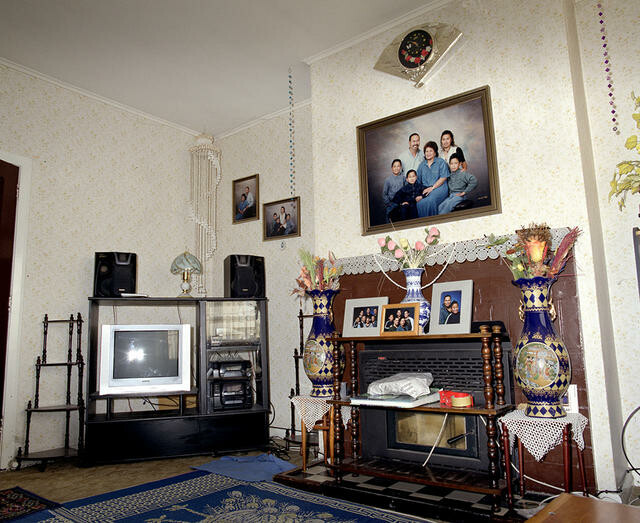
Edith Amituanai The House of Manu
In 2007, Edith Amituanai travelled to Europe to photograph New Zealand-Samoan professional rugby players who were based in France and Italy. She also took photographs in their family homes back in Aotearoa. This series is named Déjeuner, the French term for ‘lunch’, in recognition of the regular family get-togethers that one of the players claimed he was most homesick for. These photographs document what Amituanai describes as third-wave Pacific migration, as the relocation of the players to Europe was driven by the need to further their careers internationally.
The Manu Lounge was shot just prior to this, in 2006, in the home of Amituanai's Aunt Lomona in Spreydon, Christchurch. It shows the lounge laden with images and memorabilia of Carl Manu who was playing rugby in Grand Parma, Italy at the time. Shot from another angle and taken a year later, The House of Manu is part of the following Déjeuner series.
The two photographs show the same room, at first busy with family portraits and decorations, and then in a transitional stage as the family prepare to move house. Many objects have been removed –the display of photographs and mementos in front of the hearth – and one object wrapped in newspaper rests next to a packing tape dispenser. Together, they offer insight into how the idea of 'home' can evolve and shift between generations and circumstances, and how the domestic environments we piece together around us reflect our connections with the past, as well as our dreams for the future.
(Melanie Oliver, 2020)
Collection
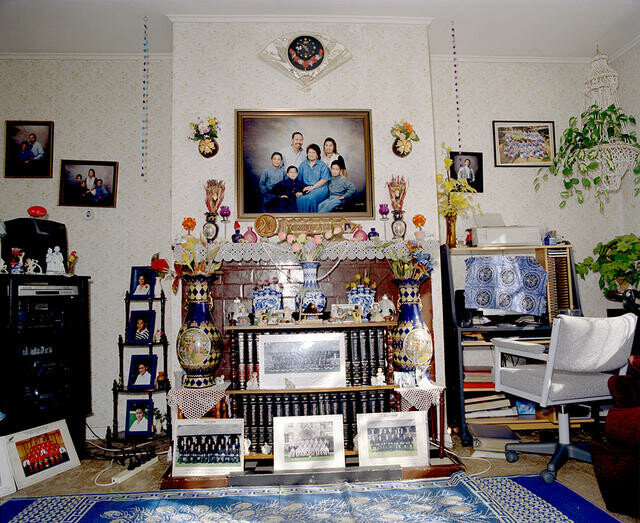
Edith Amituanai The Manu Lounge
Edith Amituanai’s parents left Samoa in the 1980s to join family in Ōtautahi / Christchurch before settling in Tāmakimakaurau / Auckland. Amituanai’s documentary-based photography generates an insider’s view of contemporary Samoan society in Aotearoa New Zealand.The House of Manu and The Manu Lounge reveal the working relationships Amituanai developed with the Manu Samoa rugby team members for a series of work she was making titled Déjeuner. She said: “I can’t photograph the All Blacks the same way, because the All Blacks are, you know, a protected image. And you get about zero point five minutes with them. And I need four years with people.” The absence of the rugby player in the family home increases our understanding of his value within his family unit; his awards and prizes recognise achievements and are a substitute for his presence while away on tour.
(Te Wheke; Pathways Across Oceania, 2021)
Collection
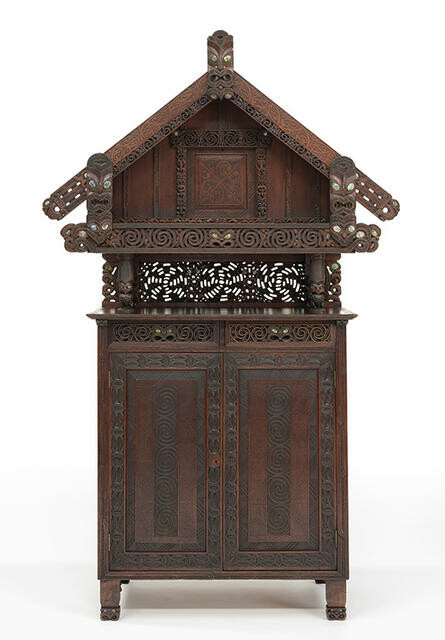
John Henry Menzies Stanford Family Pātaka Cabinet
John Henry Menzies first took up woodcarving as a youth in Lancashire, England. He immigrated to Aotearoa New Zealand aged twenty-one in 1860, and began farming on Te Pātaka o Rākaihautū / Banks Peninsula in 1877. Menzies’ interest in Māori art began in about 1882. He is unlikely to have encountered whakairo (carving) and kōwhaiwhai (rafter patterns) as living traditions until visiting Ōhinemutu in Rotorua five years later. Captivated by what he felt were endangered art forms, he filled two of three houses he built at Kiri-kiri-wairea / McIntosh Bay (later Menzies Bay) and a church at Little Akaloa with extraordinary Māori-inspired furniture and decoration. His most spectacular pieces were made for family members – this highly decorative pātaka cabinet was made for his daughter Charlotte and her husband Edwin Stanford.
(Te Wheke, 2020)