Kā Kaupapa o te Wā
What’s On
Celebrate Matariki at the Gallery
Tatai Whetū Tatai Tangata.
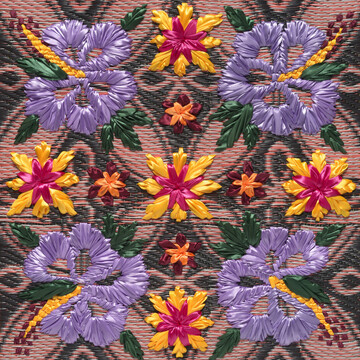
Made in the Pacific: A Collection of Tāoga
A selection of Pacific tāoga from the Canterbury Museum in conversation with contemporary artworks that highlight the continued strength in culture and traditional art forms.
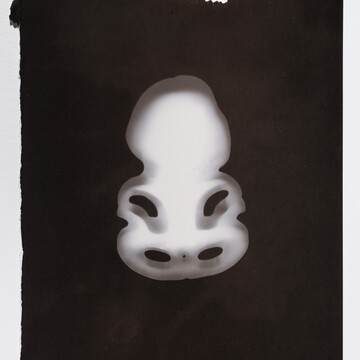
Mark Adams: A Survey | He Kohinga Whakaahua
A comprehensive survey spanning the artist's career.
E tuwhera ana te wharetoi i kā rā e 7 o te wiki, 10am - 5pm
Ka tuwhera ki te 9pm i kā pō Wenerei
Open 7 days, 10am - 5pm
Late night Wednesday until 9pm
Uruka utukore, ahokore utukore
Free entry, free wifi
Collection
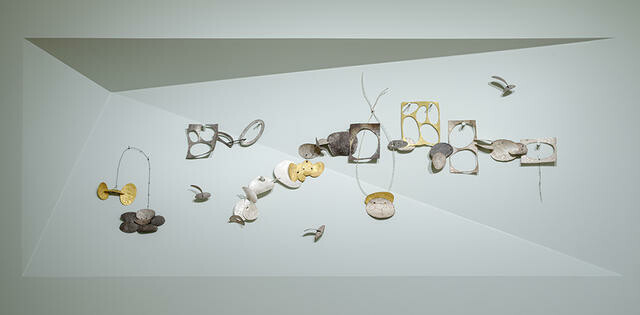
Areta Wilkinson Whakapapa II
Areta Wilkinson’s work expresses concepts of Ngāi Tahu whakapapa, genealogy and relationships, and mahinga kai, customary sites of natural resources and cultural production. Like her ancestors before her, Wilkinson utilises available resources in her making, from local river stones, clays, pigments and gold to contemporary resources like 3D prints of archaic artefacts. Layering past and present, she acknowledges Ngāi Tahu visual culture and histories through a contemporary art conversation. Wilkinson made Whakapapa II remembering Maerewhenua and Takiroa – limestone rock shelters that feature drawings made with charcoal and kōkōwai red ochre and created from the thirteenth century onwards. Wilkinson’s work is made from a range of precious materials and recalls how these drawings sit alongside each other through the placement of the individual objects, the positive and the negative elements carrying cultural – as well as aesthetic – ideas and narratives.
(Die Cuts and Derivations, 11 March – 2 July 2023)
Collection

Miranda Parkes Eliza (exploded book: French Painting)
For her series of ‘exploded books’, Ōtautahi artist Miranda Parkes used old books about painting as palimpsests for wild and colourful collages. This literal ‘painting over’ of Western art texts and images challenges and rewrites the contents, revealing the subjective nature of art history and suggesting it is more unruly and diverse than we think. Elisa Bonaparte peeks out from vibrant pink, yellow and golden layers; an eye stares back at us from the centre of a swirling silver record adorned with chocolate covered fruit and a pair of lips; and an arm reaches into what was once a Manet but is now a psychedelic party of paint. This playful, almost surreal, treatment of the book as canvas is a joyful critique of the patriarchal, heteronormative, monocultural art histories that are written and taught in academia. Instead, Miranda imagines and celebrates the other artists and artworks that we might consider important today.
(Perilous: Unheard Stories from the Collection, 6 August 2022- )
Collection
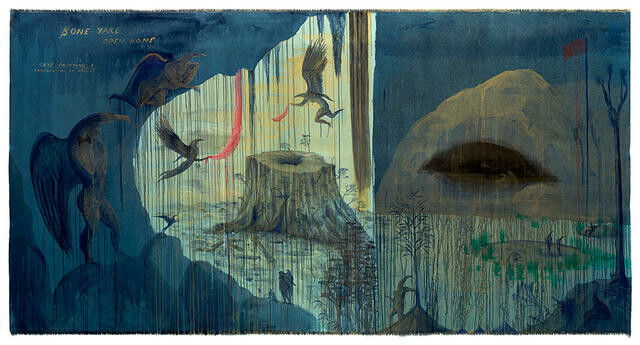
Bill Hammond Bone Yard Open Home, Cave Painting 4, Convocation of Eagles
Ōhinehou Lyttelton artist Bill Hammond sailed south from Aotearoa New Zealand to the subantarctic Maungahuka Auckland Islands in 1989. The islands are rich with an abundance of birds and diverse flora, and the experience left a lasting impression. Hammond began to imagine how Aotearoa may have looked before humans arrived, painting evocative, ghostly landscapes dominated by bird-people. This painting has connections to Ōhinehou, Matuku-takotako Sumner, Te Raekura Redcliffs and Horomaka Banks Peninsula. A large tree stump alludes to the destruction of forests across Aotearoa, reinforcing Hammond’s ongoing concern with the fragility of our natural environment and species loss. In the 800 years that humans have occupied Aotearoa, seventy percent of our indigenous landcover has been lost and more than 100 species of plants and animals have become extinct. Most extinctions have been birds, with Aotearoa losing almost half of its known species. Currently seventy-five percent of indigenous reptile, bird, bat and freshwater fish species are at risk of extinction.
He Kapuka Oneone – A Handful of Soil (from August 2024)