Michelle Kerr
Aotearoa New Zealand
Te Aitanga-a-Hauiti,
Māori
Fiona Collis
Aotearoa New Zealand
Te Aitanga-a-Hauiti,
Māori
Claudette Collis
Aotearoa New Zealand
Te Aitanga-a-Hauiti,
Māori
Te Whaitiri Tangohau-Kakau
Aotearoa New Zealand
Te Aitanga-a-Hauiti,
Māori
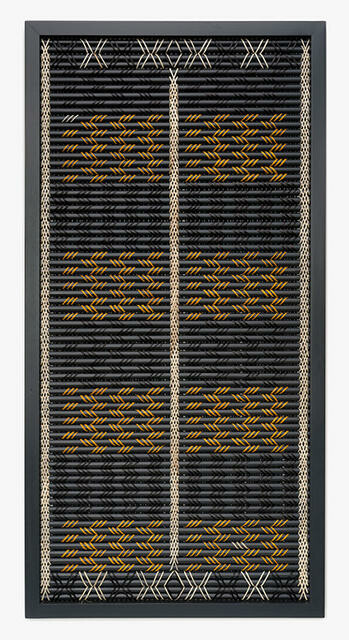
Ngā Manu a Ruakapanga
- 2021
- Kiekie, harakeke, wood; roimata toroa pattern
- Collection of Te Roopu Raranga Whatu o Aotearoa
- 1590 x 800 x 40mm
- L02/2022
Location: Touring Gallery C
Claudette Collis writes:
This design is based on the traditional roimata toroa in our wharenui Ruakapanga. In Hawaiki, Pourangahua reported to uakapanga all that he had seen and heard, and that the land on the eastern seaboard of Aotearoa would be an excellent place to grow kūmara. Ruakapanga agreed and ordered Pourangahua to return to Aotearoa immediately with the kūmara tubers in order to catch what remained of the planting season. Ruakapanga entrusted his prized birds, Hāro-ngā-rangi and Tiu-ngā-rangi, to Pourangahua’s care to hasten his return. Pourangahua was careless with Ruakapanga’s birds. Ruakapanga was furious. To avenge the maltreatment of his prized birds, he dispatched three pests that would forever blight the kūmara of Pourangahua—the anuhe to eat the buds, the mokoroa to eat the shoots and the mokowhiti to eat the leaves. To this day, these grubs continue to ravage kūmara crops throughout Aotearoa, reminding us of Pourangahua’s neglect of Ruakapanga’s birds.
roimata toroa ~ tears of the albatross
wharenui ~ meeting house on a marae (communal meeting ground or complex belonging to a tribe or sub-tribe)
kūmara ~ sweet potato
anuhe ~ kūmara moth caterpillar
mokoroa ~ larva of pūriri moth
mokowhiti ~ insect
(Bird Land: Te Kāhui Manu 15 August 2026 – 8 February 2027)
Exhibition History