Frances Hodgkins
Aotearoa New Zealand, b.1869, d.1947
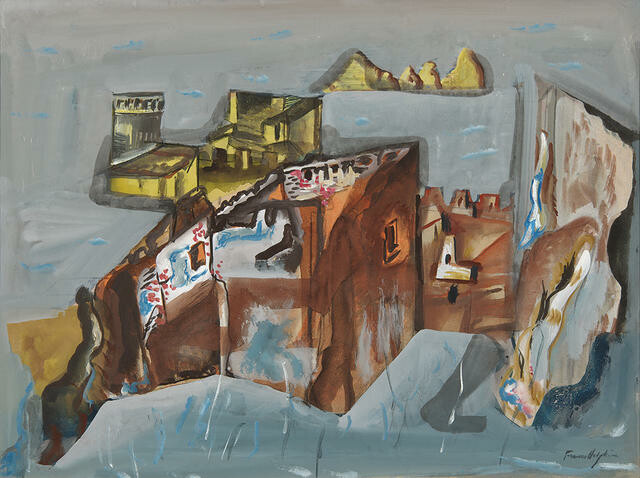
Phoenician Ruins
- c. 1935
- Gouache on paper
- Gift of Mr and Mrs M. Ash, England, 1980
- 610 x 770mm
- 80/17
Location: Ravenscar Gallery
Tags: abstraction, buildings (structures), castles (fortifications), landscapes (representations), ruins
Frances Hodgkins was one of Aotearoa New Zealand’s most successful expatriate painters, working as a professional artist in England. Throughout the 1920s and 1930s she developed a reputation for her semi-abstract landscapes and still-life paintings, subjects she sometimes combined. Hodgkins was close friends with some of the leading British artists of her day including Cedric Morris and John Piper. Driven and hard working, she continued to push herself as an artist, and her work became ever more abstract in her later years. In 1942 she stated that her “… aim [is] being able to do higher things as time goes on – and as time goes on I compete against myself more and more.” Her belief in herself and her art was recognised, shortly after her death, when she was selected alongside other leading British artists of the day including Henry Moore, John Piper, Paul Nash and Ben Nicholson for the Penguin Modern Painters series of monographs in 1948. She was the only woman artist to be included in the series.
(Timeless: Treasures from the Historical Collection 19 September 2026 – 30 May 2027)
Exhibition History
(18 December 2015 – 11 September 2016
“I am very interested in the new movement as all artists must be,” declared the Dunedin-born, Paris-based Frances Hodgkins to a Sydney reporter in 1913, when questioned about the latest developments in European art. To an Adelaide reporter she mused: “What the final result will be I cannot say. The futurists think it will end in pure abstraction, but that is so far ahead that one cannot view it with anything like seriousness.”
By the 1930s Hodgkins was herself riding the wave of modernism: while she had maintained a flexible grip on figurative representation throughout her career, her work had become increasingly abstract. This dynamic, cubist-inspired composition in gouache, a thick opaque paint, is believed to have been painted in Tossa de Mar, an ancient fishing village on the Costa Brava in Spain, where she set up a studio for several months in 1935. By this time, Hodgkins’ home base was in England, where she had established a significant reputation.
It is probable that Frances Hodgkins painted this work in the Spanish village of Tossa de Mar, on the Costa Brava, where she established a studio for a few months. The Phoenicians were masterly seafarers and traders throughout the Mediterranean but were conquered by Persia in the 6th century B.C.
While there Hodgkins began experimenting with gouache, an opaque watercolour, and continued to use it throughout the remainder of her career.
Hodgkins was born in Dunedin. Initially trained by her father, the part-time watercolourist William Matthew Hodgkins, from 1895 to 1896 she studied at the Dunedin School of Art. In 1901 she left to study at the London Polytechnic. In 1903 Hodgkins exhibited at the Royal Academy, the first New Zealander to have the honour of being “hung on the line”. Living in Paris between 1908-1912, Hodgkins taught at the Académie Colarossi, the first woman on the staff there. She eventually settled in England and exhibited with many art groups and galleries. (Label date unknown)
Related reading: In Modern Times
Notes
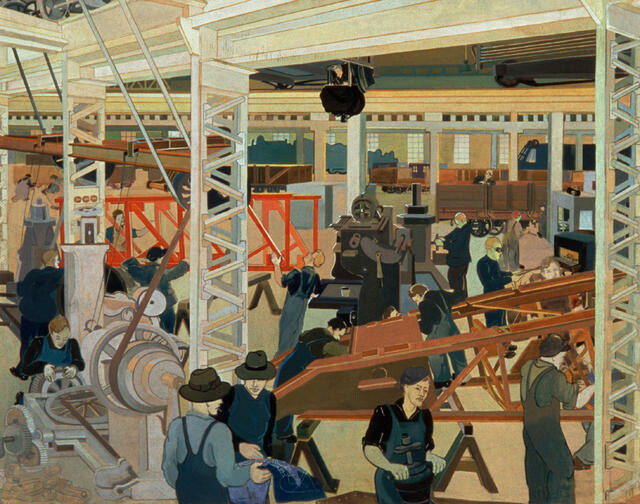
Tracking Louise Henderson
I recently wrote about Louise Henderson's painting Addington Workshops (1930) for the Press, and wanted to locate the place in which she stood to make the sketch for the work. It's a complex image and I wanted to understand more about its internal space as well as its history, but the workshops were demolished twenty years ago.
Notes
L’Art Décoratif Théâtral Moderne
A new exhibition of stage and costume designs by Russian avant-garde artists Natal'ya Goncharova and Mikhail Larionov opens this month.
Collection
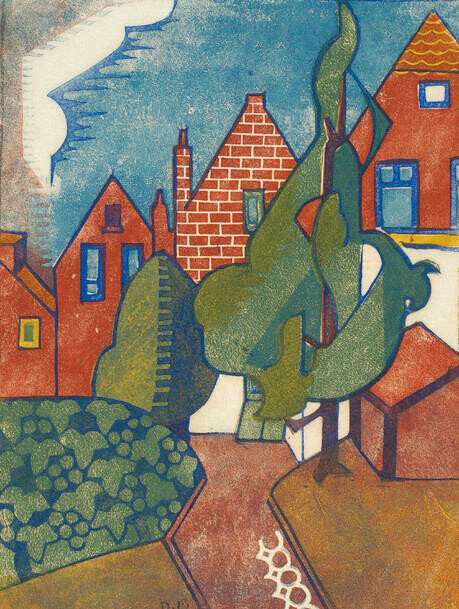
Dorrit Black Dutch Houses
Dorrit Black was a key member of the British linocut movement and contributed to the First Exhibition of British Lino-Cuts at the Redfern Gallery in 1929. In this work she focuses on the shapes, forms and patterns of tightly spaced buildings in urban environments.
(One O'Clock Jump: British Linocuts from the Jazz Age, 7 December 2024 - 11 May 2025)
Collection
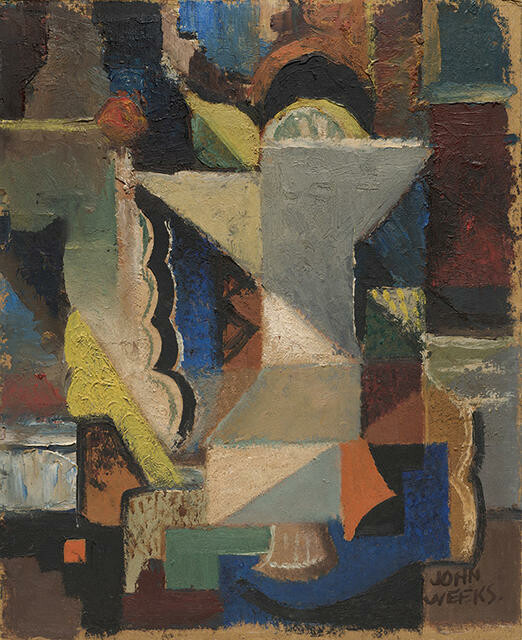
John Weeks Still Life
This work is from the Canterbury Public Library’s collection of original art works. This collection was started by Ron O’Reilly (1914-1982), who was appointed City Librarian in 1951. He had a keen interest in philosophy, literature and New Zealand art and developed personal friendships with many artists including Doris Lusk, Olivia Spencer Bower, Colin McCahon and Toss Woollaston. During his time in Christchurch he was deeply involved in the local art scene. He arranged many exhibitions in the library one such being McCahon’s The Wake in 1959. He liaised with other galleries in arranging the loans of paintings for other exhibitions, and for a period was art critic for the Press and picture buyer for the CSA Gallery. In 1953 the Library started its hire service of framed art prints, a selection of 80 reproductions which was confined to works by artists of importance in the history of painting, both old and modern masters. Shortly afterwards the Library’s collection was augmented by two substantial gifts, one from the Redfern Gallery, London of 34 original lithographs by British artists and the other, 39 prints from French cultural funds. In 1955 the City Council approved extension of the picture loan service to include original art works by local artists. The maximum purchase price was to be 19 guineas and because of this limitation the artists were often persuaded to sell their work at reduced prices. The prospect of having one’ s work on such public display was also an inducement to the artist to sell at a reasonable price. By 1960, 50 original works had been acquired. The paintings were selected by Ron O’Reilly at exhibitions, galleries and by visiting the artists in their homes.
In 1981, when purchasing ceased, the collection consisted of 297 works. 155 of these were gifted to the Robert McDougall Art Gallery in 2001. Adapted from “Library Treasures: New Zealand art works from the collection of the Canterbury Public Library, exhibited at the CSA Gallery, 9 February to 5 March 1989”.
Collection
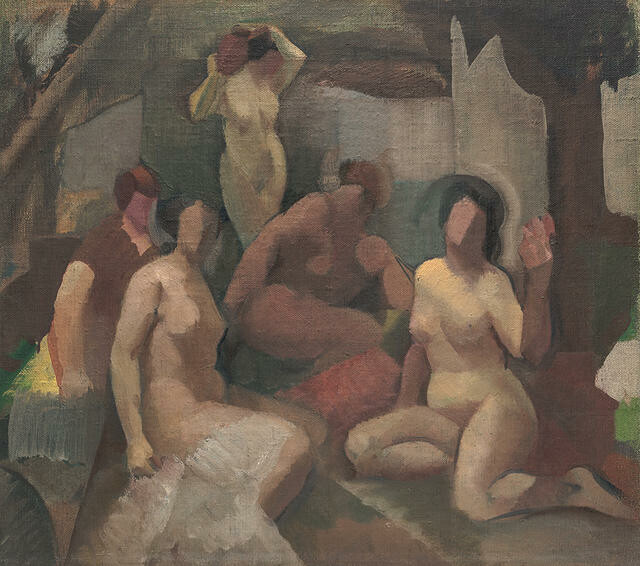
John Weeks Group Figure Study
John Weeks was regarded as New Zealand's leading exponent of modern painting for a considerable period. A teacher at the Elam School of Fine Arts in Auckland from 1930–54 he played an important role in connecting younger artists to the major developments in modern art of the early twentieth century. His reputation was enhanced by having studied and worked abroad for many years.
An ambulance medical corps officer in Britain and France during World War I, he studied art in Edinburgh from 1923, then in Paris at the studio of the cubist painter André Lhote from 1925, where he returned in 1928 after extended painting sojourns in Italy, North Africa and the South of France. (In Modern Times, 18 December 2015 – 11 September 2016)
Collection
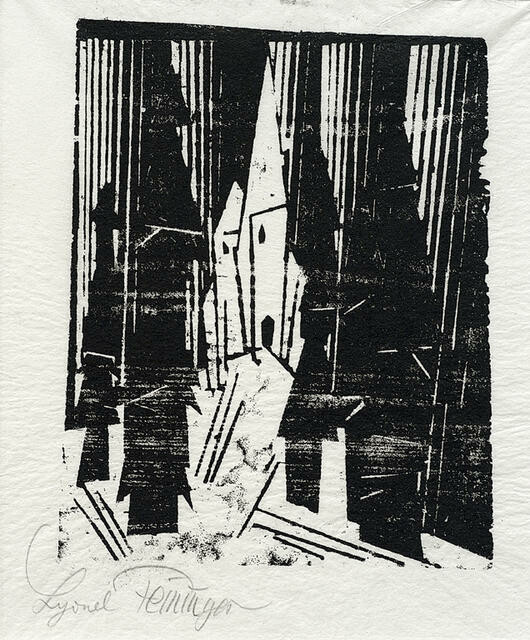
Lyonel Feininger Wald Kirche, 2
The American-born artist Lyonel Feininger had been living in Europe, mainly in Germany, since 1887. He visited Paris in 1911 while exhibiting work at the Salon des Indépendents, where the cubists were exhibiting their discoveries for the first time. Writing to a friend in 1913 from Berlin, Feininger described the moment: “In that Spring I had gone to Paris for two weeks and found the art world agog with Cubism – a thing I had never heard even mentioned before, but which I had already, entirely intuitively, striven after for years.”
Feininger’s artistic development from this point led to an invitation in 1919 from the German architect Walter Gropius to become the first master at the Bauhaus,a new school of art at Weimar. He produced many woodblock prints for their publications, including a futurist-inspired cover for their first manifesto, featuring a cathedral in a forest, a theme to which he often returned. (In Modern Times, 18 December 2015 – 11 September 2016)
Collection

Frank Weitzel Abstract Design
Aotearoa New Zealand printmaker Frank Weitzel was a promising young artist when he arrived in England in 1930 and submitted work to Claude Flight’s second exhibition of linocuts. Flight wrote to Dorrit Black that he was “…very pleased to have Mr Weitzel’s work for the show. I like it very much, it’s original, strong, good of its kind & just the sort of work we want.” Weitzel had a promising future as an artist ahead of him but unfortunately died two years later aged just twenty-six.
(One O'Clock Jump: British Linocuts from the Jazz Age, 7 December 2024 - 11 May 2025)
Collection
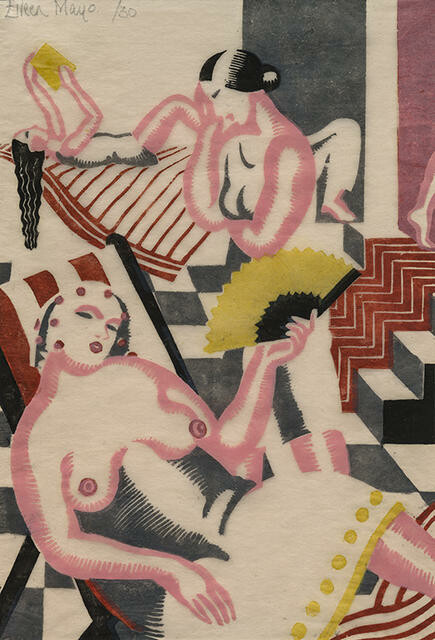
Eileen Mayo Turkish Bath
Two prints from early in Eileen Mayo’s career show the strength of her natural ability. Eileen was nineteen and studying at the Central School of Arts and Crafts, London, when she made the wood engraving Skaters. She made Turkish Bath a few years later in response to an invitation to put work in the Second Exhibition of British Lino-Cuts at the Redfern Gallery, London. Her invitation came from Claude Flight, the linocut’s principal champion, who reportedly instructed her on the technique over the telephone. She had met Flight, a teacher at the Grosvenor School of Art, while working there in 1929 as a life-class model.
(Perilous: Unheard Stories from the Collection, 6 August 2022- 21 July 2024)
Collection
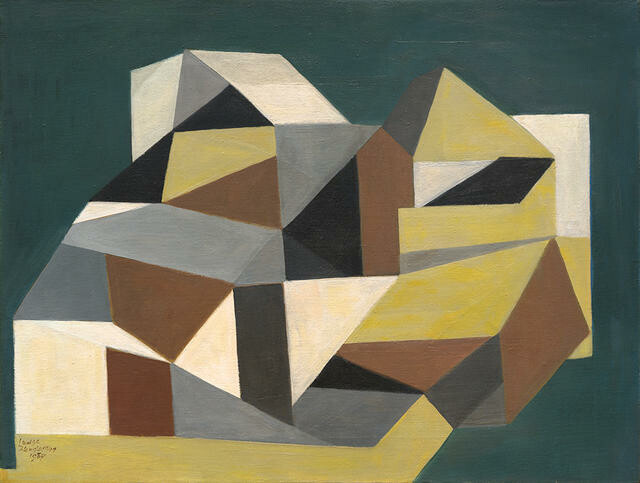
Louise Henderson The Farmhouse in Cornwall
Paris-born Louise Henderson was one of the first Aotearoa New Zealand artists to address abstraction, and became interested in architectural forms during her two years living in the Middle East from 1956–58. Made after a visit to Britain, The Farmhouse in Cornwall shows her use of built structures as a starting point for generating complex and dynamic compositions. Here, an arrangement of hard-edged forms in earthy, subdued tones deftly leads the eye, never completely allowing it to rest in one place.
(Perilous: Unheard Stories from the Collection, 6 August 2022 - 21 July 2024)
Collection
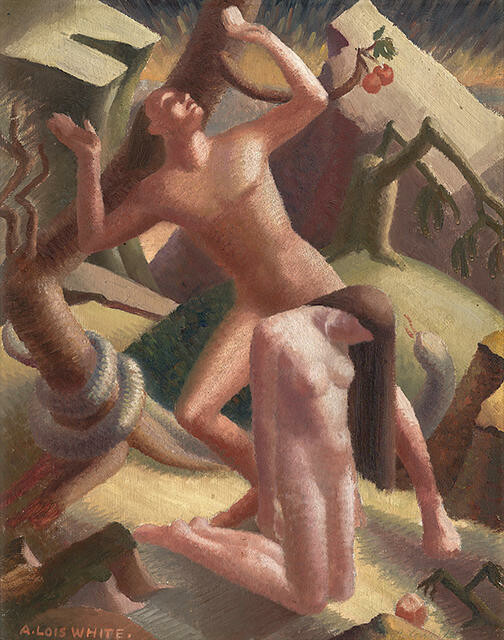
A. Lois White Expulsion
Lois White was a prominent, individualistic voice in New Zealand painting in the 1930s and 1940s, who attracted attention with her modernistic, art-deco style figure compositions.
A student at Elam School of Fine of Arts in Auckland in the 1920s, White also taught there for many years from 1928. Equally interested in the old masters as in the cubists and other modern painters, she admitted looking at “anything that I could get my eyes and brain working on […] I was very taken with all the figure compositions of Botticelli.”
Such varied sources are evident in her dramatic depiction of Adam and Eve, the first humans in the biblical account of the creation of the world. Painted at the start of World War II, it may be seen as an allegorical reflection on the human condition. (In Modern Times, 18 December 2015 – 11 September 2016)