Jean-Baptiste-Camille Corot
France, b.1796, d.1875
Environs de Rome
- 1866
- Etching
- 367 x 267mm
- 73/272
Location: W A Sutton Gallery
Tags: landscapes (representations), monochrome, natural landscapes, trees
Jean-Baptiste-Camille Corot made three Italian journeys, the first from 1825 to 1828, followed by visits in 1834 and 1843. Etched in 1866 for the Société des Aquafortistes, Environs de Rome recalls a landscape first encountered more than forty years earlier. Rather than depicting a specific location, this print evokes the forms, rhythms and atmosphere of the Roman Campagna. Through spare, sinuous lines and broad areas of light and shadow, Corot distils the landscape into a lyrical arrangement of trees, distant hills and light. As he once remarked, “I’m never in a hurry to arrive at details; the masses and the general character of a picture interest me more than anything else.”
(Timeless: Treasures from the Historical Collection 19 September 2026 – 30 May 2027)
Exhibition History
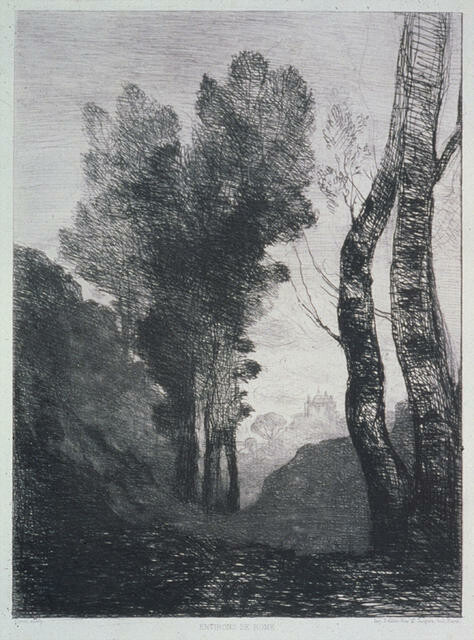
Camille Corot lived for a number of years in Rome, and in 1866 he was commissioned by the publishers Cardart and Luquet and the Society of Etchers in Paris to produce two large etchings, Souvenir d’Italie and Environs de Rome.
When he first visited Italy in 1825, it was the light that made the deepest impact on Corot. The contrast between the hard definition of full sunlight and the filtered, but glowing softness of half shadow was to revolutionise his whole palette. He made studies outdoors and worked these up into more finished works in his studio, yet he managed to retain the freshness of his outdoor studies.
Corot was born in Paris and trained as a classical artist, but his later open air naturalism became a foundation for the Barbizon School. By the 1850s Corot had established a successful career. Generous by nature, he was popular with many younger artists. He also supported Jean François Millet’s widow and gave a cottage to the blind and destitute Honoré Daumier.
(Label date unknown)