John Weeks
Aotearoa New Zealand, b.1886, d.1965
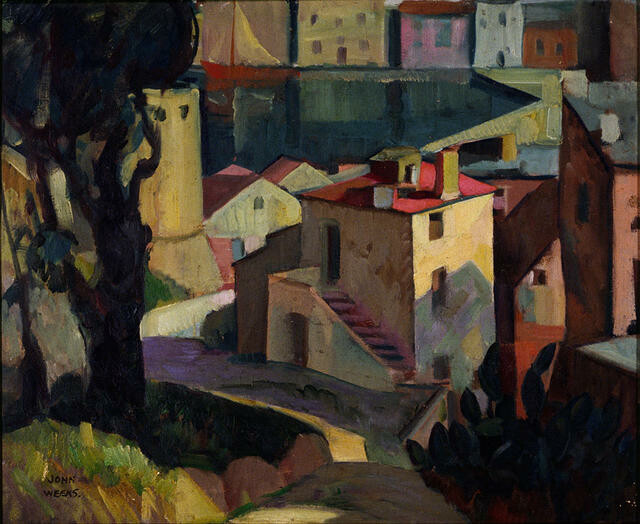
Village and Harbour
- Oil on canvas
- Purchased with assistance from the Ballantyne bequest and the Queen Elizabeth II Arts Council, 1969
- 510 x 625mm
- 69/657
Location: Ravenscar Gallery
Tags: boats, buildings (structures), harbors, houses, landscapes (representations), paths, steps (stair units), trees, urban landscapes
Francis McCracken and John Weeks followed very similar trajectories in both their artistic careers and early lives. They were young art students working in Tamaki Makaurau Auckland and Sydney respectively when World War I broke out. Both enlisted and served with the New Zealand Forces on the Western Front and after the war returned to their studies. In the early 1920s they attended the Royal Scottish Academy School in Edinburgh, before both artists developed an interest in cubism and studied under the cubist painter André Lhôte in Paris in the mid–1920s. Lhôte’s influence is seen in the restrained cubism of Tulip Still Life and Village and Harbour. Weeks returned to Aotearoa New Zealand in 1929 and took up a teaching position at Elam Art School in Auckland. McCracken remained based in Edinburgh for the remainder of his career but maintained connections to Aotearoa, regularly sending paintings back for the art societies’ annual exhibitions.
(Timeless: Treasures from the Historical Collection 19 September 2026 – 30 May 2027)
Exhibition History

Brought to light, November 2009- 22 February 2011
John Weeks studied art in Auckland, Sydney and Christchurch before making the decision in 1923 to travel to Scotland to attend the Edinburgh College of Art and the Royal Scottish Academy. The formative influence on his work, however, was the period spent studying under the cubist painter André Lhote in Paris in 1925. Like many expatriate painters, Weeks returned to New Zealand with fresh and progressive ideas on painting; through his appointment to a teaching position at Auckland’s Elam School of Fine Arts in 1929, his ideas informed and influenced a new generation of art students.