Nugent Herman Welch
Aotearoa New Zealand, b.1881, d.1970
Summer
- 1916
- Oil on canvas on board
- Presented by the Canterbury Society of Arts, 1932
- 982 x 1060mm
- 69/488
- View on google maps
Location: Ravenscar Gallery
Tags: animals, buildings (structures), clouds, hills, houses, Impressionist (style), landscapes (representations), natural landscapes, paths, summer (season), trees
Nugent Welch was a key figure of Te Whanganui-a-Tara Wellington’s art circles during the early twentieth century. James Nairn’s painting loomed large in Welch’s formative years and in 1906, two years after Nairn’s death, he helped resurrect the Wellington Sketch Club and renewed the lease on Pumpkin Cottage for artists to stay and paint once again. Summer was painted at Silverstream with the cottage visible to the left in the background. Welch’s painting is quite innovative for its time in New Zealand, particularly in his treatment of the sky. The deliberate, fractured brushwork highlights his interest in pointillism, which had been developed in the 1880s by French painters such as Seurat. Welch left for the Western Front to serve with the New Zealand Expeditionary Forces shortly after Summer was painted. The idyllic scene stands in contrast to the horrors he encountered, which included the Passchendaele offensive in 1917.
(Timeless: Treasures from the Historical Collection 19 September 2026 – 30 May 2027)
Exhibition History
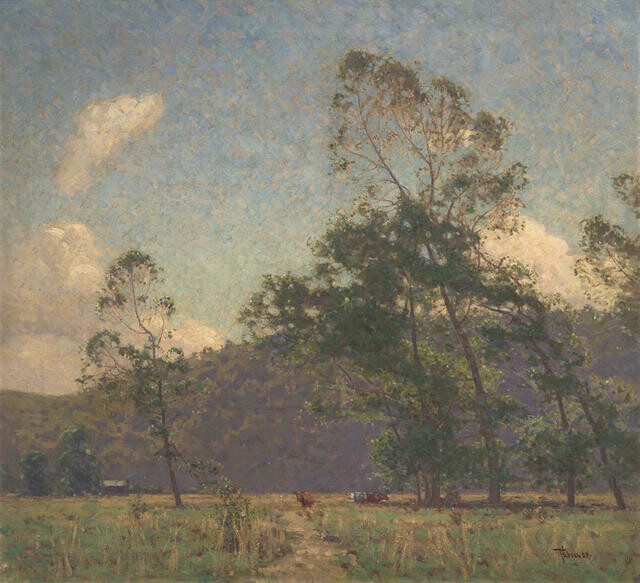
Nugent Welch was a key figure of Wellington’s art circles during the early twentieth century. James Nairn’s painting loomed large in Welch’s formative years and in 1906, two years after Nairn’s death, he helped resurrect the Wellington Sketch Club and renewed the lease on Pumpkin Cottage for artists to stay and paint once again. Summer was painted at Silverstream with the cottage visible to the left in the background. Welch’s painting, particularly in the sky, is quite innovative for its time in New Zealand. The deliberate, fractured brushwork highlights Welch’s interest in pointillism, which had been developed in the 1880s by French painters such as Seurat. (March 2018)
Interested in the effect of light on the simple rural landscape, Welch has used a modified form of Impressionism for this work developed from sketches and studies made in ‘plein air’, (outdoors), in the Hutt Valley. The fractured brushwork of the sky is similar to the pointillism developed by Neo-Impressionists like Seurat in the 1880s. In this technique the separate colours are intermingled but not mixed, leaving them to mix in the viewer’s eye and simulating the effect of light. The purple shades adapted by Welch on the bush covered hill in the background are also similar to those used by Monet and the French Impressionists, making this work an interesting and innovative treatment of the simple New Zealand landscape.
This scene is almost certainly Pumpkin Cottage, Silverstream, in the Hutt Valley.