Owen Merton
Aotearoa New Zealand / England / United States, b.1887, d.1931
St Ives, Barnoon Hill, 1910
- 1910
- Watercolour
- Presented by the family of James Jamieson 1932
- 188 x 225mm
- 69/19
- View on google maps
Location: Ravenscar Gallery
Tags: buildings (structures), chimneys (architectural elements), hills, mountains, people (agents), plein-air, seas, steps (stair units), towers (building divisions), trees, urban landscapes, women (female humans)
Like many Aotearoa New Zealand creatives of their generation, Owen Merton and Raymond McIntyre both pursued their dreams of living and working abroad. By 1910 the two Ōtautahi Christchurch born artists were working in London and would often catch up. Both took the opportunity to study, visit art galleries and develop their own art in line with modern developments in British and European art. Although McIntyre did occasionally venture to France on painting excursions, including to the picturesque village Saint-Valery-sur-Somme, he was largely content to paint London’s Chelsea neighbourhood where he lived. Merton, on the other hand, was much more outgoing and enjoyed numerous painting excursions throughout the United Kingdom and further afield to France, Spain, Italy, Algeria and Bermuda.
(Timeless: Treasures from the Historical Collection 19 September 2026 – 30 May 2027)
Exhibition History
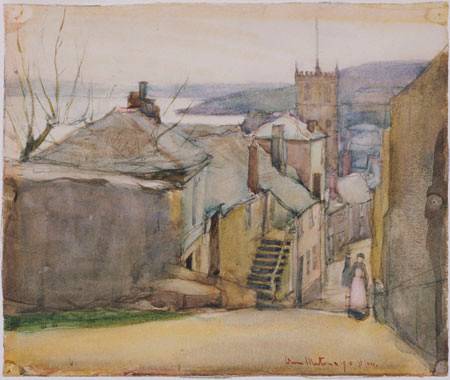
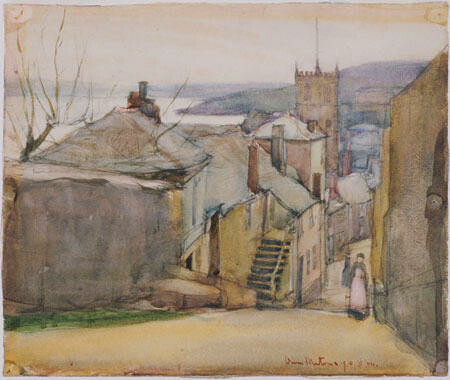
St Ives in Cornwall was a popular destination for artists interested in the plein air (outdoors) painting movement. Merton has captured the scene with well-judged watercolour washes, leaving a single layer of translucent paint where he wants to suggest the reflection of sunlight from the walls and roofs. This work, completed in the early stages of Merton’s career, shows the influence of the Post-Impressionist movement in its use of outlines, simplified surfaces and adjusted colour. The influence of James McNeill Whistler (1834-1903) can also be seen in the use of overall colour harmonies to achieve unity. Born in Christchurch, Merton studied at the Canterbury College School of Art in 1903, and in London in 1905-06. He returned to New Zealand from 1907 to 1909, holding a number of solo shows in Wellington and Christchurch. After that time he lived either in New York or in Europe. Merton was elected to the Royal Society of British Artists in 1910. He died in London.