Eileen Mayo
England / Australia / Aotearoa New Zealand, b.1906, d.1994
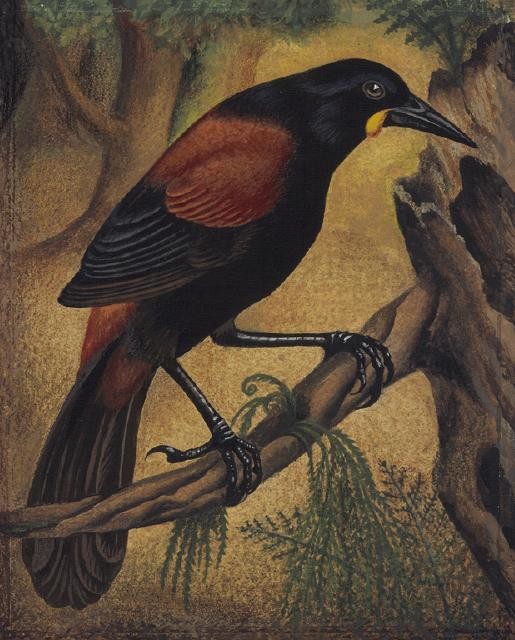
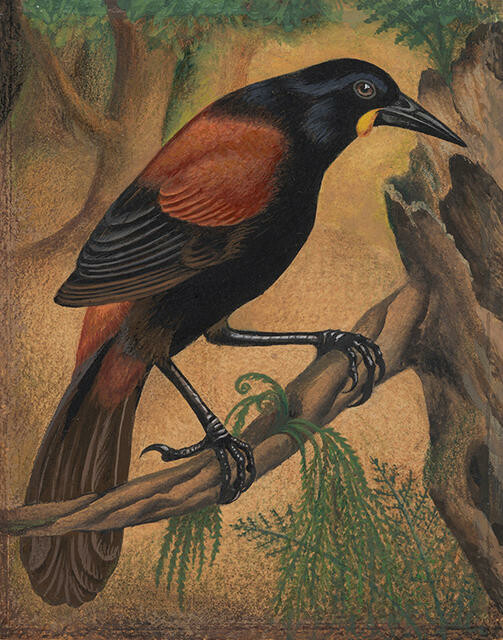
Tīeke / Saddleback
- 1976
- Gouache and coloured pencil
- Purchased, 2005
- 122 x 96mm
- 2005/010
Location: Touring Gallery A
Tags: animals, birds (animals), brown (color), ferns
Tīeke were named ‘saddlebacks’ by early European settlers after the vivid chestnut marking that sits like a ‘saddle’ across their glossy black plumage. According to Māori pūrākau, this marking was left by Māui, who singed the bird’s back with his fiery hand when it refused to fetch him water as he lassoed the sun. Also known as tiaki—te reo Māori for ‘to guard’ or ‘to care for’—tīeke are seen in some iwi traditions as kaitiaki, or guardians. In Ngāti Awa pūrākau, a pair named Mumu-au and Takere-tou are said to have travelled aboard the Mātaatua waka from Hawaiki and were left on Repanga Cuvier Island, where their calls are still believed to foretell the weather. Because of these associations, many iwi consider tīeke tapu.
As with other Aotearoa New Zealand wattlebirds, introduced predators and habitat loss following European settlement rapidly reduced tīeke populations. Once widespread across the mainland, by the mid-twentieth century they survived only on a few offshore islands. Today, intensive predator control and island translocation have seen them re-established on multiple islands and fenced mainland sanctuaries.
Lauren Hollingsworth-Smith, writer, artist and poet
pūrākau ~ ancestral narrative, myth, ancient legend, story Māui ~ an adventurer in Māori and Polynesian mythology te reo Māori ~ the Māori language iwi ~ tribe waka ~ canoe tapu ~ sacred
(Bird Land: Te Kāhui Manu 15 August 2026 – 8 February 2027)
Exhibition History

Related
Notes
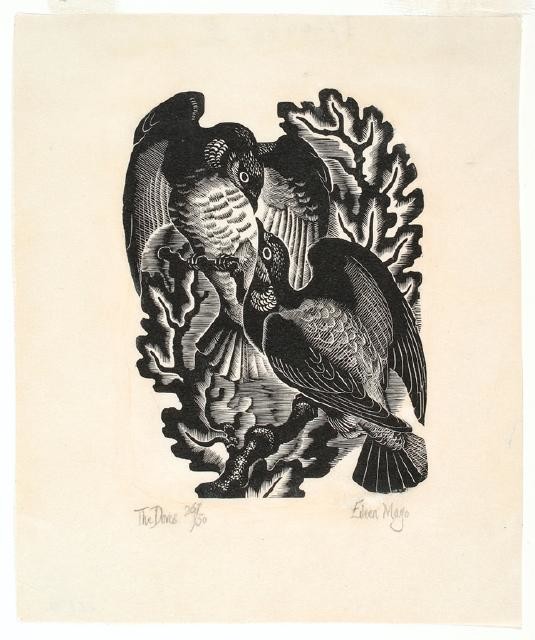
Eileen Mayo
It's 107 years since this multi-talented artist, described by art historian Kenneth Clark as 'outstandingly good', was born in Norwich, England.