
Kā Kaupapa o te Wā
What’s On
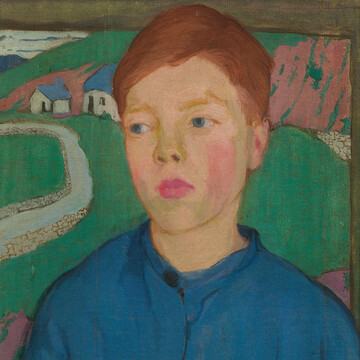
Edith Collier: Early New Zealand Modernist
A rare opportunity to view the work of one of Aotearoa New Zealand’s most adventurous and experimental modernist artists.
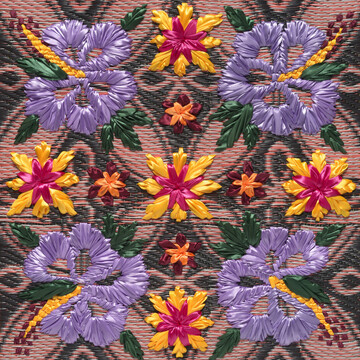
Made in the Pacific: A Collection of Tāoga
A selection of Pacific tāoga from the Canterbury Museum in conversation with contemporary artworks that highlight the continued strength in culture and traditional art forms.
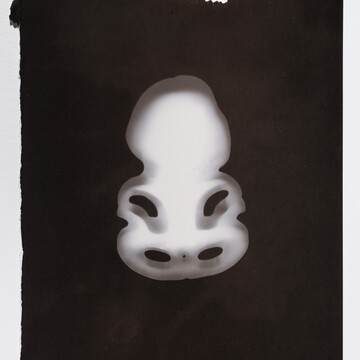
Mark Adams: A Survey | He Kohinga Whakaahua
A comprehensive survey spanning the artist's career.
E tuwhera ana te wharetoi i kā rā e 7 o te wiki, 10am - 5pm
Ka tuwhera ki te 9pm i kā pō Wenerei
Open 7 days, 10am - 5pm
Late night Wednesday until 9pm
Uruka utukore, ahokore utukore
Free entry, free wifi
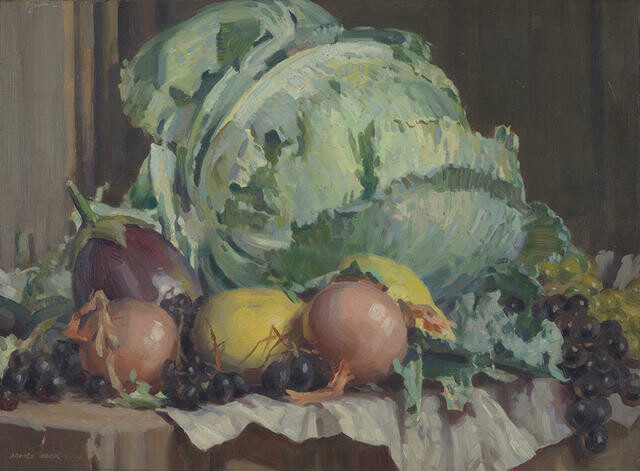
Collection
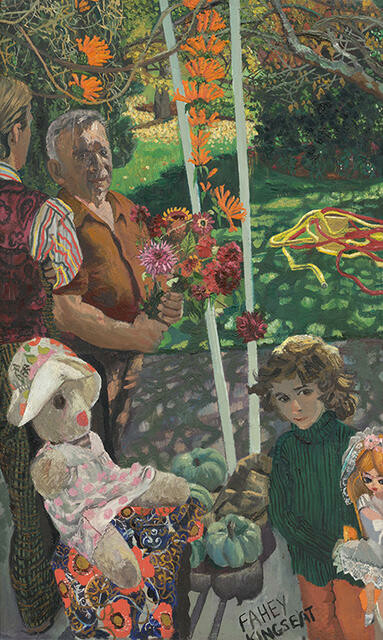
Jacqueline Fahey Speedy's Return
For the exhibition Jacqueline Fahey: Say Something! (22 November 2017 – 11 March 2018) this work was displayed with the following label:
Fahey’s husband, the noted psychiatrist Fraser McDonald, held positions at a number of institutions throughout New Zealand, and they raised their three daughters in a series of houses on hospital grounds. In Porirua, the gardens were overseen by a patient, Mr Quickly (also known as Speedy), who had studied at Kew Gardens in England and worked on a royal estate. He supplied the family with a steady supply of produce and fresh flowers. Fahey recalled that she could cope with the flowers but that the fruit and vegetables, which he clearly expected her to make into preserves, showed up her shortcomings as a ‘proper’ doctor’s wife. When the family moved to Kingseat Hospital, near Auckland, Mr Quickly came with them. This painting, a study in warm autumnal colours and dappled shadows, celebrates what Fahey described as 'the light he brought into all of our lives'.
Collection
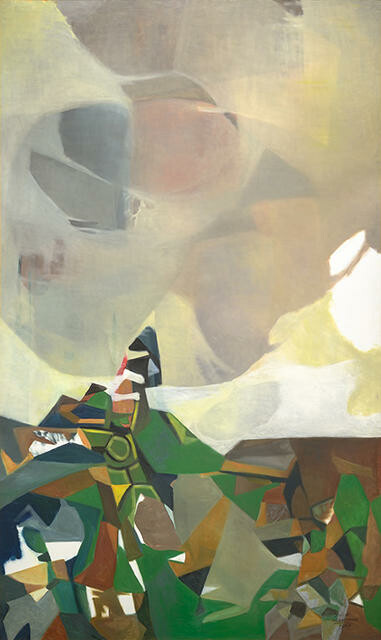
Louise Henderson June
At a time in her career when many might have expected her to slow down or even retire, French-born Louise Henderson embarked upon one of her most ambitious creative projects. The Twelve Months distilled her impressions of her life in Aotearoa New Zealand into a dozen tall canvases, filtering the rhythms of the year through her ‘abstract poetic of nature’. Borrowing their proportions from the elegant ‘double square’ of her studio windows, they combined two important aspects of her practice: the all-seeing viewpoints and organisational principles of cubism and the ability to use colour to evoke both form and atmosphere. Often inspired by the view through her window, Henderson manipulated a complex set of variables, considering how the seasons affected the weather and landscape, the changing light and position of the sun, and the fluctuating activities, rituals and moods of people in both the city and the countryside.
In the ‘winter’ months, June and July, Henderson skilfully balanced colour, form and movement to evoke rain-laden clouds, drenched fields and cold, boisterous winds.
Collection
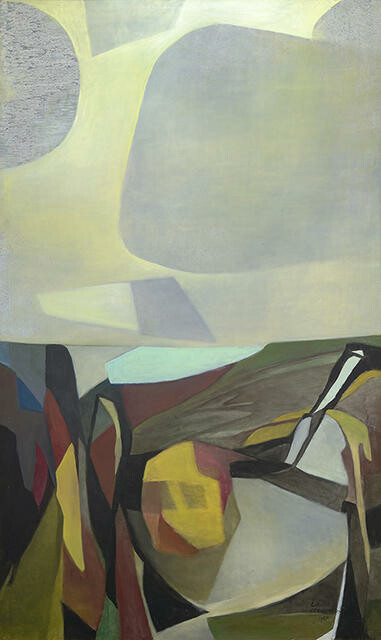
Louise Henderson July
At a time in her career when many might have expected her to slow down or even retire, French-born Louise Henderson embarked upon one of her most ambitious creative projects. The Twelve Months distilled her impressions of her life in Aotearoa New Zealand into a dozen tall canvases, filtering the rhythms of the year through her ‘abstract poetic of nature’. Borrowing their proportions from the elegant ‘double square’ of her studio windows, they combined two important aspects of her practice: the all-seeing viewpoints and organisational principles of cubism and the ability to use colour to evoke both form and atmosphere. Often inspired by the view through her window, Henderson manipulated a complex set of variables, considering how the seasons affected the weather and landscape, the changing light and position of the sun, and the fluctuating activities, rituals and moods of people in both the city and the countryside.
In the ‘winter’ months, June and July, Henderson skilfully balanced colour, form and movement to evoke rain-laden clouds, drenched fields and cold, boisterous winds.
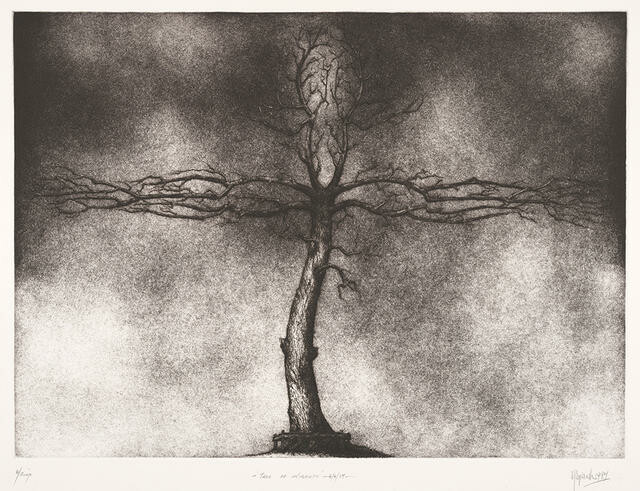
Collection
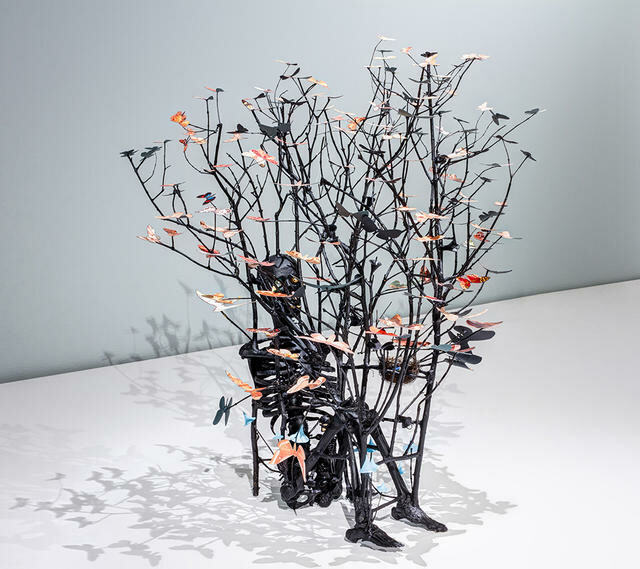
Peter Madden Crouches with moths
A shroud of moths, their outlines cut from National Geographic magazines, rises up around this frail blackened skeleton. Gripped between its teeth is a golden coin, like those the ancient Greeks inserted into dead people’s mouths as ‘Charon’s obol’, a ritualistic payment for the ferry ride to the underworld. Peter Madden’s vision is deeply macabre, but not without humour or the hint of renewal. Springing from this decaying figure’s feet are werewere kōkako, the bright blue native mushroom named for the kōkako bird’s famous wattle – reminding us that death is part of a cycle that repeat endlessly over time.
(Dummies & Doppelgängers, 2 November 2024 – 23 March 2025)
Collection
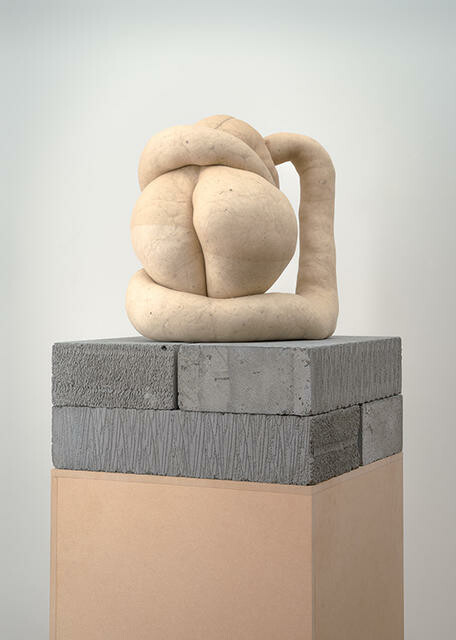
Sarah Lucas NUD CYCLADIC 1
Bodies are custom-built containers, but the bits of us other people see don’t always reflect what’s going on inside. The pantyhose limbs Sarah Lucas has coiled into this strangely human form wriggle away from easy interpretation. Sexy and provocative, they’re also powerful, carrying more than a trace of the striking Early Bronze Age figurines that inspired them.
(Dummies & Doppelgängers, 2 November 2024 – 23 March 2025)
Collection
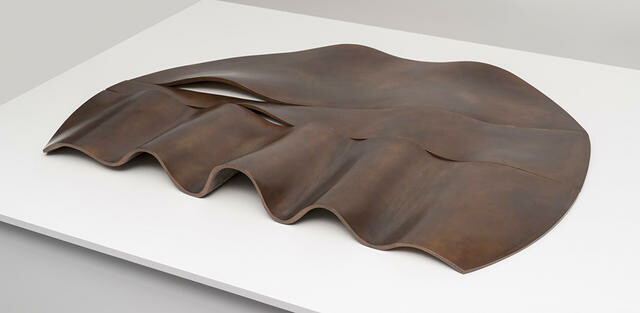
Rosemary Johnson Shadows 4
Despite the force, heat, pressure and noise implicit in the bronze melding process, Rosemary Johnson’s tectonic Shadows 4 is filled with an expansive, majestic fluidity, and holds together with an ordered sense of tension, strength and grace.Johnson became skilled in traditional metal casting processes at the Central School of Art and Design in London, after earlier studies at the University of Canterbury’s School of Fine Art. Returning to New Zealand in 1969, she became particularly well-known for her environmental art.
(As Time Unfolds, 5 December 2020 – 7 March 2021)
Collection
![On Southern Cross [Engine Room]](/media/cache/3f/2d/3f2d35846c1e9eb21305262e6b2b8296.jpg)
Louise Henderson On Southern Cross [Engine Room]
Having studied design in Paris during the 1920s, French artist Louise Henderson settled in Ōtautahi Christchurch with her husband, Hubert, in 1925, where she quickly became a significant figure in Aotearoa’s growing modernist art circles. In the 1950s she moved to Tāmaki Makaurau Auckland before returning to Paris to study under the cubist painter Jean Metzinger, who fostered her interest in the movement. Like so many painters during this period, Louise developed an interest in lithography. She produced numerous lithographs during the mid 1950s and beyond, including On Southern Cross, a cubist study of the engine plant she had seen on the recently launched Southern Cross ship.
Ink on Paper: Aotearoa New Zealand Printmakers of the Modern Era, 11 February – 28 May 2023
Collection
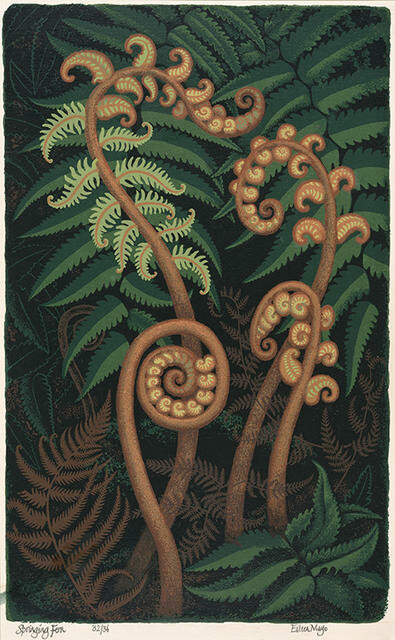
Eileen Mayo Springing Fern
English-born Eileen Mayo had lived in Aotearoa New Zealand for twenty years when she made this screenprint of young fern fronds in the lush native undergrowth. One of her final prints, it combines her enduring appreciation of the natural world with an extraordinary technical ability, conveying not only the graceful beauty of the plants she depicts, but a strong sense of their place within a complex and interconnected ecosystem. The sight of fern fronds in the act of unfurling provided the inspiration for the Māori koru, a powerful symbol of perpetual creation, growth and return.
(He Kapuka Oneone – A Handful of Soil, 2025)