Kā Kaupapa o te Wā
What’s On
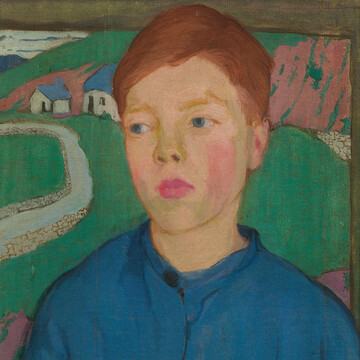
Edith Collier: Early New Zealand Modernist
A rare opportunity to view the work of one of Aotearoa New Zealand’s most adventurous and experimental modernist artists.
Made in the Pacific: A Collection of Tāoga
A selection of Pacific tāoga from the Canterbury Museum in conversation with contemporary artworks that highlight the continued strength in culture and traditional art forms.
Mark Adams: A Survey | He Kohinga Whakaahua
A comprehensive survey spanning the artist's career.
E tuwhera ana te wharetoi i kā rā e 7 o te wiki, 10am - 5pm
Ka tuwhera ki te 9pm i kā pō Wenerei
Open 7 days, 10am - 5pm
Late night Wednesday until 9pm
Uruka utukore, ahokore utukore
Free entry, free wifi
Collection
Paul Nash Promenade
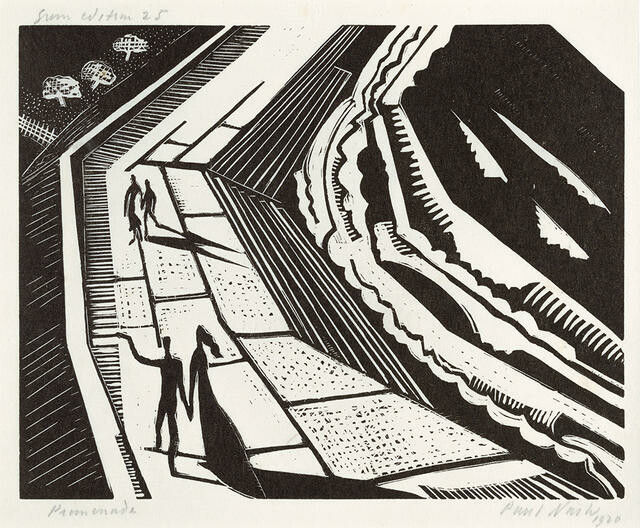
Paul Nash was a member of England’s Society of Wood Engravers in the 1920s, and this work, one of his earliest wood engravings, highlights his instinctive approach to the medium. Rather than be tied down by traditional wood-engraving practices of precision and accuracy of line, his mark-making is free and immediate. A jagged, hard-edged perspective intensifies the scene. The waves breaking on the seawall form a series of varied, simplified patterns and shapes. The elongated figures, dwarfed by the wall, intensify the scale of the structure. Nash’s rough and intuitive techniques in cutting the end-grain wood serve to intensify the image and highlight an artist approaching a medium with much tradition under his own terms.
The Golden Age 18 December 2015 – 1 May 2016
Collection
Shane Cotton The Haymaker Series I–V
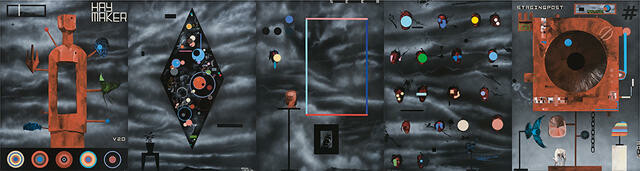
Haymaker suggests the act of making at the right moment in time. It’s also a boxing term for a powerful punch. In this massive, psychedelic, sci-fi-like painting, Shane Cotton has gathered together signs, symbols and references with elements from past paintings and unloaded them into the ether of te pito o te ao, the centre of the Māori universe. Time, power, Māori culture and tradition, semiotics and art history all play out across these five panels.The carved wooden figure shown in the first panel is Arnold Manaaki Wilson’s 1956 'He Tangata, He Tangata', Cotton’s homage to this pioneering Māori artist he respected greatly. The final panel of the work is titled Staging Post, and suggests a moment for taking account and preparing to set forth again. Here Cotton acknowledges two contemporary Māori artists, both of whom feature in Te Wheke – Peter Robinson (the chain) and Michael Parekowhai (the doe).
(Te Wheke, 2020)
Notes
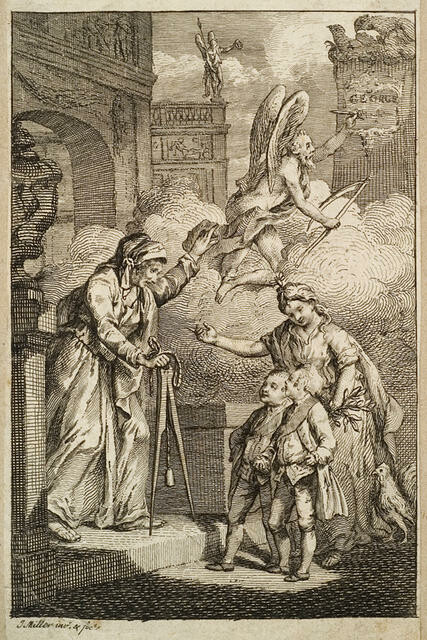
Frontispiece to 'Fables amusantes' by Tobias Miller
This article first appeared in The Press as 'Not so handsome prints with royal stories to tell' on 30 June 2015
Notes
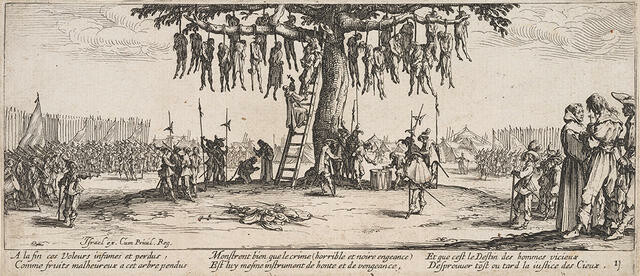
Blue Globe: Stories from the Christchurch Art Gallery Te Puna O Waiwhetū
This term we ran a competition for students in school years 3-13 in which they selected a work from the Christchurch Art Gallery collection available to be viewed online and developed a piece of writing in response to that work.
We had a fantastic response with almost 300 entries responding to a vast range of works.
Local writers James Norcliffe, Jane Buxton and Gavin Bishop judged the entries and were impressed by the high quality of work that students had submitted and they way that students used the works as a springboard for their writing rather than sticking with a descriptive piece.
Below are our finalists alongside the artwork they used for inspiration - enjoy!
Collection
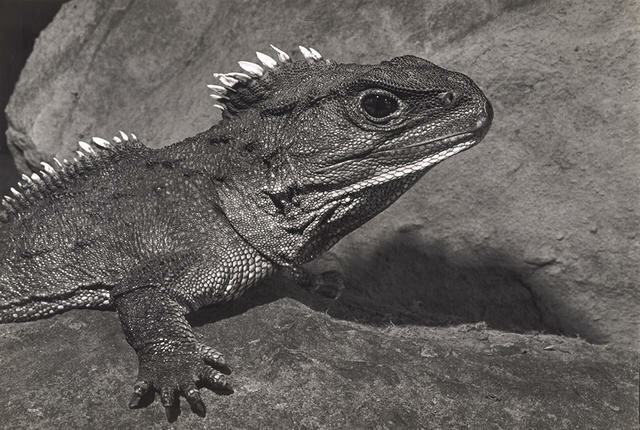
John Johns Tuatara, Stephens Island
Tuatara means ‘spiny back’ in Māori. This unusual creature is found only in Aotearoa New Zealand. There are two species of tuatara, the last surviving members of an order of reptiles that existed alongside the dinosaurs 220 million years ago. That isn’t the only unique thing about the tuatara: they have a light-sensitive ‘third eye’ beneath the scales on the top of their head; its purpose is still not completely understood by scientists.
(Beasts, 2015)
![Rabbit, Captive, near Taita, 1968 ["And who are you?"]](/media/cache/90/fa/90fa7625fdd5cdb9d7929e62f5f2c495.jpg)