Collection
Wai o te Marama

Maureen Lander Wai o te Marama

Maureen Lander made 'Wai o te Marama' for the major exhibition of Māori weaving that toured the United States and Aotearoa New Zealand in the mid 2000s, 'Toi Māori: The Eternal Thread – Te Aho Mutunga Kore'. Combining the natural fibres of harakeke and muka with nylon and fluorescent paint, Lander braided muka strands to form the triangular shape of a maro (apron), allowing the rolled leaf ends to hang like the pōkinikini (tags) found on early rāpaki (waist mats). Lander often looks to taonga in museum collections to learn from customary forms, rethinking how we might make these with the materials available to us today and reinforcing a culture of constant innovation. Recalling the genesis of 'Wai o te Marama', Lander said:

“During my years in Hokianga the sight of the full moon rising over the Wai o te Marama valley was a recurring vision, seen from the porch of my bach in Ōmāpere. The track from the floor of the valley up into the kauri forest was a favourite daytime walk of mine. Often when I paused for rest alongside the beautiful waterfall halfway up, I would imagine how the water might look lit by the moon, like its name.”

(Maureen Lander Aho Marama Strings of Light, 12 August 2023 – 14 July 2024)

Collection
Spring

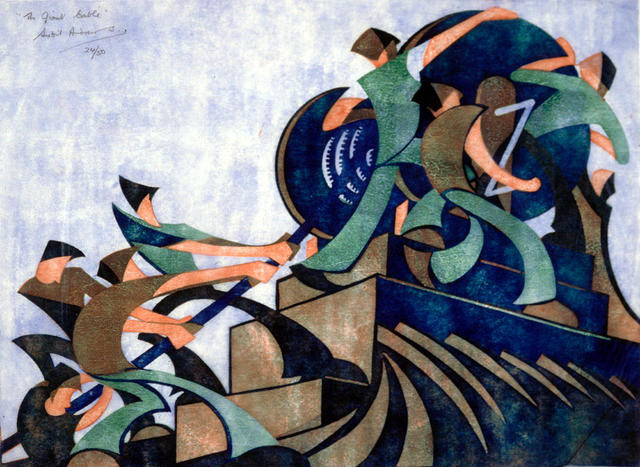
Francis A. Shurrock Spring

Like Roland Hipkins, Robert Field and William Allen, the sculptor Francis Shurrock studied at the Royal College of Art in London and immigrated to Aotearoa under the La Trobe scheme to take up a teaching position at one of the country’s art schools. Francis, or Shurrie as his students fondly called him, taught at the Canterbury College School of Art in Ōtautahi Christchurch, where he offered a contemporary, modern outlook on art that was in contrast to the conservative atmosphere of the school at that time. Francis owned a large collection of ukiyo-e Japanese woodblock prints, which he made freely available to his students and friends. He began making linocuts in the late 1920s and wood-engravings in the early 1930s, encouraging many of his students to use these mediums in their practice.

Ink on Paper: Aotearoa New Zealand Printmakers of the Modern Era, 11 February – 28 May 2023

Collection
Whither

Francis A. Shurrock Whither

Like Roland Hipkins, Robert Field and William Allen, the sculptor Francis Shurrock studied at the Royal College of Art in London and immigrated to Aotearoa under the La Trobe scheme to take up a teaching position at one of the country’s art schools. Francis, or Shurrie as his students fondly called him, taught at the Canterbury College School of Art in Ōtautahi Christchurch, where he offered a contemporary, modern outlook on art that was in contrast to the conservative atmosphere of the school at that time. Francis owned a large collection of ukiyo-e Japanese woodblock prints, which he made freely available to his students and friends. He began making linocuts in the late 1920s and wood-engravings in the early 1930s, encouraging many of his students to use these mediums in their practice.

Ink on Paper: Aotearoa New Zealand Printmakers of the Modern Era, 11 February – 28 May 2023

Collection
I don't play nice

Rhondda Bosworth I don't play nice

Photographer Rhondda Bosworth is known for making work that is direct, disruptive and disarming. Her intimate images challenge the rules of photography and the male gaze. Mainly focusing on the body and portraiture, she uses contrast, movement, test strips and collage as strategies to create powerful images that retain ambiguity, mystery or elusive meaning. Narratives are suggested, but left for us to imagine. The artist also uses the camera and photographic devices to create distance from the emotional intensity of the content. She says: “Photographs are literally about light and dark. This provides an immediate metaphor for emotional light and dark, and for ambivalence and polarity. Images that work are about dual realities – the external physical world and the internal world of thought, feeling, fantasy and memory.”

(Perilous: Unheard Stories from the Collection, 6 August 2022- )

Collection

Rhondda Bosworth Prayer book

Photographer Rhondda Bosworth is known for her strikingly intimate photographs, which are direct, disruptive and disarming. Her works challenge the rules of photography, the decisive moment and the male gaze. Focusing on portraiture and the body, often her own, the artist uses deep contrast, movement, collage and re-photography as strategies to create powerful images that also retain ambiguity, mystery and elusive meanings. She uses the camera and photographic devices to create distance from the emotional intensity of the content.

She says: “Photographs are literally about light and dark. This provides an immediate metaphor for emotional light and dark, and for ambivalence and polarity. Images that work are about dual realities – the external physical world and the internal world of thought, feeling, fantasy and memory.”

(Perilous: Unheard Stories from the Collection, 6 August 2022- )

Collection
Harry's letter / needle

Rhondda Bosworth Harry's letter / needle

Photographer Rhondda Bosworth is known for making work that is direct, disruptive and disarming. Her intimate images challenge the rules of photography and the male gaze. Mainly focusing on the body and portraiture, she uses contrast, movement, test strips and collage as strategies to create powerful images that retain ambiguity, mystery or elusive meaning. Narratives are suggested, but left for us to imagine. The artist also uses the camera and photographic devices to create distance from the emotional intensity of the content. She says: “Photographs are literally about light and dark. This provides an immediate metaphor for emotional light and dark, and for ambivalence and polarity. Images that work are about dual realities – the external physical world and the internal world of thought, feeling, fantasy and memory.”

(Perilous: Unheard Stories from the Collection, 6 August 2022- )

Collection
Exposure / my double face

Rhondda Bosworth Exposure / my double face

Photographer Rhondda Bosworth is known for her strikingly intimate photographs, which are direct, disruptive and disarming. Her works challenge the rules of photography, the decisive moment and the male gaze. Focusing on portraiture and the body, often her own, the artist uses deep contrast, movement, collage and re-photography as strategies to create powerful images that also retain ambiguity, mystery and elusive meanings. She uses the camera and photographic devices to create distance from the emotional intensity of the content.

She says: “Photographs are literally about light and dark. This provides an immediate metaphor for emotional light and dark, and for ambivalence and polarity. Images that work are about dual realities – the external physical world and the internal world of thought, feeling, fantasy and memory.”

(Perilous: Unheard Stories from the Collection, 6 August 2022- )

Collection
Memory Vista

Rhondda Bosworth Memory Vista

Photographer Rhondda Bosworth is known for her strikingly intimate photographs, which are direct, disruptive and disarming. Her works challenge the rules of photography, the decisive moment and the male gaze. Focusing on portraiture and the body, often her own, the artist uses deep contrast, movement, collage and re-photography as strategies to create powerful images that also retain ambiguity, mystery and elusive meanings. She uses the camera and photographic devices to create distance from the emotional intensity of the content.

She says: “Photographs are literally about light and dark. This provides an immediate metaphor for emotional light and dark, and for ambivalence and polarity. Images that work are about dual realities – the external physical world and the internal world of thought, feeling, fantasy and memory.”

(Perilous: Unheard Stories from the Collection, 6 August 2022- )

Load more