John Gould
England / Australia, b.1804, d.1881
Henry Richter
England, b.1821, d.1902 (Illustrator)
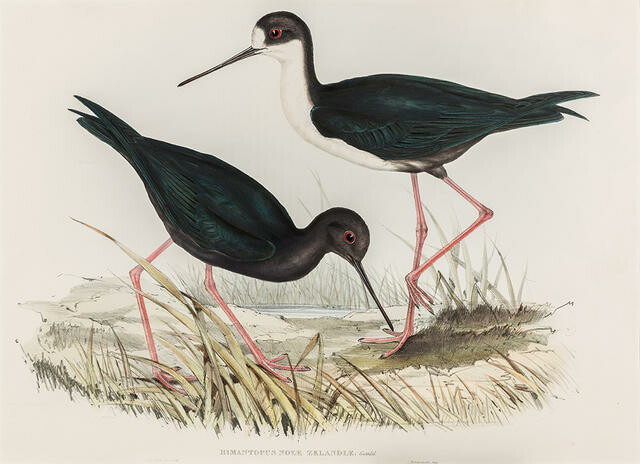
Himantopus Novae-Zelandiae (Kakī / New Zealand stilt)
- c. 1848-1860
- Hand coloured lithograph
- Purchased, 2012
- 377 x 552mm
- 2012/029
Location: Touring Gallery C
Tags: animals, birds (animals)
This hand-coloured lithograph captures two closely related birds: the rare kakī (black stilt) and the poaka (pied stilt), wading birds once regarded as a single species under the name Himantopus novaezelandiae. Elizabeth Gould’s delicate layering of colour and fine anatomical detail reflects the conventions of nineteenth-century natural history illustration, where scientific accuracy and aesthetic appeal went hand-in-hand. The stilts’ contrasting plumage and finely scaled coral legs are rendered with remarkable exactitude; Gould’s brushwork lends the feathers an almost sculptural quality—layered, luminous, almost touchable.
Once widespread across Aotearoa New Zealand, the kakī is now critically endangered, with a breeding population confined to the braided rivers of Te Manahuna, the Mackenzie Basin. It is threatened by predation, habitat loss and hybridisation with the more numerous poaka. The word ‘kakī’ can also mean ‘throat’, evoking both the bird’s call and its slender, vocal presence in wetland environments. In te ao Māori, it remains a taoka species, treasured and woven into whakapapa and local kaitiakitaka. Recent conservation efforts, led by Ngāi Tahu and the Department of Conservation, have seen a cautious resurgence in kakī numbers.
Lauren Hollingsworth-Smith, writer, artist and poet
te ao Māori ~ the Māori world
taoka ~ treasure, thing of cultural value
whakapapa ~ genealogy, lineage, ancestry
kaitiakitaka ~ guardianship, stewardship
(Bird Land: Te Kāhui Manu 15 August 2026 – 8 February 2027)
Exhibition History